Ask Permission From No One: The Cigar, the State and the Free Adult
A free adult does not need the state's permission to live, and the handmade cigar is where Europe is now testing how far that permission can be withdrawn.
Rene Rebollo · Nov 21, 2026

I. A Line Being Crossed
Today, an adult in Spain who smokes a cigar on an outdoor terrace is acting entirely within the law. He imposes nothing on anyone who has not chosen to sit nearby, and he has already paid substantial excise duties on the product he is using.
That may soon change. The bill approved by the Spanish Council of Ministers on 21 July 2026 extends smoke-free zones to hospitality terraces, beaches, swimming pools and other outdoor spaces, and sets fines for serious breaches of up to €600,000. It is now before the Cortes Generales.
The question this paper asks is not whether smoking is healthy. It is not. The question is older and more important: when did adults begin to need permission to live their own lives? And who gave public officials the authority to grant or withhold it?
This paper is an indictment as much as a defence. It charges Europe's governments with three failures. They have forgotten that they serve citizens rather than rule them. They take more of citizens' money every year while delivering a continent that falls further behind. And they answer every problem with another restriction on private life.
Against this, the paper defends one principle: individual liberty is the default condition of a free adult, and every restriction on it carries the burden of proof. The handmade cigar is the case study. The remedy is participation: citizens engaged in politics every day, not once every four years.
II. The Principle: Liberty Is the Default
A free society begins from one premise: an adult owns his own life. His body, his time, his money and his pleasures are his to govern. This is not a privilege granted by a ministry. It precedes every ministry.
The classical liberal tradition gave this premise its clearest form. John Stuart Mill argued in On Liberty (1859) that the only legitimate reason to use power over a member of a civilised society, against his will, is to prevent harm to others. His own good, physical or moral, is not sufficient reason. John Locke grounded political authority in the consent of the governed. Neither imagined a state that would decide which legal pleasures an adult may enjoy, and where.
The burden of proof belongs to the restriction
From this premise follows a rule that modern governments have quietly inverted. The citizen does not owe the state a justification for how he lives. The state owes the citizen a justification for every limit it imposes.
Today the order is reversed. The adult who wishes to smoke a cigar on a terrace is asked to prove that he deserves the right. The official who wishes to forbid it is presumed to be acting in the public interest. This paper rejects that inversion. We will not argue for our right to live as we choose. We will ask the state to demonstrate, with evidence and with proportion, why it should be allowed to interfere.
Public servants serve the public
The language of government contains its own correction. A minister is, by etymology, a servant. A civil servant is employed by citizens and paid from their earnings. Political power in a democracy is borrowed, not owned. It is lent by the people for limited purposes, and it can be recalled.
When officials begin to treat adult citizens as wards to be managed, protected from their own choices and corrected in their habits, the relationship has been turned upside down. The servant has begun to behave as the master. Restoring the proper order is not a radical demand. It is the founding idea of every free constitution in Europe.
Freedom is not only for approved choices
Liberty that extends only to choices the authorities approve of is not liberty. It is permission. The real test of a free society is how it treats the choices that officials, experts or majorities dislike: the cigar, the glass of wine, the motorcycle, the unconventional career, the lifestyle that does not fit a public-health target. A right that must be justified to the satisfaction of the government is not a right at all.
III. The Cigar as a Warning Sign
Freedom is rarely abolished in one decision. It is lost one reasonable-sounding rule at a time, each written for a different problem and applied to everything within reach. The premium handmade cigar shows this process with unusual clarity.
A different product
A premium cigar is not a cigarette with a different shape. It is an agricultural and artisanal product. Its leaves are grown, cured, fermented and aged for years. It is rolled by hand by a skilled torcedor, one at a time, in Cuba, the Dominican Republic, Nicaragua, Honduras or the Canary Islands. A cigarette factory produces thousands of units per minute; a master roller produces perhaps a hundred cigars in a day.
The way it is consumed is equally different. A premium cigar is expensive, takes an hour or more to smoke, is not inhaled, and is enjoyed occasionally by adults, often to mark an occasion. It is not a product of habit for teenagers.
This category can be defined precisely in law. In April 2026, a United States federal court reaffirmed an eight-part definition of a premium cigar, including a wrapper of whole tobacco leaf and a binder of 100 percent leaf tobacco. If a court can draw the line, so can a legislature.
One law for every product
European regulators have chosen not to draw it. Spain's bill applies the same regime to traditional tobacco, e-cigarettes with and without nicotine, heated tobacco and other related products. A hand-rolled cigar aged for a decade is placed in the same legal category as a disposable vape.
At EU level, the European Commission opened a call for evidence on 18 May 2026 for the revision of the Tobacco Products Directive. The options under discussion include mandatory plain packaging across the Union and revised health warnings. For premium cigars, plain packaging would erase the bands, boxes and artwork that are part of a centuries-old craft tradition. In parallel, the Council is negotiating a recast of the tobacco excise directive, with a Presidency compromise text circulated on 6 November 2026.
Further afield, the direction of travel is unmistakable. The United Kingdom's generational ban will prohibit anyone born after 2009 from ever buying cigars legally, and Ireland is considering similar legislation. An adult of 40 in the year 2050 would be forbidden from buying a product his older colleague may buy freely, solely because of his date of birth.
Resistance works: the American example
In the United States, the outcome has been different, because citizens and producers fought back. In 2016 the Food and Drug Administration extended its tobacco rules to premium cigars through the so-called Deeming Rule. The three main cigar associations challenged it in court. After a decade of litigation, on 15 April 2026 Judge Amit Mehta again vacated the rule as applied to premium cigars, exempting them from FDA regulation. Flavoured and machine-made cigars remain regulated, which shows that a narrow, well-defined exemption is workable.
The FDA may still appeal. But the lesson is clear: overreach is not inevitable. It can be challenged, and it can be defeated.
IV. The Indictment: How Governments Work Today
The cigar is a symptom, not the disease. Europe's governments now run on a model that would be unrecognisable to the founders of its democracies: they tax more, borrow more, regulate more and answer for less. When they fail, they ask for more money and more power to fix the failure. The charges below fall under four heads: how governments take and spend citizens' money, how they hold back growth and housing, how they handle power and borders, and how little they answer for any of it. None of this is about one party or one country. They describe how government itself now works.
Taxation: the state's share of your work
Across the European Union, taxes and social contributions reached 40.7 percent of GDP in 2025, up from 40.2 percent the year before, according to Eurostat. In France the figure was 46 percent; in Belgium, 44.7 percent. Revenue rose in 19 of the 27 member states.
A state that collects four of every ten euros a society produces has already made a large share of its citizens' decisions for them: how much they can save, what they can build, what risks they can afford to take. Tobacco excise is only one more layer on a burden that is already among the highest in the developed world.
Taxed at every stage of life
The headline ratio hides how often the same money is taxed. Across the European Union, a citizen is taxed when he earns, again when he spends, when he buys a home, every year he owns it, when he sells it, in a growing number of countries when he leaves, and finally when he dies. The table below follows one life through the system, with examples from member states.
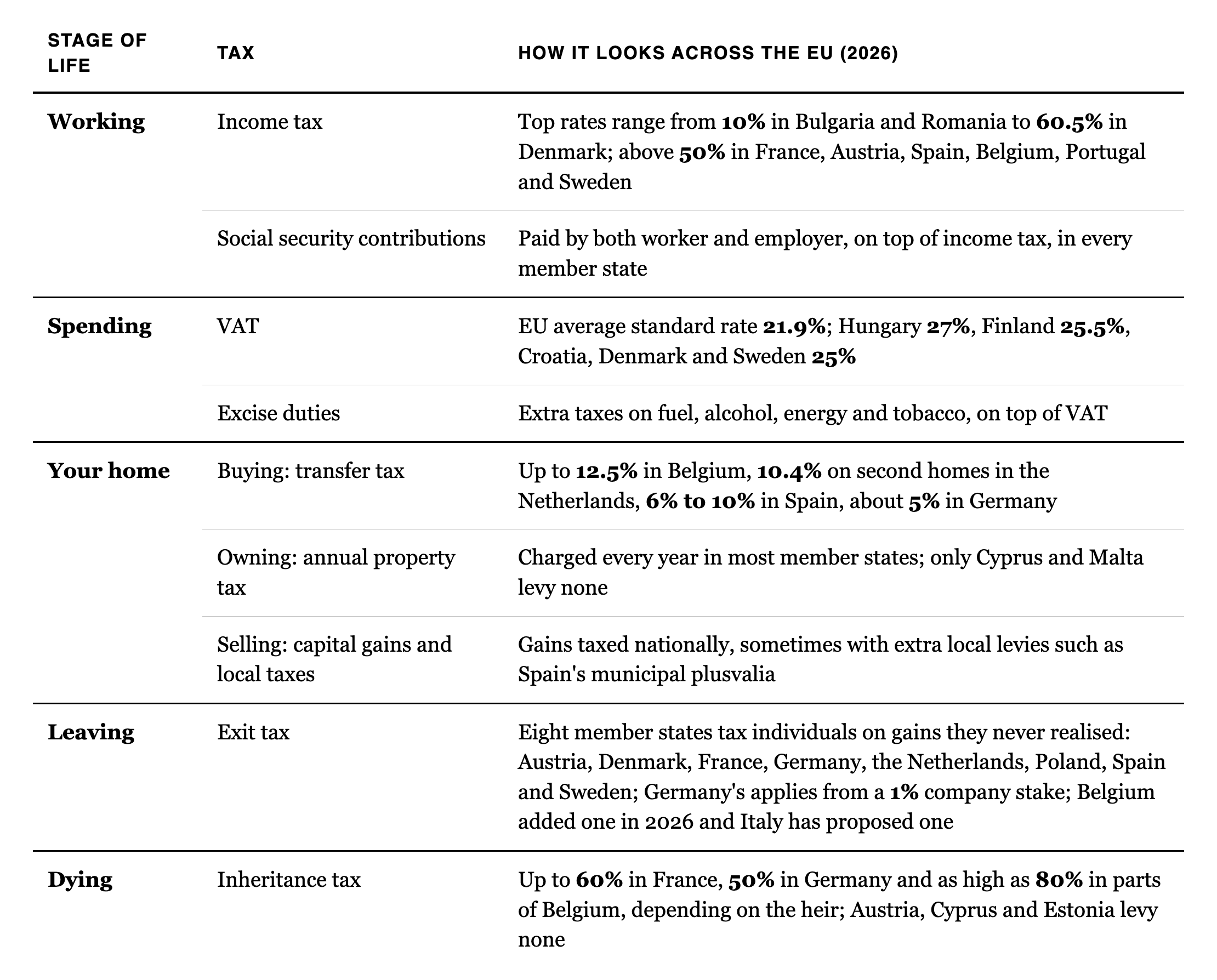
The trend is toward more, not less. In April 2026 the European Commission published a two-volume study on wealth, capital and exit taxes, and several governments have tightened exit rules to stop wealthy residents from leaving. Spain shows the cumulative effect on ordinary workers: the Juan de Mariana Institute calculates that a Spanish worker keeps only €46.40 of every €100 his employer spends on his job, and counts 141 tax and contribution increases between 2018 and 2026.
The logic of the exit tax deserves attention. Governments want productive and wealthy citizens to stay. But instead of asking why those citizens want to leave, and fixing the high taxes, slow growth and heavy regulation behind that choice, they make leaving harder and more expensive. A country confident in what it offers does not need to charge people at the door. And there is a reason the root problems go unaddressed: they were created by the same governments now writing the exit rules. It is easier to build a wall than to admit the house needs repair.
Where the money goes
European governments spent 49.6 percent of GDP in 2024, well above what they collected in tax. Social protection and health together take 55 percent of that spending, and nearly half of all social benefits go to pensions and survivors. Supporters argue this is the price of a strong welfare state. But it leaves little room for the investment in research, technology and infrastructure that Europe's own competitiveness reports say it needs. Europeans carry one of the heaviest tax burdens in the developed world, and receive a continent that is falling behind on growth, innovation and productivity.
And what do citizens get for the largest share of that spending, health and social benefits? Ask anyone who has waited for a specialist. In Spain, 853,509 patients were waiting for non-urgent surgery at the end of 2025, a record. The average wait for an operation was 121 days, more than one patient in five waited over six months, and the average wait just to see a specialist was 102 days. The United Kingdom, with Europe's best-known public health system, had about 7.3 million treatments waiting in 2026. Citizens pay for health care through some of the highest taxes in the world, and are then told to wait months to use it. Few Europeans would call that value for money.
Debt: taxation postponed
Government debt in the euro area stood at 88.9 percent of GDP at the end of the first quarter of 2026, up from 87.7 percent a quarter earlier. Debt is not free money. It is taxation transferred to future citizens, many of whom cannot yet vote and none of whom consented. A political class that cannot balance its own accounts is poorly placed to lecture adults on responsible living.
Innovation: the cost of a permission culture
Europe's own leaders have documented the price of over-regulation. The 2024 report on European competitiveness by Mario Draghi, former President of the European Central Bank, identified regulatory barriers and weak startup financing as key reasons Europe's most promising companies fail to grow or leave. By his count, the United States produced 40 large AI foundation models in one year, China 15 and the European Union three. A year after publication, only around 10 percent of his recommendations had been fully implemented.
What a society needs in order to prosper is no secret: low and simple taxes, light and predictable rules, secure property, open markets, and the freedom to try, fail and try again. Europe's own reports say as much. The obstacle is not knowledge. It is that the remedy would require the regulators, agencies and political class to admit that they are the problem: that the layers of rules, permissions and taxes they have built are what keep Europe from being efficient, productive and innovative. No bureaucracy votes to shrink itself.
A popular saying captures the pattern: when a new market, product or service appears, the United States builds it, China studies how to become the best at it, and the European Union regulates it and taxes it. It is a joke, but Europeans no longer laugh at it, because it describes their economy too well.
The instinct that produces these results is the same instinct that regulates the cigar: the assumption that nothing should happen until an authority has approved it.
Housing: a crisis made by regulation
Spain's housing crisis shows what happens when the state makes it hard to build, buy, rent and own. The Bank of Spain estimates a shortage of about 750,000 homes accumulated between 2021 and 2025. In 2025 alone, around 240,000 new households were formed while only about 92,000 homes were completed.
The cause is not a lack of land or builders. It is permission. Spain's competition authority, the CNMC, found that turning land into buildable plots normally takes 10 to 15 years, and that land makes up about 45% of the cost of a home. Developers must deal with three levels of government, municipal, regional and national, and a building permit alone can take up to two years. The CNMC's own recommendation is fewer planning restrictions and less red tape.
Owners are not protected either. Squatting has become a national concern, and while a 2025 reform added squatting offences to the fast-track trial procedure, lawyers note that overloaded courts rarely meet its deadlines. Proposals for eviction within 48 hours have been held up in Congress, with the deadline for amendments extended again and again.
The solution is not another public housing plan or another rent control. It is to let people build: release land, cut the permit process to months instead of years, and guarantee that an owner can recover his own home quickly. Make it hard to build, buy and rent, and you get exactly the crisis Spain has today.
The European Union and the erosion of sovereignty
The European project began as a common market among free nations. It has grown into a layer of government that sets rules on tobacco packaging, excise duties, product standards, borders and asylum, often far from the voters who must live with the results.
Migration policy is one example of where decisions now sit. The Pact on Migration and Asylum, adopted in 2024, began applying in all member states on 12 June 2026. Whatever one's view of its content, the principle at stake is democratic: decisions of this weight should be made by institutions that citizens can clearly identify, hold to account and, when necessary, vote out. The further power moves from the voter, the weaker that accountability becomes.
Migration: laws that are not enforced
Nowhere is the gap between what governments promise and what they deliver wider than on irregular migration. The problem is not only how many people arrive. It is that the law is not applied once they do.
When a person has no right to remain in the EU, a member state issues an order to leave. Most of those orders are never carried out. In the fourth quarter of 2025, 117,545 non-EU citizens were ordered to leave an EU country, and only 33,860 were returned, fewer than three in ten. Some countries do far worse: in the third quarter of 2025, France carried out about 14% of its return orders, Greece 14% and Spain 13%.
The consequence is a system that rewards breaking the rules. People whose claims have been rejected often remain for years, many still housed or supported at public expense while appeals and failed removals drag on. Citizens are fined for smoking on a terrace, while orders issued by their own states are ignored. Taxpayers fund both the enforcement apparatus and the cost of its failure.
Official crime data adds to public frustration. In Germany, the Federal Criminal Police Office reports that non-German suspects remain significantly overrepresented in violent crime, at 42.9% of suspects, while foreign nationals are around 15% of the population. In Catalonia, a 2025 report by the regional police recorded foreign nationals as 60.3% of arrests for sexual assault and 73% for violent robbery. In Spain as a whole, most people convicted are Spanish nationals, about 70% in 2025, but conviction rates per 1,000 residents are higher among foreign nationals.
These figures concern foreign nationals in general, not only people in the country illegally, and researchers point out that much of the gap narrows once age, sex and income are taken into account. That is exactly why the failure matters. When a state cannot enforce its own decisions on who may stay, it surrenders the public's trust, and leaves citizens to draw their own conclusions from numbers their governments prefer not to discuss.
Brussels' answer has been more legislation. In June 2026 the Council and Parliament agreed a new Return Regulation allowing "return hubs" outside the EU. Irregular crossings did fall by 26% in 2025, to about 178,000. But new laws mean little if old ones are not enforced. A state that cannot even protect its own borders fails the most basic test of a legitimate government. And if a government is not acting in its citizens' interests, citizens are entitled to ask: whose interests is it protecting?
Accountability and the political class
Citizens across Europe have watched a steady series of corruption investigations, misuse of public funds and conflicts of interest involving officials at every level of government. The pattern is corrosive in a specific way: those who demand the most discipline from citizens often accept the least scrutiny of themselves. A government that asks adults to justify a cigar should first be able to justify its own expenses, appointments and contracts.
Paternalism as a governing philosophy
Underlying all of this is a philosophy, more than any single party: the belief that the state knows better than the citizen how the citizen should live, and that public policy should steer private behaviour toward approved outcomes. It appears on the left and the right. It speaks the language of health, safety, sustainability and protection. Its result is always the same: the individual shrinks, and the state grows.
V. We Do Not Owe You an Explanation
There is a point at which argument itself becomes a concession. When citizens are required to defend each private choice before officials, they have already accepted that those officials are the judges of how they live. We do not accept it.
A free adult should never have to justify to any government:
- What he smokes, drinks or eats in his own life.
- How he spends the money he has earned and already been taxed on.
- Which risks he chooses to take with his own body and his own time.
- Which traditions, pleasures and rituals give his life meaning.
- Where he gathers peacefully with others who share them.
We will listen to evidence. We will respect the rights of others not to be harmed. We will accept reasonable rules where our choices genuinely affect third parties. But we will not ask permission to be adults, and we will not apologise for living according to our own judgement.
To every legislator, minister and official who believes otherwise, our message is simple and respectful: you were elected and employed to serve the public, not to manage it. Listen to the people you work for, and step back from the private lives that are not yours to govern.
VI. Anticipating the Objections
A serious case for liberty must face the strongest arguments against it. Supporters of stricter regulation raise four in particular. Each deserves an answer.
"Secondhand smoke harms others." This is the strongest objection, and Mill's principle accepts it: harm to others is a legitimate ground for rules. But the remedy must be proportionate to the harm. Enclosed public spaces are one thing. An open-air terrace, a private club or a dedicated cigar lounge where every person present has chosen to be there is another. Designated spaces, ventilation standards and venue choice protect non-smokers without abolishing the freedom of smokers.
"Smokers impose costs on the public health system." Spain's Ministry of Health links around 50,000 deaths a year to tobacco and nicotine, and public systems bear treatment costs. This is a real concern. Yet the same logic could justify regulating diet, alcohol, sport, driving and almost any lifestyle choice, which shows how far it reaches. Tobacco users in Spain already pay heavy excise duties. And if collective financing of healthcare becomes a reason to control private behaviour, the problem lies in how the system is designed, not in the citizen's freedom.
The cost argument also invites a question about priorities. A government that worries about what a cigar smoker costs the health system spends freely elsewhere: on subsidies, on an asylum and reception system that fails to enforce its own decisions, and on an ever-growing administration. Meanwhile, problems that weigh on every household, above all housing, go unsolved year after year.
"The European Union is democratic; member states chose it." Membership was ratified by national parliaments and, in several countries, by referendum, and the single market has brought real benefits. The objection here is not to cooperation among European nations. It is to the steady drift of decisions on personal life, from tobacco packaging to excise, toward institutions that most citizens cannot name and cannot easily hold to account. Subsidiarity, the EU's own principle that decisions should be taken as close to citizens as possible, should be applied in earnest.
"Taxes fund services Europeans value." Public healthcare, pensions and infrastructure are widely supported, and many Europeans accept high taxes in exchange. That is a legitimate democratic choice. But a high tax burden makes it more important, not less, that the state respects the freedoms that remain. And Europe's slow growth and innovation gap have many causes, including demographics and fragmented capital markets, but regulatory burden is one that Europe's own experts have repeatedly named.
These objections justify targeted, proportionate rules. They do not justify treating every adult as a patient and every pleasure as a public-health emergency.
VII. Concrete Proposals
Principles need policies. For the premium handmade cigar, we call on Spanish and European legislators to adopt the following:
- A legal definition of the premium handmade cigar, modelled on the eight-part test reaffirmed by the US federal court in April 2026: whole-leaf wrapper, 100 percent leaf-tobacco binder, hand rolled, no characterising flavours, minimum weight and price thresholds.
- A separate regulatory category for products meeting that definition, distinct from cigarettes, e-cigarettes, heated tobacco and nicotine pouches.
- Exemption from plain packaging in the revised Tobacco Products Directive, preserving bands, boxes and artwork, with a proportionate text health warning in place of cigarette-style graphic images.
- Licensed cigar lounges and private members' clubs permitted as an explicit exception to smoke-free rules, where every adult present has chosen to be there.
- Proportionate taxation, with premium cigars kept in their own excise category rather than aligned with cigarette rates.
- Firm age limits: sale only to adults aged 18 and over, strictly enforced. Protecting minors is a legitimate role of the state; controlling adults is not.
- A sunset and review clause on every new restriction on adult behaviour, requiring the government to show, with evidence, that the measure achieved its stated goal and is still necessary.
Beyond the cigar, the same principles call for broader reforms, one for each charge in Section IV:
- A ceiling on the tax burden, with every new tax carrying a sunset date and an evidence review.
- An end to exit taxes on citizens who simply choose to live elsewhere.
- Enforcement before new legislation: existing return decisions carried out before any new migration law is passed.
- A housing permit guarantee: building permits decided within 90 days, after which approval is automatic, and more land released for construction.
- Fast recovery of occupied homes, with squatters removed from a primary residence within 48 hours.
- Subsidiarity in practice: decisions on personal lifestyle returned to national parliaments, and from them, wherever possible, to citizens themselves.
VIII. Politics Is Not a Career
This paper is addressed to cigar smokers, but not only to them. The terrace today will be something else tomorrow: your car, your diet, your savings, your speech, your business. Every citizen who values liberty has a stake in how this question is answered.
The deepest cause of overreach is not any single law. It is the separation between those who govern and those who are governed. Politics has become a profession, practised by a class that moves between parties, ministries and institutions, while citizens are consulted once every four or five years and then asked to wait. A free society cannot run this way. Politics should not be a career. It should be the ordinary, continuous business of every citizen.
Participation does not require running for office. It requires showing up, consistently:
- Respond to public consultations. The EU's consultation on the Tobacco Products Directive was open to everyone. National ministries run similar processes. Officials count these submissions.
- Write to your representatives. Contact your deputies in the Congreso, your senators and your MEPs. Ask them, in writing, where they stand on personal liberty and proportional regulation.
- Organise. Join or support associations of consumers, retailers, lounges and producers. The American cigar associations won because they acted together for a decade.
- Support legal challenges. Courts exist to hold governments to the law. Fund and back cases against disproportionate rules.
- Act locally. Many restrictions begin in town halls and regional parliaments. Attend meetings, speak, and vote in every election, not only the national one.
- Demand accountability. Support term limits, transparent public spending and sunset clauses on new regulation.
The cigar community can lead by example: informed, organised, persistent and civil. Liberty has never been preserved by people who waited for permission to defend it.
IX. Conclusion
Return to the adult on the terrace. He is not asking the state for anything. He is not asking for a subsidy, a service or a favour. He is asking only to be left alone, as an adult, in a moment that belongs to him.
Whether Europe allows him that moment is a small question with large consequences. A government that cannot tolerate a cigar on an open-air terrace will not stop there, because the reasoning that justifies this restriction justifies almost any other. A citizenry that accepts it will find the next one easier to accept.
The cigar is only the symbol. The real charge is against a way of governing that treats citizens as subjects to be managed, taxed and corrected. By its own measures, that model has failed: higher taxes, higher debt, slower growth and fewer freedoms. It will not reform itself, because those who run it benefit from it. Citizens must reform it. We choose self-government, and we ask every reader, smoker or not, to choose it with us and to defend it every day, not once every few years.
Sources
- Spanish Ministry of Health, approval of the tobacco bill, 21 July 2026
- Euronews, Spain moves to ban smoking on terraces and beaches
- América TV, fines of up to €600,000 under Spain's draft law
- Rocket Lawyer España, key points of the anti-tobacco bill
- US FDA, notice on the premium cigar definition, April 2026
- Cigar Aficionado, D.C. Justice Rules for Premium Cigars—Again
- Cigar Aficionado, U.K. and Ireland generational ban coverage
- National Law Review, call for evidence on the EU Tobacco Products Directive
- Council of the EU, tobacco excise directive compromise text, 6 November 2026
- Cyprus Mail, Eurostat tax-to-GDP figures for 2025
- Eurostat, government debt at 88.9% of GDP in the euro area
- Mario Draghi, one year after the Draghi report
- Arab News, EU yet to fully commit to Draghi's report
- Council of the EU, Pact on Migration and Asylum
- MySpainVisa, Spain IRPF and VAT rates for 2026
- thinkSPAIN, transfer tax and property taxes
- Global Property Guide, municipal plusvalia and capital gains
- Currencies Direct, taxes on buying and selling property in Spain
- Devesa Law, Spain's exit tax
- TaxAtlas, inheritance and gift tax in Spain
- Juan de Mariana Institute, IMP 2026 report
- Euronews, where Europe spends its money
- Eurostat, social protection expenditure, early estimates
- Euronews, top personal income tax rates in Europe, 2026
- Tax Foundation, VAT rates in Europe
- Euronews, where property taxes are highest and lowest in Europe
- Government of the Netherlands, real estate transfer tax rates
- International Investment, taxes on buying housing in Europe
- Liberty Mundo, the Commission's study on exit taxes
- Freenance, exit tax thresholds by country
- IMI Daily, Belgium's new exit tax
- Tax Foundation, estate, inheritance and gift taxes in Europe
- Eurostat, returns to third countries, Q4 2025
- Euronews, which EU countries carry out return orders
- Frontex, irregular border crossings in 2025
- EUAA, Council and Parliament deal on the Return Regulation
- Breitbart, BKA figures on non-German violent crime suspects, 2025
- The European Conservative, migrants overrepresented in German violent crime data
- El Español, Mossos d'Esquadra report on arrests in Catalonia, 2025
- Elderecho.com, INE convicted population statistics, 2025
- UC3M, study on crime rates by nationality
- OCU, Bank of Spain diagnosis of the housing shortage, 2026
- Ara, CNMC report on land, licences and housing costs
- CNMC, proposal to reduce planning restrictions, June 2026
- OBS Business School, real estate market report
- Infobae, limits of the 2025 anti-squatting reform
- Idealista, squatting bills stalled in Congress
- Euronews, record surgical waiting list in Spain, 2025
- Spanish Ministry of Health, waiting list summary, December 2025
- Health & Protection, NHS waiting list, May 2026
Cover photo: Immo Wegmann / Unsplash

Cigar Roller, Software Theorist