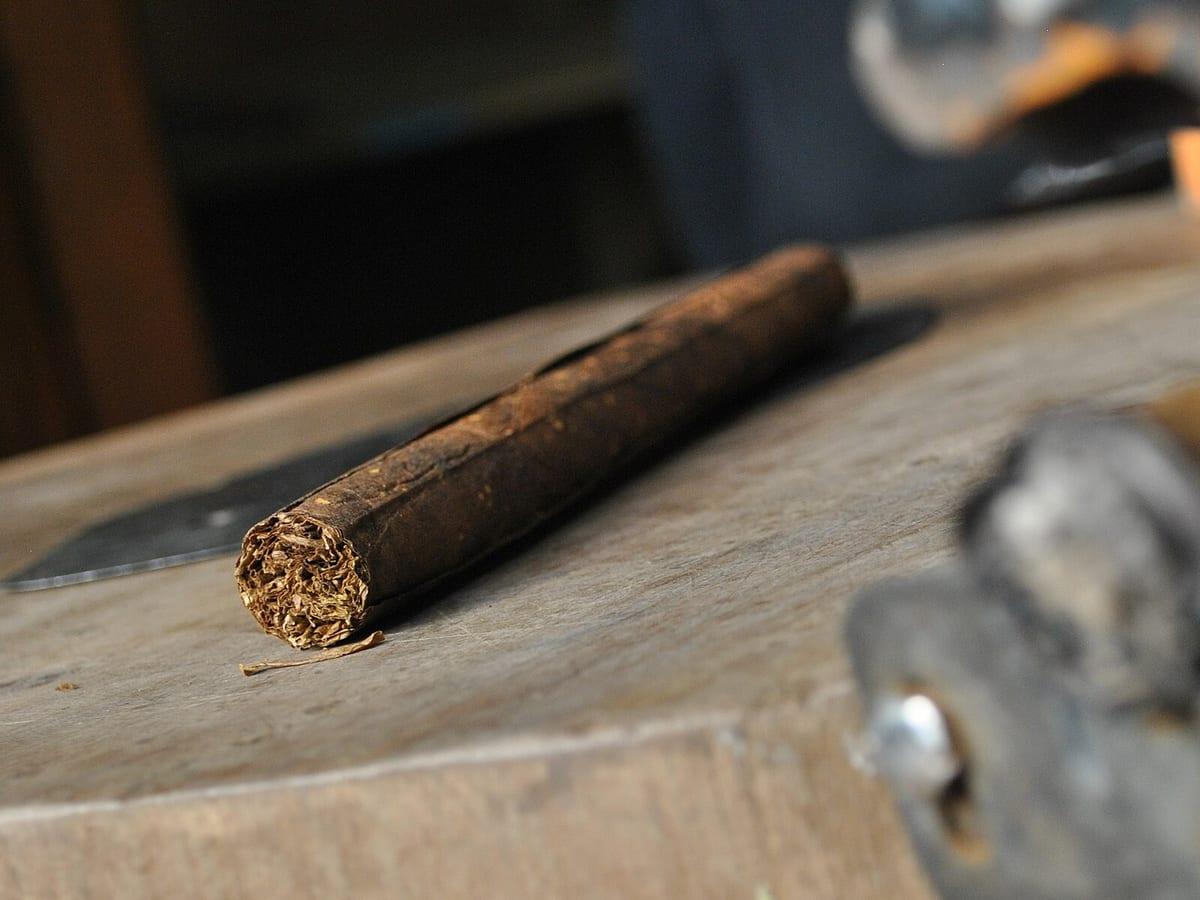
A cigar can be made from excellent tobacco and still smoke badly if it is poorly built. Construction decides how freely a cigar draws, how evenly it burns and whether the blend tastes the way its maker intended, because a cigar that burns crooked or draws too hard never delivers the balance of leaves the blender chose. This lesson covers how factories catch defects, the checks a smoker can make before lighting, the common defects with their causes and remedies, the damage storage can do, and when a cigar is not worth the effort.
How factories prevent defects
Every serious factory checks construction, though the methods differ. In Cuba, supervisors who are themselves top-grade torcedores watch over brigades of 30 to 40 rollers, checking their technique and the size of their cigars. Since the end of 2001, every Cuban factory has tested the draw of its bunches on a suction machine, after the bunch has been pressed in its mould and before the wrapper goes on. Quality-control technicians check finished cigars for weight, length, girth, consistency, construction and appearance, with particular attention to the tightness of the wrapper and the finish of the cap, and samples of each roller's work are regularly taken apart to check how they were built. Each factory's tasters, the catadores, meet every day and score cigars for draw, burn, aroma, flavor, strength and overall quality. Cigars that fail never become Habanos, and because torcedores are paid by the piece, rejected cigars are deducted from the roller's daily quota.
Draw machines reached some Dominican factories more than a decade before Cuba. At Tabacalera de García in La Romana, which makes the non-Cuban Montecristo and H. Upmann, the share of cigars rejected as plugged fell from about 35 percent in the late 1980s, before the factory used a draw machine, to 2 or 3 percent after it. Many of the best factories in the Dominican Republic, Nicaragua and Honduras now test bunches this way, and Perdomo, in Estelí, says it draw-tests every cigar it makes. Some traditional makers rely on well-trained supervisors instead. Finished cigars are checked against standards for ring gauge, length, weight and appearance, and overweight cigars are rejected, because extra weight usually means too much filler and a tight draw. Many factories also run daily tasting panels; at La Aurora in the Dominican Republic, the panel can pull a cigar from inventory if it falls short.
Defects still slip through in any factory, and storage can create new ones, so it pays to know what to look for.
Before you light
A short check before lighting catches most construction problems.
- Press the cigar gently between thumb and finger along its whole length. It should feel firm but springy, with no soft or hard spots.
- Look at the wrapper: smooth, intact and tight at the seams, with no cracks, tears or lifting edges.
- Look at the cap and the foot: a clean, even cap, and a foot evenly packed, with no gaps or dense knots.
- After cutting, take a cold draw, a gentle puff before lighting. The air should pass with light, even resistance.
Problems with the draw
Most draw problems come from how much filler went into the bunch and how evenly it was packed. A loose cigar, with too little filler or filler bunched unevenly, feels soft and spongy, draws too easily and burns hot and fast, with an ash that falls early. Little can be done beyond smoking it slowly to keep the heat down.
A tight draw is the opposite problem: drawing is hard work, the cigar gives little smoke and it goes out often. The usual causes are filler packed too densely or a cigar kept too humid, whose swollen leaves close the air channels. Rolling the cigar gently between the fingers can loosen the filler, and a cigar that feels damp often recovers after a few days at lower humidity. A plug is the extreme case: a folded or twisted leaf, or a knot of filler, that stops almost all of the draw, often with a hard spot that can be felt near the head. Massaging the hard spot sometimes frees it, and a draw tool, a thin pick pushed through the head into the filler, can clear a plug near the cap.
Soft and hard spots along the body show uneven bunching even when the overall draw is fine. The burn will run fast where the cigar is soft and slow where it is hard, so it pays to watch the burn line and touch it up early.
Problems with the burn
Three burn faults have names of their own. Canoeing is one whole side of the cigar burning faster than the other, so that the unburned side stands up like the side of a canoe. It usually starts with an uneven light, but uneven filler, a wrapper that burns differently from the binder, or uneven humidity can cause it too. A touch-up on the lagging side, and turning the cigar now and then as you smoke, usually brings it back. A cigar that keeps canoeing after every touch-up is badly made, too young, or both.
A runner is a single narrow streak of burn racing ahead along the wrapper, usually following a seam, a thick vein or a thin patch in the leaf. Caught early, it stops with a touch-up to the lagging edge. Tunneling is the center of the cigar burning faster than the outside, leaving a hollow core inside an unburned shell. It is usually a moisture problem, a damp wrapper over drier filler or a cigar kept too humid, though fast-burning leaf at the center of the blend can cause it too. A touch-up to the outer leaves can save the cigar, and if several cigars from the same box tunnel, resting the rest for a few days at lower humidity usually cures them.
Problems with the wrapper and cap
A cap that lifts or splits after cutting was either applied poorly or has dried out, and it tends to get worse as the cigar warms, so cut such a cigar carefully and smoke it gently. A cracked wrapper, split along the leaf, means the cigar dried out or was brought back to humidity too fast. A wrapper that lifts and peels away from the binder was rolled with too little gum or tension, or has swelled and shrunk through swings in humidity; the burn tends to follow the loose edge, so it too is best smoked gently. A gentle curve in the body is normal in a cigar made by hand, but a sharp bend or kink, from a rolling fault, pressure in storage or damage in transit, restricts the draw.
Damage in storage
Some defects appear long after a cigar leaves the factory, and almost all of them come from humidity or temperature. Habanos recommends keeping cigars at 16 to 18 °C (61 to 64 °F) and 65 to 70% relative humidity, held steady rather than swinging. A rule of thumb widely quoted outside Cuba is 70% humidity at 21 °C (70 °F). Why Humidity Matters, in the Storage & Humidity topic, explains the reasons.
A cigar that dries out shrinks, loses its aroma and turns brittle, so its wrapper can crack when it is cut, handled or lit. Rushing a dry cigar back into a humid humidor does damage too, because the filler swells faster than the wrapper and splits it, so it should be brought back slowly, over one to two weeks. Kept too humid, cigars swell, feel spongy, draw tight, burn poorly and tend to tunnel, and a few days at lower humidity usually brings them back.
Tiny round holes in the wrapper, about the size of a pinhead, often with fine dust beside them, are the mark of the tobacco beetle, Lasioderma serricorne. Its eggs can be in the tobacco from the start, and they hatch when cigars are kept above about 23 °C (73 °F) with high humidity; Habanos advises never letting a humidor go above 18 °C. The larvae feed on the tobacco for several weeks and tunnel out through the wrapper, and the adults are reddish-brown beetles 2 to 3 mm long. Any cigar with holes should be removed at once and the rest checked closely. To kill eggs and larvae, seal the cigars in plastic bags and freeze them for three days at about −17 °C (1 °F) or colder, then move them to a refrigerator for at least 24 hours, so they warm slowly and do not crack, before returning them to a clean humidor. Many smokers freeze new cigars the same way as a precaution.
Fuzzy white, green or blue spots, usually starting at the foot or the cap, are mold, a sign of storage that was too humid or poorly ventilated. A fine, even white powder that brushes off without leaving a mark may instead be plume, which is harmless. Anything fuzzy, green or blue is mold, and when in doubt it is safest to treat it as mold. Mold and Plume, in the Storage & Humidity topic, explains how to tell them apart and what to do.
Fixing problems while you smoke
Several remedies work on a lit cigar, and the earlier they are used, the better they work. A touch-up, a flame held to the lagging part of the burn line without puffing hard, fixes most canoeing and runners if it comes early. A purge, blowing gently out through the cigar, clears stale or bitter smoke before the next puff. A cigar that keeps going out may be too humid or smoked too slowly, and letting it rest before relighting often helps. A tight cigar can be loosened by rolling it gently between the fingers, and a plug near the cap can be cleared with a draw tool.
When to give up
Some cigars are not worth the effort: a plug that will not clear, a cap that keeps unraveling, a cigar that canoes or tunnels again after every touch-up, and any cigar with mold or beetle holes. Set it aside. The tobacco may be good, but the cigar will not reward the patience.