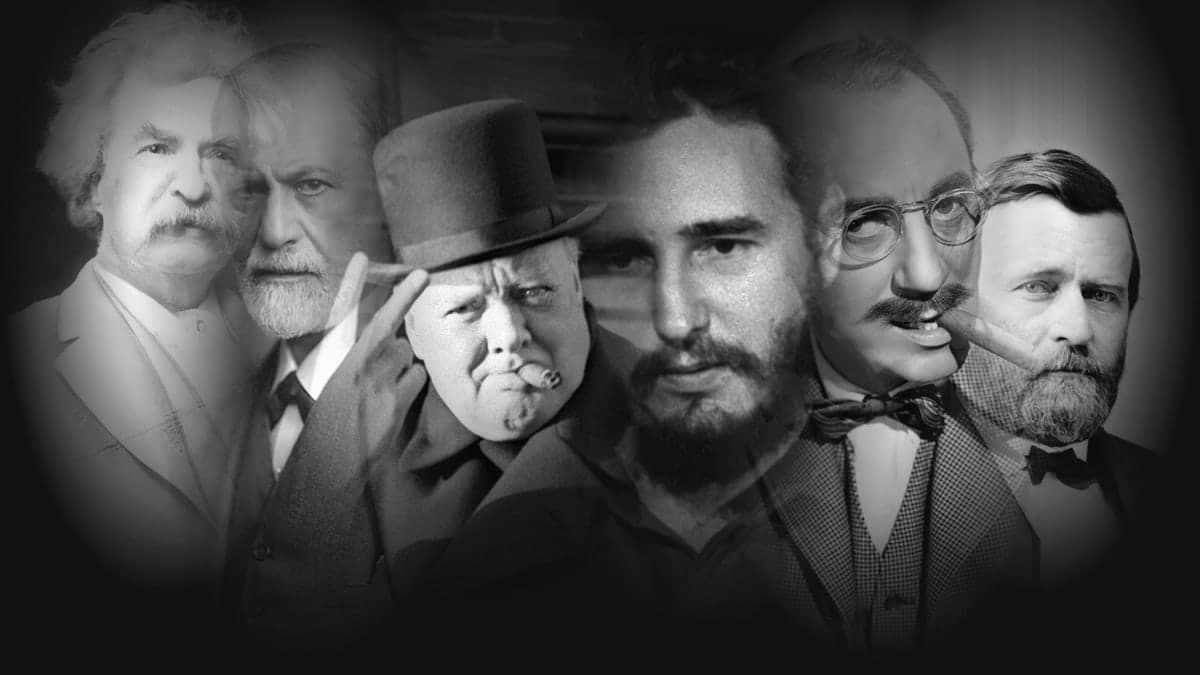
Winston Churchill led Britain through most of the Second World War, and his cigar became part of his public image.
A Taste Acquired in Cuba
In November 1895 the young Churchill arrived in Havana with a fellow officer, Reginald Barnes, to observe the Cuban rebellion against Spanish rule. When the Spanish commander failed to meet them, they lived for several days on oranges and cigars. From then on Churchill favored Cuban cigars above all others.
A Daily Habit
Churchill typically smoked eight to ten cigars a day, often letting them go out and chewing on them. His favorite brands included Romeo y Julieta and the now-defunct La Aroma de Cuba, and regular suppliers kept him stocked throughout his life, even during the war. At Chartwell, his home in Kent, he kept 3,000 to 4,000 cigars, mostly Cuban, in a room next to his study, on shelves labeled "large" and "small", "wrapped" and "naked". To keep the chewed end from getting soggy, he wrapped it in a strip of brown paper with a dab of glue, which he called a bellybando. For his first high-altitude flight in an unpressurized plane, he even had an oxygen mask made so that he could keep smoking.
A Sacred Rite
In February 1945 Churchill hosted a lunch for King Ibn Saud of Saudi Arabia and was told that neither smoking nor alcohol was allowed in the royal presence. As he recalled in his war memoirs, he answered that his own rule of life prescribed smoking cigars and drinking alcohol as an absolutely sacred rite, before, after and if need be during all meals. The king accepted.
The Churchill Size
The size named after him is a standard Cuban format, 7 inches long with a 47 ring gauge, called the Julieta No. 2 inside the factory. Many say Romeo y Julieta created it after a visit by Churchill in the late 1940s, while others believe the Churchill name did not appear on its cigars until the 1950s. Before there were Romeo y Julieta Churchills, the same size was sold as the Romeo y Julieta Clemenceau.