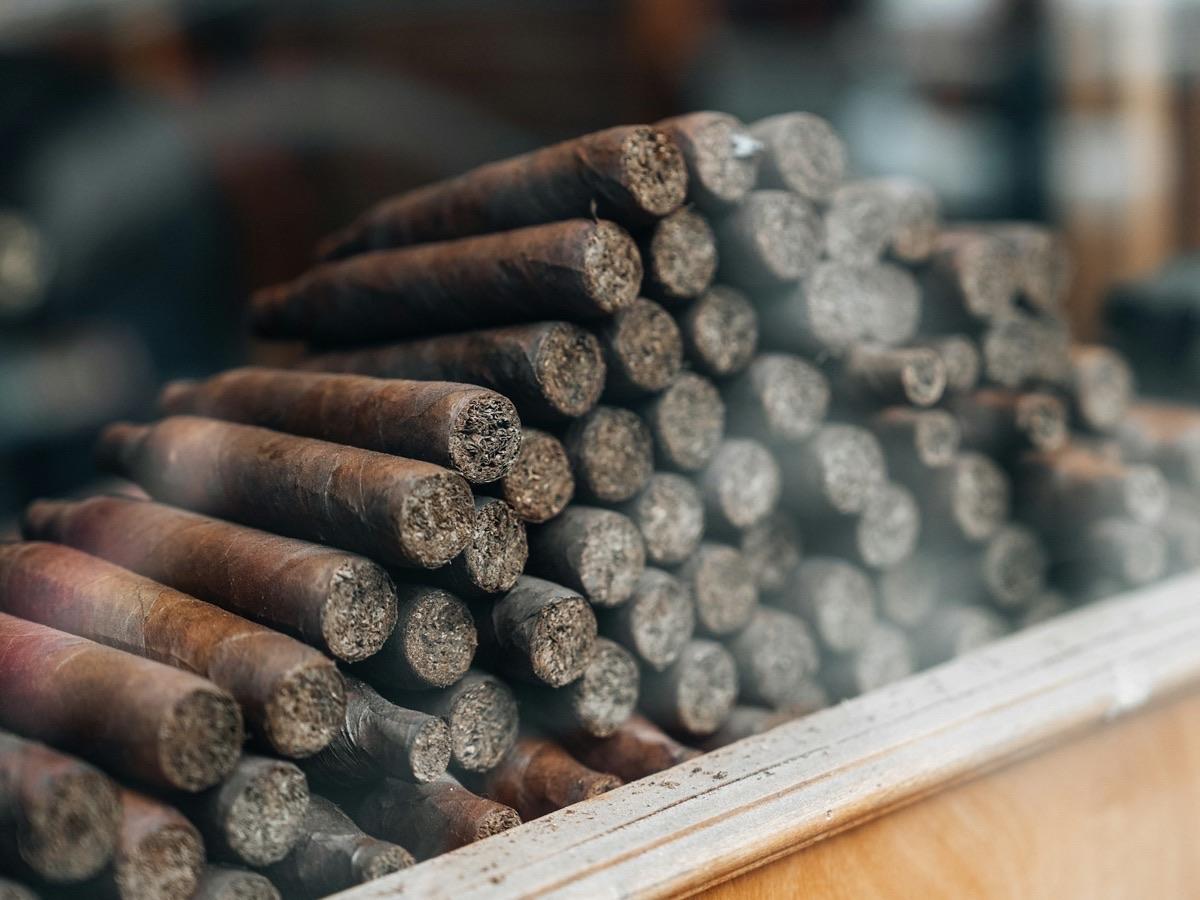
La tripa, the filler, is not simply gathered and wrapped. Before the binder goes on, each filler leaf is folded, and the way it is folded decides where the air will travel when the cigar is smoked. Three methods are in common use: entubado, accordion and book. They differ in how much time and skill they take and in how open a structure they leave inside the cigar, so the same blend can draw and burn differently depending on which one is used.
Entubado
In entubado, from the Spanish entubar, "to put into a tube", the buncher rolls each filler leaf into itself like a small scroll and then gathers the scrolled leaves into the bunch. Each tube keeps its own channel for air, and the result is a firmly packed cigar with a free, even draw. It is the hardest and slowest of the three methods, and for that reason it is rarely used in large-scale production.
Entubado is the old Cuban way of bunching. In 2007 a retired Cuban roller, Rodolfo Taboada, explained that he still preferred it, because cigars bunched this way always draw. By then, though, most Cuban rollers, particularly the younger ones, had turned to the accordion method, which they found as effective and much quicker. Outside Cuba a few makers use entubado for particular lines: Drew Estate has rolled every Herrera Estelí, a line it has made in Estelí, Nicaragua, since 2013, this way. Drew Estate's rollers also use a hybrid they call estrujado, or "lazy entubado", which starts with a base of two leaves and adds some of the remaining filler entubado-style.
Accordion
In the accordion method, each leaf is folded back and forth into pleats, like the bellows of an accordion, and the pleated leaves are stacked before they are rolled into the binder. The folds leave room for air between them, so an accordion bunch draws well, and when such a cigar is cut open, its leaves spread apart like the instrument they are named after. The method takes more skill and time than the book method, but less than entubado.
Book
In the book method, the buncher lays the filler leaves flat on top of one another and folds the stack together, like closing a book, before rolling it into the binder. It is the simplest and quickest of the three, and probably the most common method in premium cigars today. The price of that speed is a less open structure, with fewer channels for air, so a book bunch depends more on the buncher keeping the leaves straight and the packing even.
The three methods compared
The table sets the three methods side by side.
| Method | How the leaves are prepared | Air channels | Skill and speed | Where it is used |
|---|---|---|---|---|
| Entubado | Each leaf rolled into a tube, like a scroll, before the bunch is assembled | One for each leaf | The hardest and slowest | The old Cuban method; a few lines today, such as the Herrera Estelí |
| Accordion | Each leaf folded into pleats, then stacked | Many, between the folds | Between the other two | Most Cuban rollers today |
| Book | Leaves laid flat on one another and folded together | Fewer | The simplest and quickest | Probably the most common method in premium cigars |
Read from top to bottom, each method trades some openness for speed. None of them guarantees a good cigar: a careless entubado bunch can plug, and a careful book bunch can draw perfectly. What every method demands is the same: leaves aligned from the foot to the head, no twisted leaves or knots, and the same compression along the whole bunch.
The Lieberman
A Lieberman, also called a Temsco, is not a fourth way of folding but a device for rolling the bunch: a hand-cranked frame with a leather or canvas apron. The buncher lays the binder and the filler on the apron and works the handle, which rolls them together into a bunch. It is faster and more uniform than rolling the bunch by hand, and it is used almost everywhere in the Dominican Republic, much less in Central America and not at all in Cuba. The wrapper and the cap are still put on by hand.
Whether a cigar bunched on a Lieberman counts as handmade is a matter of debate. Much of the trade calls it handmade, since the wrapper and cap are rolled by hand, but such a cigar can never be totalmente a mano, the Cuban phrase for a cigar made by hand at every step, the bunch included.
Figurados
Tapered and bulging shapes do not fit any one method neatly. Bunchers usually combine methods to build the taper, and they have to place each leaf with care, because a single misplaced leaf can plug a pointed head. This is one reason figurados are left to the most skilled rollers. After the bunch is made, by whatever method, it goes into a mould and on toward the wrapper; the Cigar Construction topic, starting with Bunching the Filler, follows it from there.