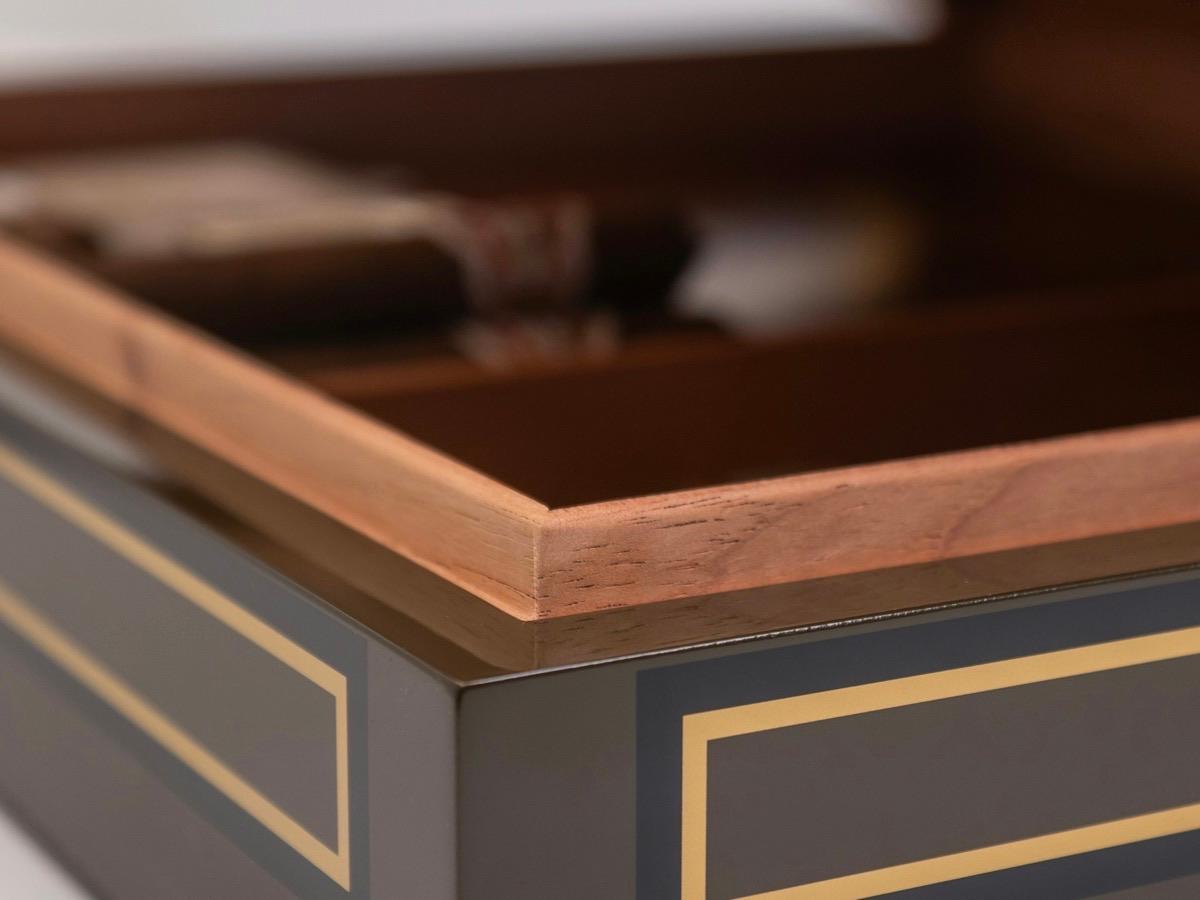
A humidor that held its level yesterday can drift today, and the drift is usually slow and quiet: a humidifier gone dry, a hygrometer reading wrong, a season arriving dry or damp. Maintenance is the habit of catching that drift before the cigars feel it. This lesson covers the routine, the two kinds of hygrometer and how to calibrate one, what to put in the humidifier, and how the seasons change the job. The reasons behind the level, and the fight against mold, sit in the Storage & Humidity topic.
A simple routine
The maintenance of a humidor is a check, not a chore. Open the box, read the hygrometer, and glance at the humidifier: a pack that has gone stiff or thin is spent, a foam or gel that has dried is empty, and each is replaced or refilled before the humidity has a chance to fall. Boveda's rule for its packs is to replace them every three months, and the same quarterly glance catches most other systems too. If the reading runs low, the humidifier is refilled or changed; if it runs high, the box is left open briefly or a gentler source put in. The point of the routine is that the cigar is never asked to absorb a day of bad storage.
Hygrometers, analogue and digital
A hygrometer is the instrument that measures relative humidity, the figure a humidor lives by; in Spanish it is the higrómetro. They come in two kinds. An analogue hygrometer shows a needle on a dial, usually driven by a coil of metal or a strand of hair that lengthens and shortens as the air changes; it is cheap and readable but often drifts several points and has to be corrected often. A digital hygrometer gives the number straight on a screen from an electronic sensor, and the standard trade guidance is blunt: digital models are far more accurate than the analogue dials. Even a new digital one should not be trusted out of the box, though, and both kinds are checked before they are relied on.
Calibrating a hygrometer
A hygrometer is calibrated by holding it in air of a known humidity and correcting the reading. The classic way is the salt test, which costs nothing. A little plain table salt is dampened with a few drops of distilled water in a bottle cap or small dish, to a thick paste rather than a solution, and sealed into a bag or airtight container with the hygrometer; after several hours, ideally overnight, the air above the damp salt rests at 75 percent relative humidity, so any reading other than 75 shows the error. A calibration kit does the same more cleanly: Boveda's one-step kit is a sealed 75 percent standard, and the maker suggests recalibrating a hygrometer about every six months. Digital models often need the error setting only once; the needle of an analogue dial is simply turned to match.
What goes in the humidifier
Whatever the humidifier, it is fed nothing but distilled water, for the same reason as in seasoning: tap water carries minerals and chlorine that stain the cedar and taint the cigars. The elements themselves differ. A foam humidifier is a sponge that slowly releases water, and it is usually charged with a half-and-half solution of propylene glycol and distilled water; the propylene glycol moderates the release and holds the humidity near 70 percent while discouraging mold. Crystals, or gel, are polymer beads that swell with water and release it; beads of silica or similar material do the same and can be re-wetted. A two-way humidity pack, sealed in a breathable membrane, both adds and absorbs moisture to keep one set level, and is replaced rather than refilled.
The table compares the elements.
| Element | What it is | How it is kept | Holds a set level |
|---|---|---|---|
| Foam | A sponge, usually with propylene glycol | Charged with distilled water or a PG solution | Loosely |
| Crystals or gel | Polymer granules that swell with water | Topped up with distilled water | Loosely |
| Beads | Silica or similar, re-wettable | Topped up with distilled water | Loosely |
| Two-way pack | Salts in a breathable membrane | Replaced, about every three months | Precisely, to the level printed on it |
Read down the table and the split is between elements that only add moisture and the pack that corrects in both directions. The one-way elements are cheap but need watching, because they cannot take excess water back out; the two-way pack holds the level it is made for and asks only to be replaced. Humidification Methods, in the Storage & Humidity topic, places these small elements alongside the fans and reservoirs of the large cabinets.
Seasonal care
The seasons move a humidor even when it sits untouched. Winter's heated indoor air is dry and pulls the level down, so the humidifier needs topping up more often, sometimes twice as often, and a very dry climate or high altitude may call for a stronger pack; summer's humidity does the opposite, and a box that runs persistently above the mark is aired or given a lower pack. Keep the box off windowsills, radiators and heating vents, out of direct sun, and away from anywhere the temperature swings, because temperature and humidity move together. Below about 23 degrees Celsius (73 degrees Fahrenheit) the cigars are safe from the tobacco beetle eggs that warmth can hatch, as Cigar Anatomy warns, and a steady cupboard is where a humidor does its quiet, uncelebrated work of keeping cigars smokeable for years.