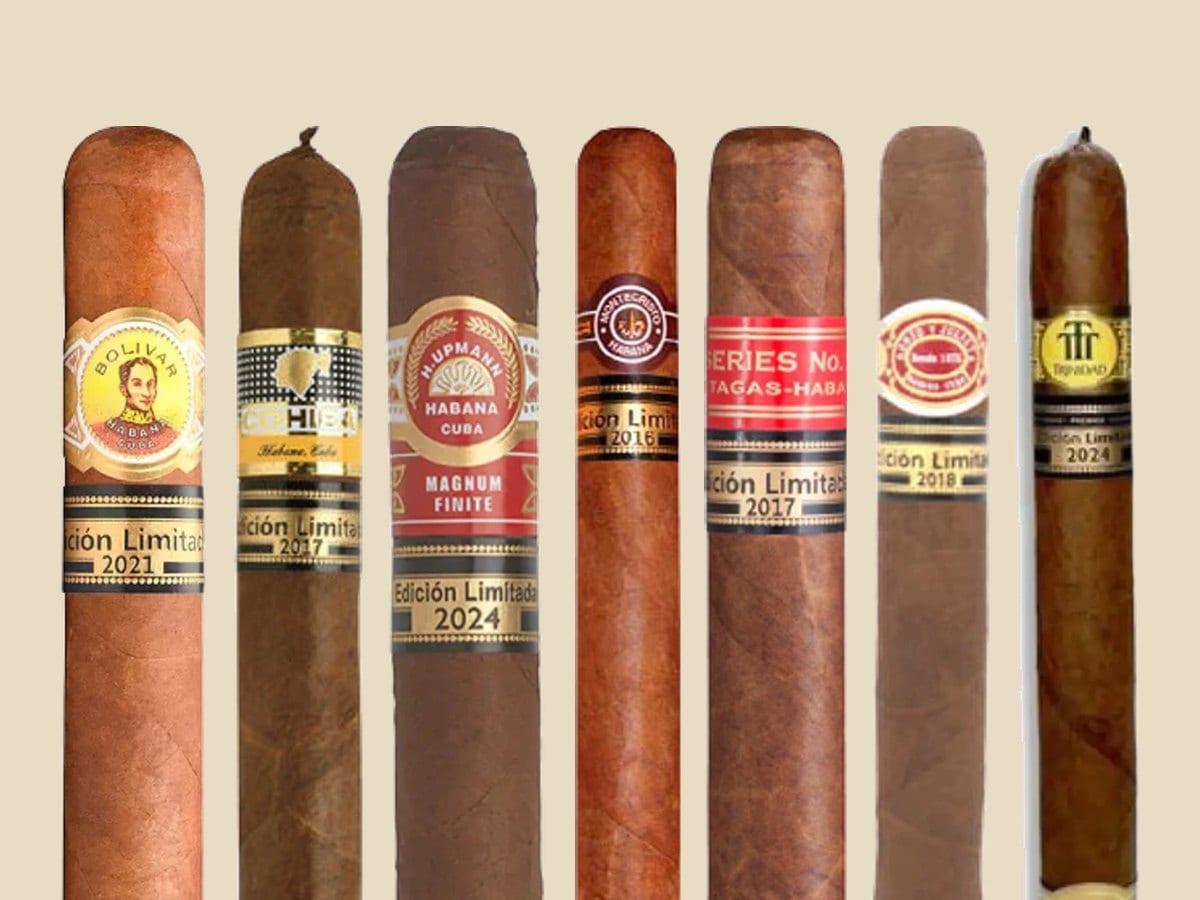
This lesson profiles the limited editions that have become landmarks, with their dates, and says why each one matters to collectors. It treats most of them briefly, because the Iconic Cigars topic gives several of these cigars lessons of their own, and Major Cigar Brands tells the stories of the houses behind them. The interest here is narrower: what a limited edition is, shown on the clearest examples.
Cuba's Edición Limitada as an institution
The Edición Limitada, described in the Types of Limited Editions lesson, is the model of a written, repeating limited series. Because it has run every year since 2000, always in an uncommon vitola, always with leaf aged at least two years, and always dated by its black-and-gold band, it has trained collectors to think of a Cuban limited edition as a dated, numbered object that can be collected year by year across the brands. Several houses have taken turns in the series. The annual rhythm, more than any single year's cigar, is what made the programme famous.
The Cohiba Behike
The Havana line most associated with outright rarity is the Cohiba Behike, launched in 2010 in three sizes: the BHK 52, 54 and 56, each named for its ring gauge. A cigar's ring gauge is its thickness in sixty-fourths of an inch, called the cepo in Spanish, so the BHK 52 is 52 sixty-fourths of an inch across and the 56 is the widest of the three. The leaf that sets the Behike apart is its use of medio tiempo, the two small leaves at the very top of a sun-grown tobacco plant, on the plants that grow them at all; they are the rarest leaves a plant gives, and Habanos says they give the cigar its exceptional character. The Behike quickly became the most costly line in the Cuban catalogue, and it is the subject of its own lesson in the Iconic Cigars topic.
Dominican icons
The Dominican Republic produced the limited releases that broke Cuban dominance of the rarest tier. Fuente Fuente OpusX appeared in November 1995 as the first puro, an all-Dominican cigar, with a wrapper grown by the Fuente family's own farm at Chateau de la Fuente in a sun-grown leaf called Rosado; until then the trade had held that a wrapper of that quality could not be grown in the Dominican Republic. Much of the cigar's fame comes from that first, a wrapper of a kind that had not existed before, and the line has stayed scarce by deliberate, small allocation ever since. Within it, the Opus X Lost City is a limited edition in the strict sense: its wrapper came from a fifteen-acre plot planted out of season in 2004 as a set for the film The Lost City, and the cigars were first released in 2009, in five vitolas in 2010, of roughly 4,000 to 12,000 cigars a size.
Padrón's anniversary lines are limited in a different way, by year rather than by one batch. The 1964 Anniversary Series appeared in 1994 for the company's thirtieth year, and the stronger Serie 1926 followed in 2002, named for the birth year of the founder, José Orlando Padrón, and rolled from Nicaraguan leaf aged at least five years; the Family Reserve, begun in 2009, is a numbered annual series built on leaf aged at least ten years. None of these is a single vanished batch, but each is scarce in its year and numbered on the box and the band.
A Cuban-Davidoff footnote
Davidoff's rare cigars cross the Cuban and the New World worlds. The house made its Havanas for a quarter-century, and its Dom Pérignon, named for the champagne and released in 1977, is covered in the Iconic Cigars topic; production ended in 1991, and the surviving boxes are now pure collectibles. After moving to the Dominican Republic, Davidoff built its limited programme on the year instead of the single batch, with the annual "Year of the ..." zodiac editions described in the Types of Limited Editions lesson and a separate super-premium tier of one-off humidor cigars.
Why these endure
The releases that last are the ones where the scarcity is real and stated. Each of the cigars above has a number, a date or a named leaf behind it, and a house that has kept its word about not over-making them. The point of the whole topic gathers here: a limited edition is a promise, made visibly, that there is a count and an end, and the ones that endure are the ones whose makers kept it.