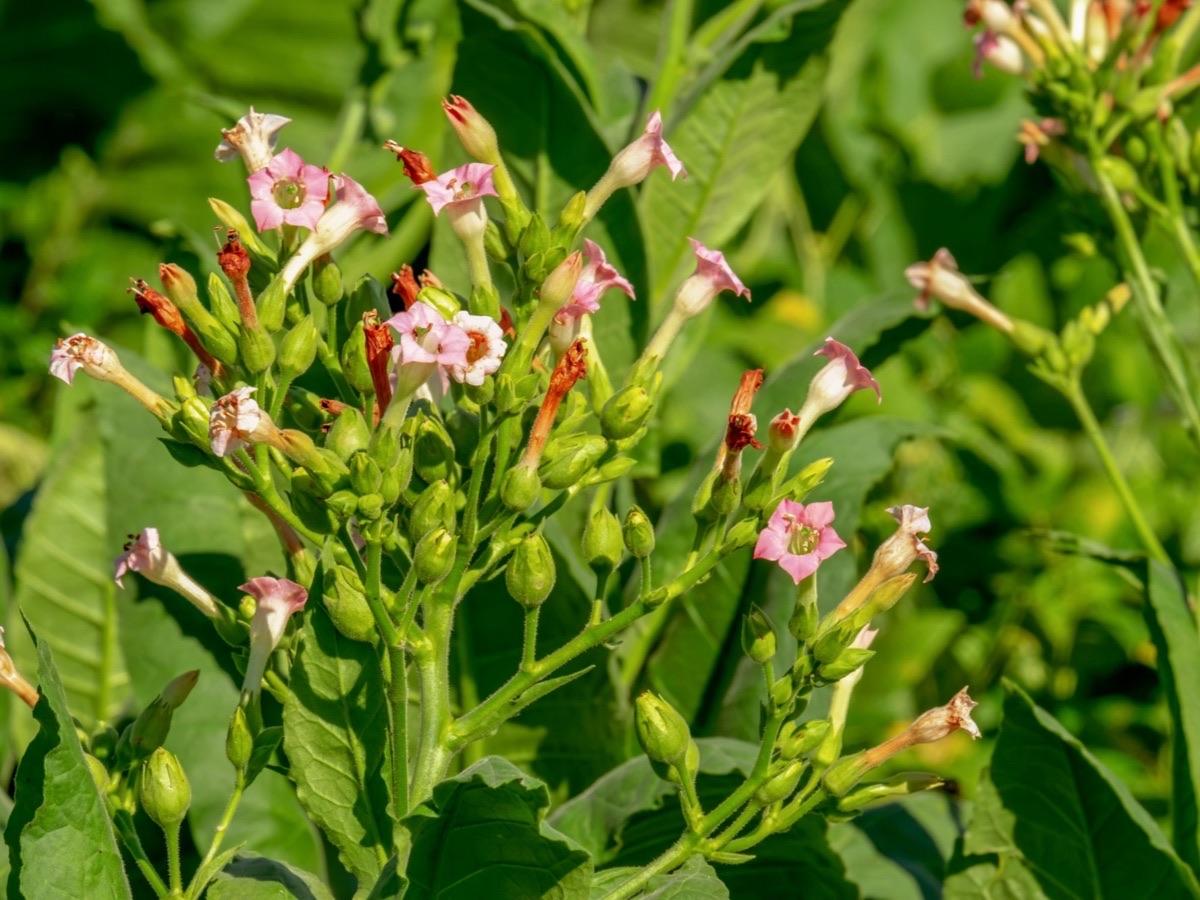
This lesson follows the tobacco plant as a living thing, through the stages of its whole life, from a seed weighing less than a tenth of a milligram to a plant two meters tall bearing seed of its own. Plant Growth Stages, in the Tobacco Farming topic, follows the same plant through the field work of a season, the earthing-up, topping and harvest. Here the subject is the plant itself: how it sprouts, how it builds its leaves, why and when it flowers, and how it makes its seed.
The stages of a tobacco plant's life
The table follows a cigar tobacco plant through its life, with typical durations from Cuban and U.S. sources. They vary with the variety, the climate and the season.
| Stage | Where | About how long |
|---|---|---|
| Sprouting and seedling | In the seedbed or tray | 5 to 10 weeks from sowing |
| Taking root and making leaves | In the field | The first five to six weeks after planting |
| Forming the flower bud | In the field | About 38 to 42 days after planting in Cuba |
| Flowering, if not topped | In the field | 76 days after planting for Corojo 2012 |
| Ripening of the leaves, on topped plants | In the field | From about 40 to 60 days after planting to about 90 to 100 days |
| Ripening of the seed pods, on seed plants | In the field | After flowering, until the pods turn brown |
Read from top to bottom, the plant spends a month or two in the seedbed and three to four months in the field. Most cigar plants never reach the last two rows, because they are topped at the bud; only the seed plants complete the cycle.
From seed to seedling
A tobacco seed holds a tiny embryo and a small store of food, and that store is all the seedling has until it has roots and leaves of its own. Heavy seed carries more of it, which is why the Connecticut researchers of 1905 found that heavy seed gave large, healthy, even plants, and light seed early, weak ones. Because the seed is so small, it is sown on the surface and barely covered: on a traditional Cuban bed it is broadcast with sand and covered with straw, and in a float tray it is dropped into a dimple and left with its top showing. In Kentucky trials, good seed sprouted 91 to 93 percent within 14 days.
The seedling's first two leaves are the cotyledons, the seed leaves that were already folded inside the seed. The true leaves follow from the bud between them, one after another, and the stem begins to lengthen. Connecticut's station recorded in 1937 what happens when this order fails: seedlings from one bad lot of seed grew large, thick cotyledons and then one true leaf, or none, or leaves fused together, and the beds were worthless. In a normal bed, the seedling has about five leaves and stands 10 to 16 centimeters tall when it is ready for the field.
Making leaves
Once planted out and rooted, the plant puts its energy into leaves, which form one at a time at the growing tip of the stalk. How many it makes before it flowers depends first on its variety. Habana 2000, Criollo 98 and Corojo 99 give 14 to 16 leaves a plant, Sancti Spíritus 96 12 to 14, and Corojo 2012, which carries 24 leaves in all, 20 usable ones. Untopped, Corojo 2012 grows about two meters tall; its largest leaf is the ninth from the bottom, and a leaf from the middle of the stalk measures about 48 by 25 centimeters. Selection can change the count: in U.S. breeding trials in the early 1900s, two years of selecting seed plants raised Sumatra-seed shade tobacco from 19 or 20 leaves to 23 or 24, without making the plants taller, by shortening the distance between the leaves.
Leaf number and plant height matter for the work as well as the yield. The same researchers noted that leaves are hard to pick from shade plants more than seven or eight feet tall, and that a shade tent much higher than nine feet is hard to build, so breeders looked for more leaves on shorter stalks. The fast growth of the plant's second month, which shapes the size and thickness of its leaves, is described in Plant Growth Stages.
Flowering
When the plant has made its leaves, the growing tip stops making them and turns into a flower head. Untopped, Corojo 2012 flowers 76 days after planting, and Cuban cigar tobacco shows its flower bud 38 to 42 days after planting, which is when it is topped. Most of the plant's leaves are formed by then.
For some tobaccos, day length decides when this happens. Early in the 20th century, U.S. Department of Agriculture scientists working near Washington, D.C., were puzzled by a tobacco called Maryland Mammoth that grew huge in summer but would not flower, so that no seed could be had from it. In a greenhouse in winter, however, it flowered at an ordinary size. In 1920 Wightman Garner and Harry Allard showed that the short days of winter were the cause: Maryland Mammoth flowered only when the days were short enough. They called the response photoperiodism, and it has since been found in many plants.
Flowers, pods and seed
A tobacco flower head carries many tubular flowers that do not all open at once, so that flowers, green pods and ripe pods can be found on one head at the same time. Each flower usually pollinates itself, though insects and hummingbirds cross some of them, as Seed Genetics and Hybridization explains. A fertilized flower becomes a small pod, about 1.6 by 0.9 centimeters on Corojo 2012, which ripens from green to brown and holds several thousand seeds. A plant can bear half a million seeds or more, and the more leaves it has, the less seed it sets.
Seed plants are the only cigar plants that are allowed to finish this stage. Every other plant is topped at the bud, and the plant answers by sending out suckers, new shoots from the joint of each leaf, as Topping and Suckering, in the Tobacco Farming topic, explains. Without its flowers the plant turns to thickening and ripening its leaves, the subject of Leaf Maturity.