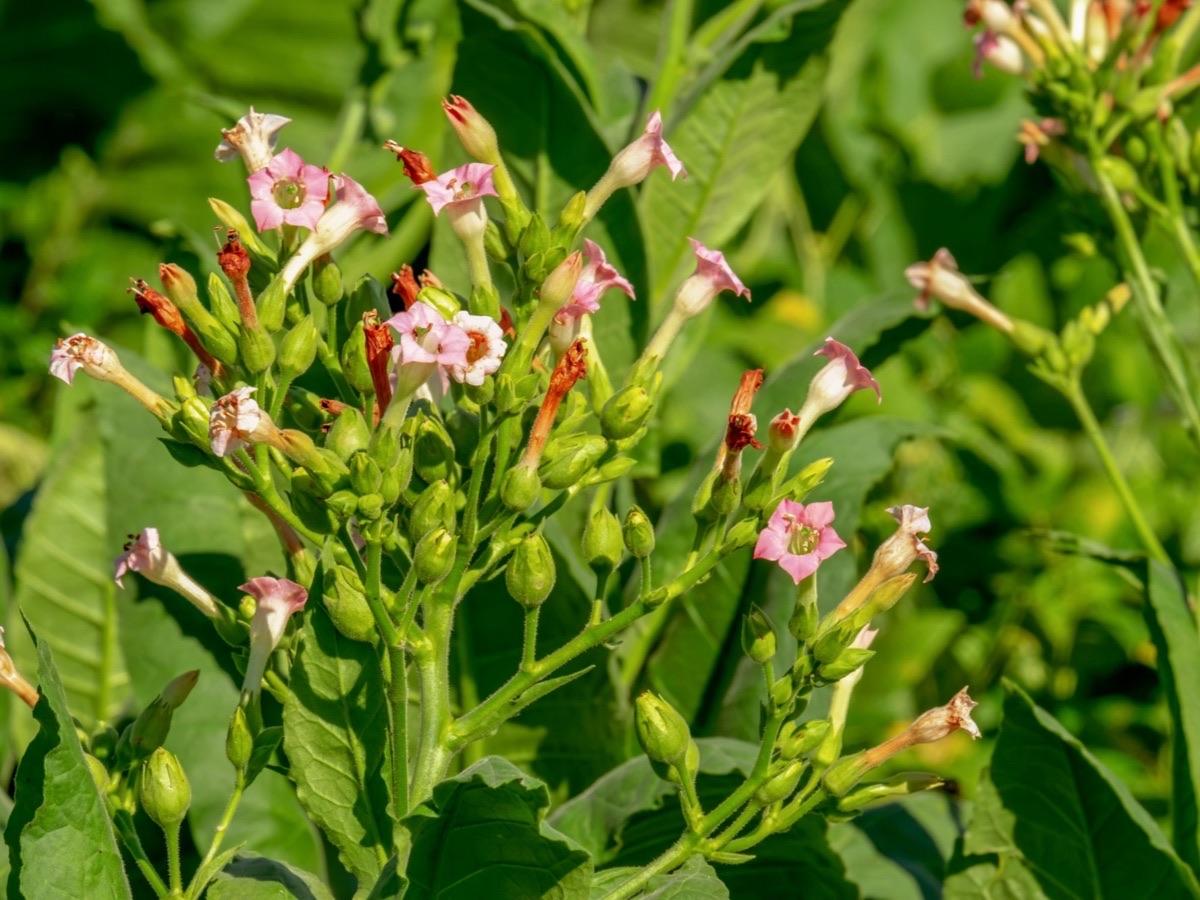
Every leaf on a tobacco plant has a life of its own. It forms at the tip of the stalk, grows to full size, works for the plant for some weeks, and then begins to age, and somewhere along that aging it is ripe for picking. This lesson follows a leaf through that life, explains what changes in it as it ripens, why the leaves on one plant ripen at different times, what speeds or slows ripening, and what happens to a leaf picked too early or too late. Timing and Maturity, in the Tobacco Farming topic, explains how growers judge the moment to pick in the field, and Color Transformation, in the Curing & Fermentation topic, how the leaf's aging goes on in the barn.
A leaf's life
Leaves form one after another at the growing tip, so the lowest leaves on the stalk are the oldest and the topmost the youngest. The lowest of all, which Cuban growers call mañanitas, are the ones the seedling brought with it from the seedbed. The leaves are not all the same size: on an untopped Corojo 2012 plant the largest is the ninth from the bottom, with smaller leaves below it and above it.
Because they are older, the lower leaves ripen first. As the U.S. tobacco researchers put it in 1907, as a rule the bottom leaves ripen first, the middle leaves next and the top leaves last. The gap can be long. On one grower's farms in Estelí, the ligero, the topmost leaves, matures 15 to 20 days after the leaves below it, and a Cuban plant is stripped of its leaves over about 30 days from the first picking to the last, as Priming and Harvesting, in the Tobacco Farming topic, describes. Filler Leaf Positions (Primings), in the Fillers topic, explains how each position becomes a different class of leaf.
What changes as a leaf ripens
A growing leaf makes sugars for the plant and is rich in nitrogen and in green chlorophyll. As it ripens, it begins to break down its own chlorophyll, and its nitrogen declines with it. The green fades, letting the yellow pigments show through, which is why a ripe leaf looks slightly lighter, and the leaf thickens and takes on a leathery feel. Studies of tobacco leaves find that chlorophyll and nitrogen fall together as a leaf matures, which is why a chlorophyll meter, which measures how green a leaf is, can track both. Cuban research on shade-grown wrapper found the best wrapper came from middle leaves still holding 4.3 to 4.7 percent nitrogen at harvest.
Ripening is the start of the leaf's aging, and curing continues it. A leaf picked ripe is still alive and goes on breaking down its chlorophyll, starch and proteins in the first days in the barn, until its cells die and it browns, as Color Transformation explains.
What speeds or slows ripening
Nitrogen slows it. A plant well supplied with nitrogen keeps growing longer, with larger leaves that cure darker, and growers give all their nitrogen in the first three weeks or so after planting, as Nutrients and Fertilization explains. Topping speeds it: once the flower head is gone, the plant turns its energy to thickening and ripening the leaves it has. Topping late has the opposite effect on quality, because Connecticut trials in the 1920s found that plants topped after early bloom gave overripe leaves with yellow, variegated and mottled colors.
The variety matters too. Some varieties are bred to be early: a Nicaraguan grower chose Habano Mejorado 98 in part because it was ready 90 to 100 days after planting. And the evenness of ripening is inherited. The U.S. researchers found in 1907 that among Connecticut's Sumatra-seed and Cuban-seed shade plants some ripened evenly from the bottom to the top, and that by selecting those plants and saving their seed under bags they could breed whole strains that did so.
Picked too early, picked too late
The stage at which a leaf is picked shows in the cured leaf. The table compares what the researchers of 1907 and 1910 and Connecticut's trials of the 1920s found.
| Picked | In the field | After curing |
|---|---|---|
| Too early | Still fully green and growing | Uneven color; more easily damaged by fungi and bacteria |
| Ripe | A little lighter in color, thicker, leathery | The leaf the grower aims for, like the middle leaves of a well-grown plant |
| Too late | Yellowing, often mottled | Lacks elasticity, gloss and strength, if wrapper; yellow, variegated or mottled colors |
The table explains why stalk-cut tobacco is a compromise. When the whole plant is cut at once, its lowest leaves are overripe and its top leaves underripe while the middle leaves are at their best, and the 1907 researchers found the bottom and top leaves of such plants worth less than the middle ones. Priming, which takes each leaf as it ripens, avoids the problem, as Priming and Harvesting explains.
Wrapper is picked on the young side of ripe. Shade-grown wrapper is taken when it is fully developed but before its change of color is easy to see, because by then it is likely to be too ripe, as Timing and Maturity explains, and Connecticut Broadleaf is cut fairly young too, no later than three weeks after topping.