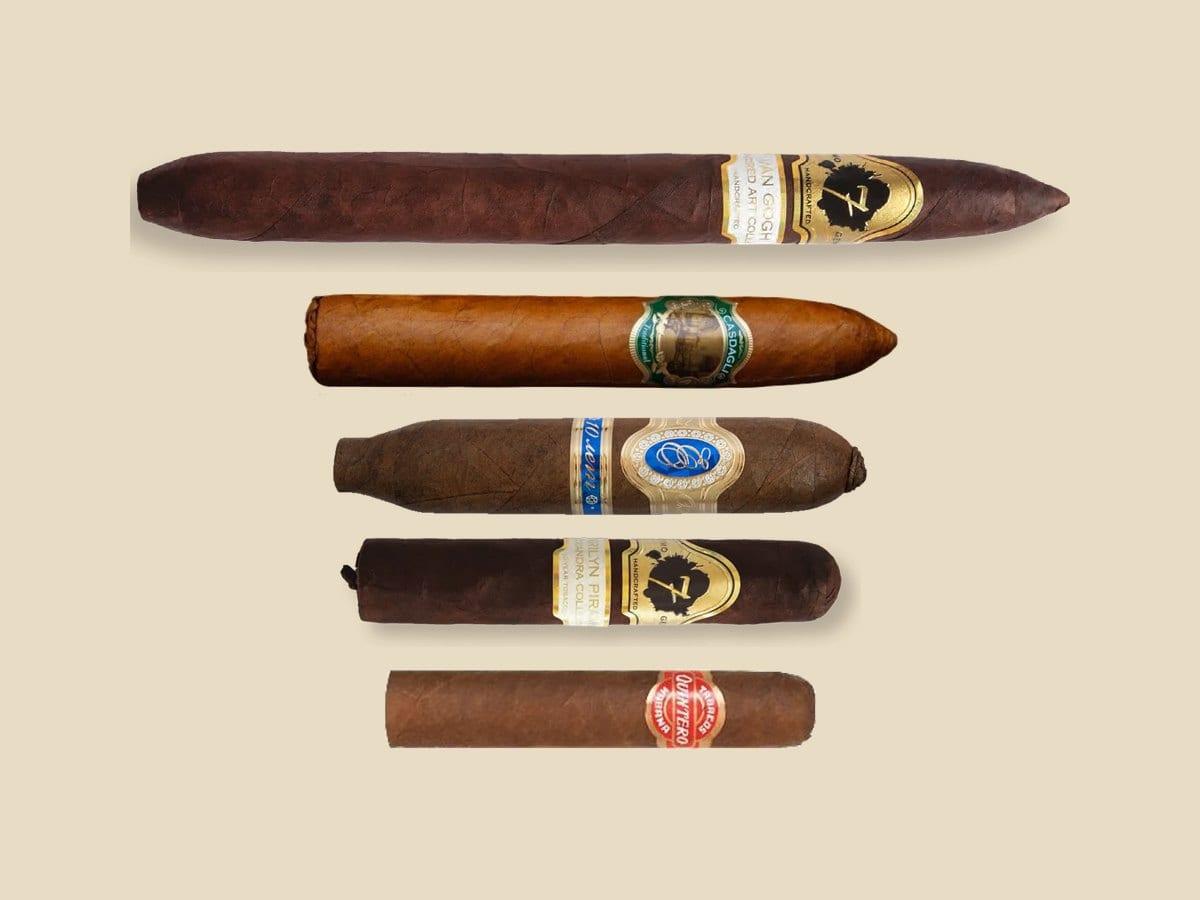
Most cigar lines are made in several sizes from the same blend, or liga in Spanish: the recipe of filler, binder and wrapper leaves. Smokers soon notice that the sizes of one line do not taste the same. This lesson explains why, what blenders do about it, how the sizes smokers prefer have changed in every market, Cuba's included, how factories keep each size exact, and how to choose a size for the time you have.
Why one blend tastes different in each size
The wrapper is a thin skin, a single leaf wound around the outside of the cigar, so its share of the tobacco depends on the ring gauge. The amount of wrapper grows with the cigar's circumference, in step with the diameter, while the room for filler grows with the cross-section, with the square of the diameter. Double the diameter and you double the wrapper but give the filler four times the room. The binder follows the same rule as the wrapper. Length changes how long a cigar lasts and how much tobacco it holds in all, but not these shares.
The table works this out for five common ring gauges, taking a 50-ring robusto as the reference.
| Ring gauge | Typical size | Wrapper's share of the tobacco | Room for filler, per inch of length |
|---|---|---|---|
| 38 | Lancero | About 1.3 times a robusto's | About 0.6 of a robusto's |
| 42 | Corona | About 1.2 times | About 0.7 |
| 50 | Robusto | The reference | The reference |
| 54 | Thick toro | About 0.9 times | About 1.2 |
| 60 | Gordo | About 0.8 times | About 1.4 |
The two ends of the table are far apart. In a 38-ring lancero the wrapper's share of the tobacco is about 1.6 times what it is in a 60-ring gordo of the same blend, and the lancero has room for only about 40 percent as much filler for each inch of its length. A slim cigar therefore takes fewer filler leaves, and every one of them counts for more.
The results line up with what smokers notice. Slim sizes, 42 ring and under, tend to taste more of the wrapper, so its sweetness, spice or earthiness comes through clearly, and a lancero has little filler to balance a wrapper that is too strong or too plain. José Oliva, of Oliva, which makes its cigars in Nicaragua, has said that a lancero should be made only if the wrapper can carry the cigar. Very thick sizes, 55 ring and up, tend to taste more of the filler, broader and rounder, and they smoke cooler and more slowly. The sizes in between, such as the corona gorda at 46 and the robusto at 50, balance the two.
What blenders do about it
A line's character comes from its blend, but one recipe does not always work in every size, and many blenders adjust for it. In Cuba, Habanos explains that the blender compensates in the thinner sizes by, for example, leaving out the strongest-flavored ligero, the thick leaf from the top of the plant, which would dominate a cigar with so little room inside. The Mareva's 42 ring, by contrast, lets the blender use three filler leaves to their full.
Thick sizes raise the opposite problem. Henke Kelner, who blended Davidoff's cigars in the Dominican Republic, has said that a very thick cigar needs tobaccos of greater strength, well distributed through the bunch. Ernesto Perez-Carrillo tried the blend of his Pledge line in a 60-ring size with different proportions of ligero and could not get the complexity he wanted, so he made the line's new size, the Apogee, at 6¼ × 58 (159 mm). Lanceros are difficult in their own way: Litto Gomez of La Flor Dominicana has called them hard to make and hard to blend.
Not every maker changes the recipe. Some keep one blend for every size and let each size show a different side of it. Either way, two sizes of one line are rarely identical, and many smokers have a favorite size for each blend. The clearest way to taste what size does is to smoke two sizes of one line side by side, for example a corona and a robusto.
How ring gauges have changed
Through most of the twentieth century, slim and medium sizes were the norm everywhere. In the United States, 42-ring lonsdales were among the most popular sizes for decades, and by the early 1990s the robusto had become the country's favorite. The cigar boom of the 1990s pushed rings higher outside Cuba. Diamond Crown, made in the Dominican Republic, appeared in 1995 with every size at 54 ring, which seemed fat at the time. By 2010 the 6 × 60 had become one of the best-selling sizes in American shops, and makers soon went further: E.P. Carrillo launched its INCH line, for rings of 60 and more, in 2012 and added a 70-ring size in 2013, and by 2019 a few cigars had reached 80.
Cuba followed. Its regular straight-sided cigars traditionally stopped at 50 ring, until the Cohiba Siglo VI arrived at 52 in 2002. In 2010 the Cohiba Behike line brought rings of 52, 54 and 56, and the Romeo y Julieta Wide Churchills, 130 mm (5⅛ in) × 55, opened the 55 ring the same year, followed by the Partagás Serie E No. 2, 140 mm (5½ in) × 54, in 2011. By early 2019 Cuba made some 30 cigars of 56 ring or more, limited editions included, among them a 60-ring Cohiba, and in 2025 the Behike BHK 58, 178 mm (7 in) × 58, became the thickest cigar in its regular range. The Cohiba Behike lesson in Iconic Cigars tells that line's story.
The fashion has since settled. In yearly surveys of American cigar shops, the toro replaced the robusto as the best-selling size in 2020. In 2025 two shops in three named the toro as their best seller, against one in six for the robusto and one in ten for cigars of 60 ring or more, down from about one in six in 2020; not one named the petit corona. Elsewhere tastes differ. In 2019 a distributor of Cuban cigars in the Middle East described thick cigars as a clear trend in the region, while the main distributor in Asia reported that most smokers there still preferred traditional sizes and chose a double corona when they wanted something bigger. In Cuba's established markets the trend has been towards shorter but wider cigars, which give the same flavor in less time, such as the H. Upmann Half Corona, 90 mm (3½ in) × 44, launched in 2011, and the Montecristo Petit Edmundo, 110 mm (4⅜ in) × 52. Even so, the slim Mareva remains by far the most popular Cuban size.
How factories keep a size exact
Consistency starts at the rolling table. After the torcedor rolls the filler leaves into the binder, the bunch is pressed in a mold, the molde, of wood or plastic, for 30 minutes or more to set its shape. A mold is a block with slots cut to the length and diameter of one format, so every format needs its own, and figurados need molds in their own shapes. Two of the best-known modern figurados, the Arturo Fuente Hemingway and the La Flor Dominicana Andalusian Bull, both began with old molds.
Finished cigars are then checked against their format. The traditional tool is the cepo, a wooden gauge with a hole for the ring gauge and a notch for the length. Factories also weigh cigars, because one that is heavier than it should be usually draws tight, and they test the draw. In Cuba a draw machine, which measures the draw of a pressed bunch by suction before the wrapper goes on, was introduced at the end of 2001 and is now used in every factory to sample each day's work. Outside Cuba such machines were rare around 1990 and are now found in most factories. The Construction Defects lesson in Cigar Anatomy explains what these checks catch.
Skill matters as much as tools. Habanos describes four grades of torcedor, and only the top grade may roll the largest and most complicated sizes. At one Havana factory in the 1990s it could take six years before a roller qualified to make a pirámide.
Choosing a size
Size is mostly a question of time. Habanos gives a rough smoking time for each of its principal formats, and the table lists them from the shortest to the longest.
| Format | Size | Smoking time, according to Habanos |
|---|---|---|
| Panetela (Laguito No. 3) | 115 mm (4½ in) × 26 | About a quarter of an hour |
| Perla | 102 mm (4 in) × 40 | About 20 minutes |
| Petit Edmundo | 110 mm (4⅜ in) × 52 | 20 to 25 minutes |
| Petit Corona (Mareva) | 129 mm (5⅛ in) × 42 | About 30 minutes |
| Corona | 142 mm (5⅝ in) × 42 | Over half an hour |
| Robusto | 124 mm (4⅞ in) × 50 | 30 to 40 minutes |
| Edmundo | 135 mm (5⅜ in) × 52 | About 50 minutes |
| Lancero (Laguito No. 1) | 192 mm (7½ in) × 38 | Most of an hour |
| Pirámide | 156 mm (6⅛ in) × 52 | About an hour |
| Churchill (Julieta No. 2) | 178 mm (7 in) × 47 | Over an hour |
| Double Corona (Prominente) | 194 mm (7⅝ in) × 49 | A good hour and a quarter |
Time follows the amount of tobacco more than any single measurement. The slim Lancero, almost as long as the Double Corona, smokes in about the time of the shorter but much thicker Pirámide, and the short, thick Petit Edmundo lasts about as long as the slim Perla. These are Habanos' own figures and assume a steady pace. Other guides allow more, often 45 minutes to an hour for a robusto and an hour and a half or more for a double corona, and many smokers take longer still.
Pace changes the time more than anything else. At about one gentle puff a minute any cigar stays cooler and lasts longer, while a cigar hurried to finish in time grows hot and bitter, so it is better to choose one you have time for. For a short break, a petit corona, a corona or one of the short, thick sizes such as the half corona fits. To taste a wrapper at its clearest, choose a slim size, such as a corona or a lancero. For a long evening, a toro, a Churchill or a double corona gives the blend time to develop. And when you try a strong blend for the first time, a smaller size is the wiser choice, because it holds less nicotine in all, as Strength Tolerance Over Time explains.