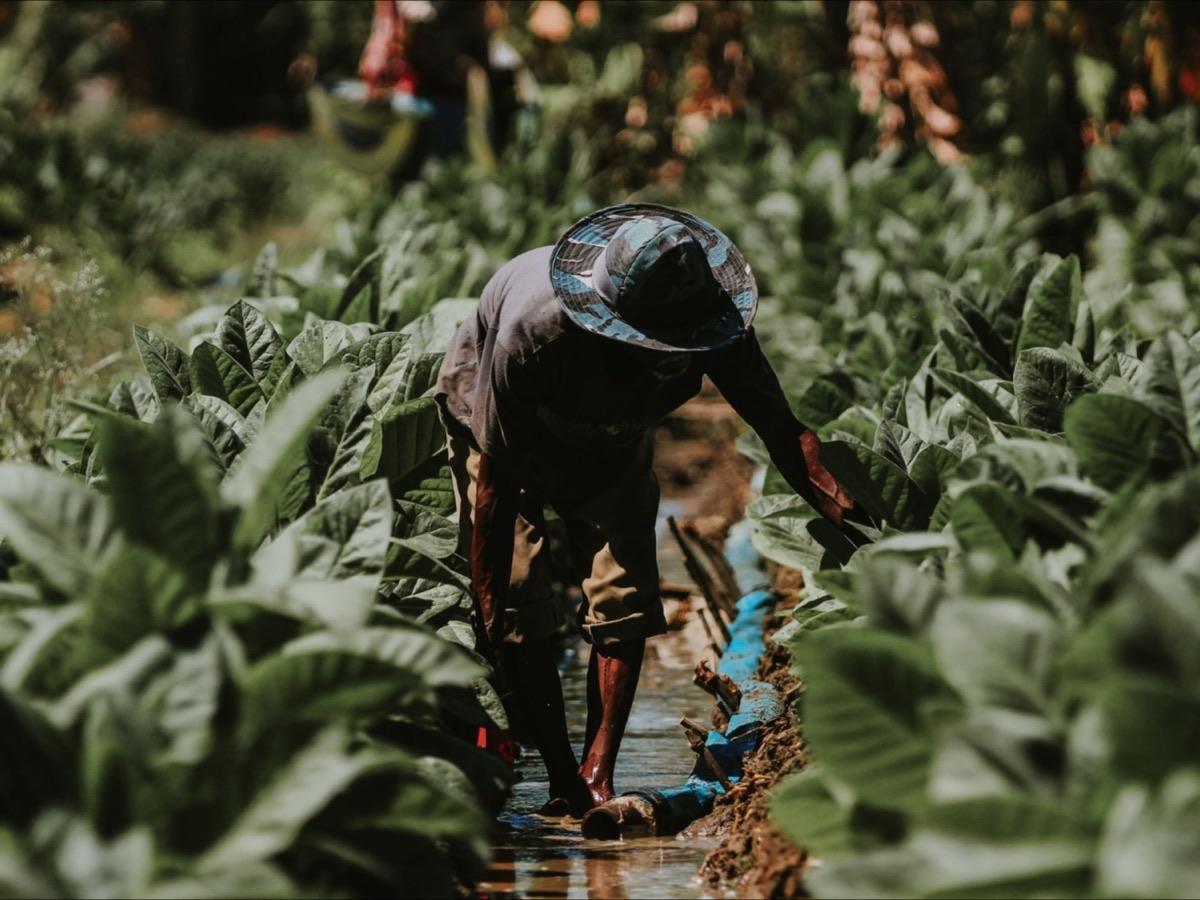
The harvest is the last and most delicate work in the field. A leaf that has been grown, protected and topped for months can be torn, bruised or picked at the wrong moment in a few seconds. This lesson explains how cigar tobacco is harvested: by priming, leaf by leaf, as most of it is, and by cutting the stalk, whole or in pieces. Timing and Maturity explains how growers know when a leaf is ripe, and Curing Barns, in the Curing & Fermentation topic, follows the leaf once it reaches the barn.
Why prime
A tobacco plant ripens from the bottom up, so on any given day some of its leaves are ready and others are not. Priming takes only the ripe ones. A Connecticut study of the 1920s explained the advantage: primed leaves are picked when the grower judges each one ripe, while stalk-cut tobacco must be harvested when the plant as a whole is at its best, which is harder to judge. Priming also keeps the leaves from each level of the plant together. A 1908 U.S. guide to shade-grown wrapper told growers to make four primings of the crop and keep each one separate.
The word priming has two meanings. It is one pass of the harvest, and it is also the leaves taken in that pass, and so a position on the plant, the meaning used in the names of the filler classes, as Filler Leaf Positions (Primings), in the Fillers topic, explains.
The primings in Cuba
Habanos describes the Cuban harvest: picking can begin about 40 days after planting out; only two or three leaves can be taken at a time, with days to wait between pickings; and a single plant takes close to 30 days to harvest. Shade-grown plants, taller and with more leaves, need more pickings than sun-grown ones.
Cuban growers name the cuts, or cortes, by their place on the plant. The lowest leaves of all, the mañanitas, are the leaves the seedling brought with it from the seedbed; they are too small for Habanos, and on shade-grown fields they are picked mainly to let air into the plantation and keep it clean. The table lists the cuts above them, from the bottom up, with the days on which they were picked in a four-season study of shade-grown Criollo 98 in Partido.
| Cut | Leaves | Picked, days after planting (Partido study) |
|---|---|---|
| Libre de pie | The first two | 60 |
| Uno y medio | The next three or four | 67 |
| Centro ligero | The next three or four | 74 |
| Centro fino | The next three or four | 81 |
| Centro gordo | The next three or four | 86 |
| Corona | The top three or four | 90 |
Read down the table and the pickers came back about once a week, a little faster toward the top, and the harvest ended about 100 days after planting. Other Cuban sources put the first cut earlier, from about 40 days. Cuban growers prize the middle cuts: centro ligero can give wrapper of high quality, and centro fino is classed as high quality. In Pinar del Río, sun-grown leaf is picked the same way, leaf by leaf, and strung for the barn; the Cubans call it sol ensartado.
Priming elsewhere
Connecticut primes its shade tobacco from the bottom up through the summer. In late June the three bottom leaves, too small for wrapper, are removed; the first priming follows in early July, and the pickers return about once a week, taking about three leaves from each plant each time, in about six primings by most accounts. A team of 250 workers could usually pick 50 acres in a day in 2006. In Ecuador, Oliva's pickers take the leaves at the very bottom of the stalk about 55 days after planting and work up the plant over the next 20 days; A.S.P.'s Connecticut-seed plants grow so tall that pickers bend them over to reach the sixth and last priming.
In Nicaragua, a study of a sun-grown farm in Jalapa recorded five cuts, starting 90 days after planting and four or five days apart, and a shade-grown Connecticut-seed crop near Estelí seven cuts, starting at 75 days and six to eight days apart. The Padrón family reported in 1997 that it took about 40 days for the first leaf to be picked. Perdomo picks every leaf by hand and marks the primings with strings of different colors. The Eiroa family's Corojo plants in Honduras give seven primings, 14 leaves in all. In Mexico, the Turrent family primes its San Andrés Negro in just two passes, the first taking four leaves and the second twelve. In Cameroon, the leaves are picked by hand, almost entirely by women, and sorted by priming.
Some growers also strip the lowest leaves early. Nicaraguan growers remove the leaves nearest the ground, often damaged by mold, about 30 days after planting.
Handling the leaf in the field
A picked leaf is fragile. The 1908 guide warned pickers not to jam or press the leaves down in the basket, so as not to bruise them, and Connecticut's shade leaves are kept covered on their way out of the field, because the sun would start burning them within about 20 minutes. Cuban guidance advises against picking in the first days after a field has been suckered. The leaves are then carried to the curing barn, in Cuba often by oxen, and strung or speared for hanging, as Curing Barns explains.
Cutting the stalk
Connecticut Broadleaf, and Havana Seed before it, is harvested whole. Two or three weeks after topping, workers cut each plant at the surface of the soil with one clean slanting cut, using hatchets, and leave it to wilt on the ground for an hour or two so that the leaves bend without breaking. The stalks are then speared onto four-foot laths, about six inches (15 centimeters) above the cut, five broadleaf plants to a lath, and taken to the barn. Guidance in Kentucky and Tennessee adds two cautions: cut at ground level, so that stumps don't punch holes in wrapper leaves, and don't cut more than can be picked up quickly, because the sun burns wilting leaves.
Cuba has a third method. Sol en palo, the sun-grown tobacco of the central and eastern provinces, is harvested in mancuernas, pieces of stalk cut with a knife that carry two to four leaves each. In one trial in Granma, the plants were cut at 73 days, from the top down, in pieces of two to four leaves, with the top piece, the corona, carrying three. Habanos describes the mancuerna as cutting the stem in sections with two leaves attached.
The table compares the three methods.
| Priming | Stalk-cutting | Mancuernas | |
|---|---|---|---|
| What is picked | A few leaves at a time | The whole plant | Pieces of stalk with two to four leaves |
| How many passes | Several, a few days apart | One | Several |
| Where | Most cigar tobacco: Cuba's Pinar del Río, Central America, the Dominican Republic, Ecuador, Connecticut Shade, San Andrés | Connecticut Broadleaf and Havana Seed | Cuba's central and eastern provinces |
| Why | Each leaf picked when ripe; primings kept apart | Fast; suits a thick leaf cut young | The Cuban method for sol en palo |
Priming is the slower method, but it is the one used for most cigar leaf. Stalk-cutting is kept for tobaccos such as Broadleaf, harvested young and whole on purpose. Mexico's San Andrés leaf is often described as stalk-cut, but the Turrent family, its best-known growers, prime theirs, as Curing Barns notes.