A tobacco plant needs a steady supply of water, but cigar tobacco is mostly grown when the sky supplies little of it. The great cigar countries of the Caribbean and Central America plant after the rainy season and harvest before the next, so their growers decide for themselves how much water each field gets. This lesson explains why the crop is grown that way, when the plant needs water most, how fields are watered in Cuba, Central America, the Dominican Republic and Connecticut, and what too little or too much water does to the leaf.
A dry-season crop
In Cuba, Nicaragua and the Dominican Republic, tobacco goes into the fields between October and January, after the hurricane season, and is harvested by spring. In Partido, the Cuban wrapper region south-west of Havana, the rainy season brings most of the year's rain, about 1,500 millimeters, while the dry season, the one suited to tobacco, brings only 300 to 350. Growing in the dry months spares the crop the storms and much of the disease that wet weather brings, but it means the crop has to be irrigated.
For growers with irrigation, that is an advantage. Litto Gomez, of La Flor Dominicana, said in 2016 that the farm in the Dominican Republic didn't depend on rain because it irrigated itself, and during a drought in 2019 put it plainly: when there is no rain and you have irrigation, you are in control of the water and, pretty much, of the quality. Hendrik Kelner, of Davidoff, said the same year that fields without irrigation could not be planted at all.
Not every crop is irrigated. In the Dominican Republic's 2015–16 season, three-quarters of the Olor crop, a native filler tobacco, grew on dry, unirrigated land. Cuba's sol en palo, a sun-grown tobacco of the central and eastern provinces, is often grown without irrigation or with only a little. In Mexico's San Andrés valley, the dark San Andrés Negro is planted when the heavy rains begin in June. Connecticut's crop grows through the New England summer, irrigated only in dry spells. And in Cameroon, where wrapper grows on small farms, there is no irrigation at all.
When the plant needs water
A newly planted seedling needs moist soil to take root, which is one reason Cuban growers plant into furrows that have just been filled with water. After that, water matters most in the plant's second month, from about knee height to early bloom, when the plant grows fastest. In Connecticut, research in the 1930s found that the second half of July, which falls in that stage, decided the crop.
Researchers at Cuba's tobacco experiment station in San Juan y Martínez measured this for shade-grown wrapper between 2008 and 2010. They divided the season into three periods, roughly the first 20 days, days 25 to 56 and days 56 to 90 after planting, and watered each plot whenever its soil fell to a set share of the water it could hold. The most export-grade wrapper came from plots kept at 70 percent of that capacity in the first period and 75 percent in the second and third.
How fields are watered
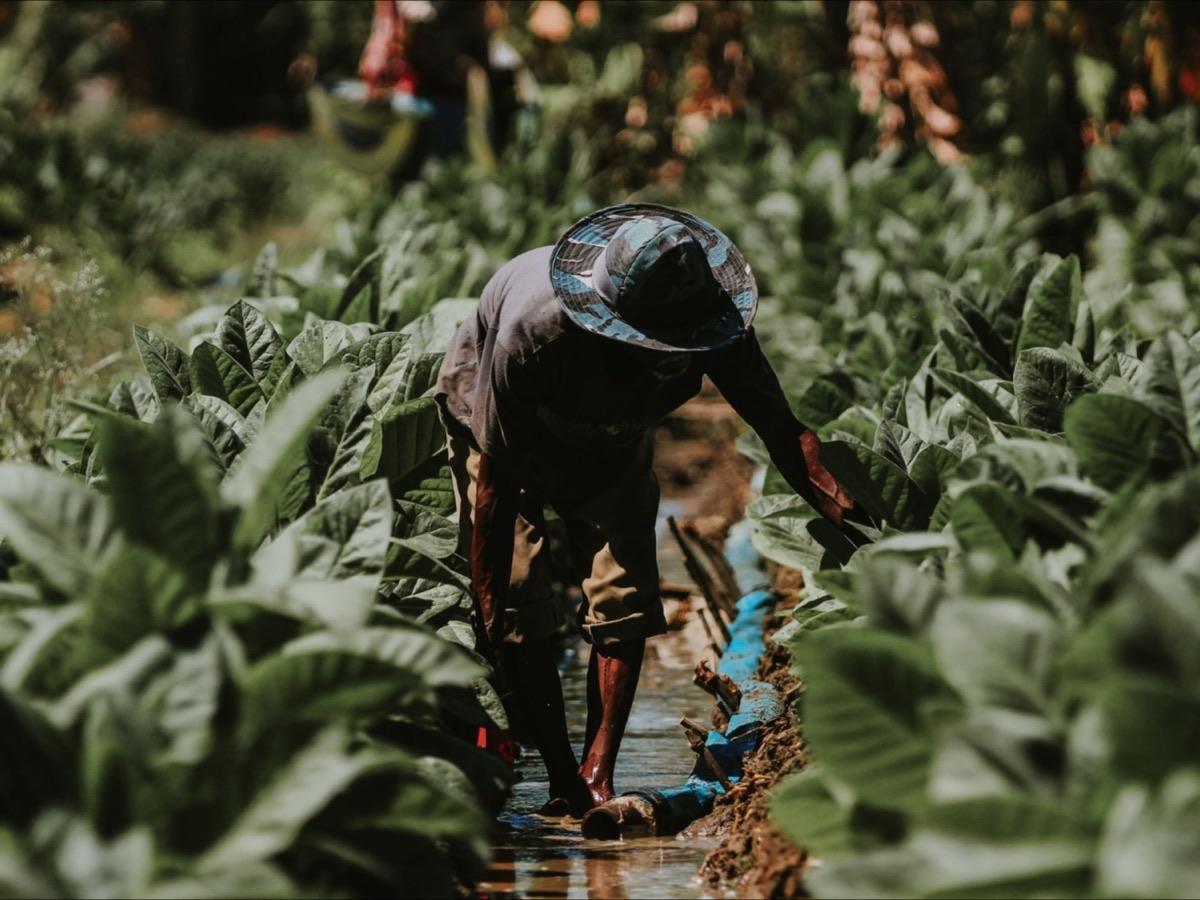
Cuban tobacco has traditionally been watered by furrow. The aporque leaves each row of plants on a ridge with a furrow between rows, and water is let into the furrows to soak the ground beside the roots. In a trial in Granma, in eastern Cuba, a sun-grown field got one watering at planting and five more, 6, 24, 37, 45 and 60 days later, each of 250 to 300 cubic meters a hectare, the equivalent of 25 to 30 millimeters of rain. Drip irrigation and fertigation, which carries fertilizer in the water, have come into Cuba more recently, mainly for wrapper. Since electricity in Cuba is unreliable, growers in San Juan y Martínez have turned to solar pumps, which irrigated 1,216 hectares there, 38 percent of the area under tobacco, in the 2025–26 season; before them, some fields were watered at night, whenever the power came on.
Central American growers use every method. In Nicaragua, studies of farms in Jalapa and Estelí describe sprinklers for the first 45 days or so, then water run down the furrows. Perdomo uses drip irrigation with its own water filtration to control how much water and fertilizer each plant gets, and in Honduras the Eiroa family's El Corojo farm, in the Jamastrán valley, had drip irrigation on more than 400 acres (160 hectares) in 2017. The drier north-west of the Dominican Republic was described in the 1990s as relying on a large system of irrigation canals.
Connecticut moved from furrows to sprinklers in the mid-20th century. Its agricultural station advised in 1953 that a field be watered when the plants began to wilt in the morning and did not recover by night, never more than once a week, with about an inch (25 millimeters) of water at a time; it had not yet seen a season that needed more than three or four waterings. In shade fields the sprinklers were raised above the cloth. The table compares the methods.
| Method | How the water gets to the plant | Where it is used |
|---|---|---|
| Furrow | Run along the furrows between the ridged rows | Cuba, Nicaragua, older Connecticut practice |
| Sprinkler | Sprayed from above, in the shade fields from above the cloth | Connecticut, early weeks in Nicaragua |
| Drip | Delivered to each plant through tubes, often with fertilizer | Cuban wrapper fields, Perdomo, El Corojo |
| Canals | Brought to the fields through a network of canals | North-west of the Dominican Republic |
| Rain alone | From the sky, with no irrigation | San Andrés, Cameroon, much Dominican Olor |
Too little water
Drought shows in the leaf. Connecticut's agricultural station reported in 1953 that a dry season came about every second or third year, and that dry-weather leaves were thicker, darker and gummier, did not ferment as readily, held fire less well, and tasted and smelled worse. Its irrigation trials showed what water was worth: over five years, irrigation raised the value of the crop by an average of 37 percent and the leaf's fire-holding capacity, how long it keeps burning, by 30 percent.
A dry year with irrigation can still give good tobacco. When drought struck the Dominican Republic in 2019, growers with irrigation expected a smaller harvest but a better one, since dry weather also keeps disease down.
Too much water
Too much water is as harmful as too little. Waterlogged seedlings die, which is one reason fields are ridged. Heavy watering washes nitrogen out of the soil: Connecticut growers who watered by furrow found the nitrogen leached locally and had to add more, and in muddy soil the plants were easily blown down. Long cloudy, wet spells while the plants are growing fastest give thin, brittle leaves that tear at harvest. Wet weather just before harvest also brings leaf disease: guidance for Connecticut Broadleaf in Kentucky and Tennessee warns that two inches (50 millimeters) or more of rain in the last 10 to 14 days before harvest can leave green spots in the cured wrapper. Pest and Disease Control and Weather Risks take up these threats.