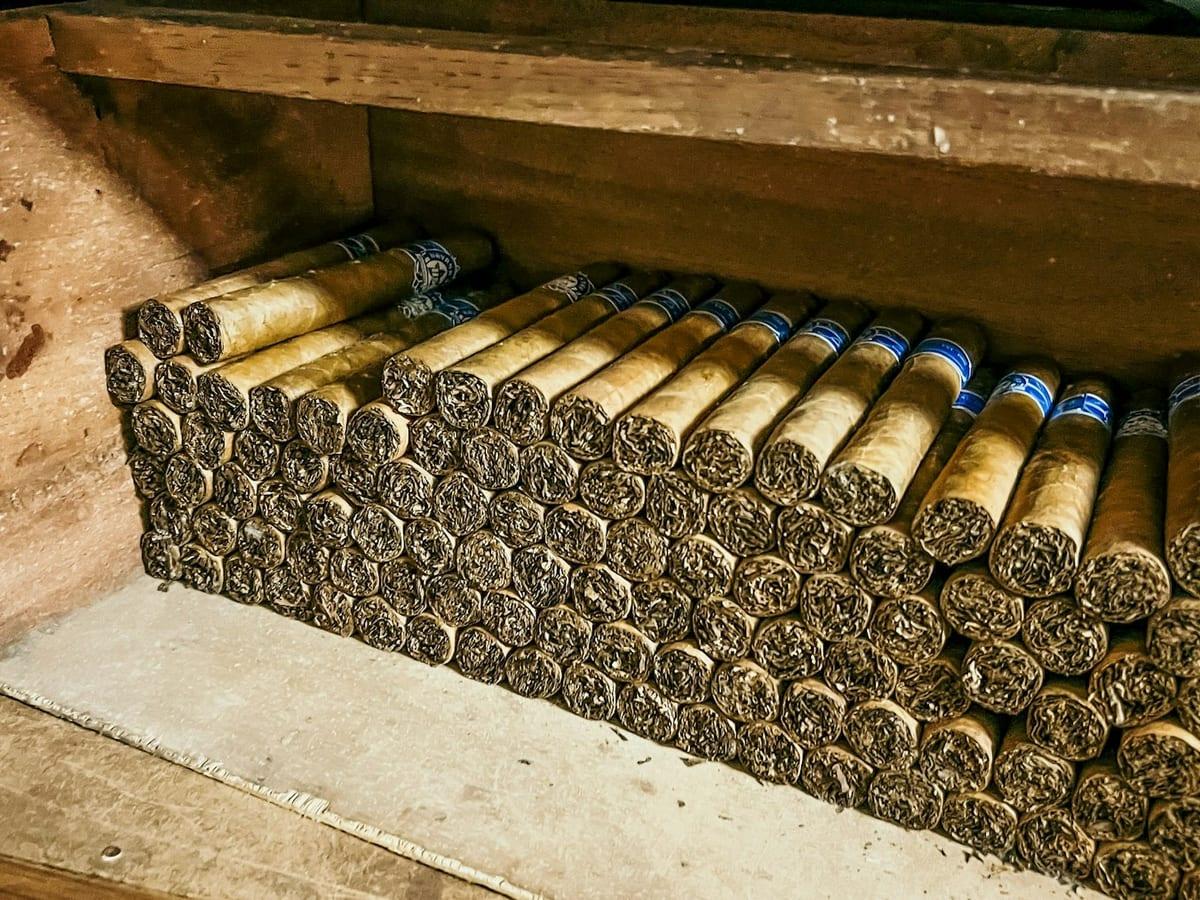
A collector ages cigars as a deliberate set, buying boxes to lay down for years and watching how they change. That calls for two judgments the casual smoker never has to make: which cigars will improve, and which will simply get older. This lesson explains what aging can and cannot do for a cigar, how a vintage and a box code are read, and what an aged cigar is worth. Agricultural and leaf aging, the years in the bale before rolling, are covered in Fermentation Cycles, in the Curing & Fermentation topic.
What improves, and what does not
The cigars that gain most from age are the ones that are strong to begin with. A blend built on ligero, the thick, oily upper leaves of the plant, has a great deal to lose—its rawness and bite—and the years take precisely that away while keeping its richness, which is why aging cigar tobacco matters most for stronger leaf and why full-flavored, robust cigars in their youth are the ones collectors lay down. The trade's own words for it: a cigar that is rich and full when young is a candidate for aging, while a mild one will mostly get milder.
So the lightest cigars are usually the poorest keepers. A thin, pale Connecticut Shade wrapper starts delicate, and time takes what little it has; aged too long it grows flat and papery rather than rounder. A light, Connecticut-wrapped cigar is generally better smoked young than coiled in a box. Between the two extremes sit the Habano and Corojo wrappers of Nicaragua, Ecuador and the Dominican Republic, whose pepper and cedar soften into cocoa and leather over a few years, and the dark maduro leaf of San Andrés and Broadleaf, which is fermented the longest already and changes least of all.
The point is that aging cannot add what the leaf never had. It rounds and softens and marries; it does not create flavor. A bad or dull cigar does not become good with age, only older, and even a great one has a limit beyond which it stops gaining and begins to lose its edge, its oil slowly spent. Where that limit falls is a matter of debate among collectors, but many put the sweet point at five to ten years, while the same collectors happily smoke cigars kept far longer.
Reading a vintage
A vintage is a date, and it needs reading carefully. When a cigar carries a vintage, the year usually names the harvest of one of its tobaccos—most often the filler—not the year the cigar was rolled, so a box dated with a distant year may name leaf harvested long before the cigar was rolled and sold. Vintage dating is far rarer in cigars than in wine, where every bottle carries a year. Most cigar boxes carry no harvest date at all.
Cuba has its own way of dating importance. Habanos boxes are stamped with a code that gives the month and year of boxing, and collectors use it to tell one batch from another. On top of that, Habanos releases shorter-run cigars whose age is part of the point: the Reserva, whose leaf has aged at least three years, and the Gran Reserva, at least five, and an annual year-dated Edición Limitada, blended with rarer leaf than the regular lines. The Limited Editions topic describes these releases in detail.
The market for aged cigars
Age has a price. A cigar kept for years in good conditions is worth more than the same cigar was new, and nowhere more than among Cuban cigars, where an aged box—and above all an old or pre-embargo one—sells for a large premium. The long-lived, full-bodied Havanas, the brands built on strong filler, are the ones collectors most want with years on them. The non-Cuban world has its aged favorites too, and makers lean on the idea: Padrón ages the tobacco of its standard lines at least two and a half years, of its 1964 Anniversary Series four, of its 1926 Serie five and of its Family Reserve ten, and the Fuente Fuente OpusX and other full, slow-burning Dominican and Nicaraguan cigars are widely bought to be laid down. These are cigars whose leaf was already years old before rolling, so the smoker's cellar adds a second, deliberate aging on top of the maker's.
That premium is real but not automatic. A cigar must have been kept at the right temperature and humidity, in steady conditions, for the whole of its life, or the years have taken from it instead of given; a box dried out or overheated at some point is no treasure. And the same judgment applies as in buying new: the cigar has to have been worth aging in the first place. Collectors pay for provenance and condition, not for age alone.