A cigar is sold as a finished thing, but its leaf has not finished. The tobacco in it fermented in pilones and aged in bales for years before it was rolled, as Fermentation Cycles and Ammonia Release, in the Curing & Fermentation topic, describe; once rolled, the cigar goes on changing, more slowly, and it is that later change that smokers call aging, añejamiento in Spanish. This lesson explains what happens inside an aging cigar, and the two ways a smoker is most likely to keep one—in its original box, or as singles in a humidor. Why Humidity Matters, in the Storage & Humidity topic, covers the conditions in full.
What aging does to a cigar
Fermentation breaks down the leaf's proteins, amino acids and part of its nicotine and drives off most of the ammonia they release, and this is what makes a well-fermented cigar smooth. But a small share of that work is still going on when a cigar is boxed. A young cigar can taste and smell sharp, with an edge of ammonia, because the leaf was not rested long enough, and smokers are advised to rest such a cigar for some weeks or months; good makers age their cigars after rolling for a month to more than a year, so the tobaccos marry and mellow. That is the factory's version of what a smoker's humidor later continues.
In the humidor, three things go on at once. Oxidation slowly softens the cigar's oils and its nicotine compounds, taking the harsh edges off a young, strong cigar. The last fermentation residues keep breaking down, and the small amount of ammonia still in the leaf is gradually lost, so the smoke sheds its sharpness and any lingering bitterness. And moisture moves until it is even throughout the leaf, so that wrapper, binder and filler burn as one instead of each at its own rate. The result is not a different cigar but a quieter one: the same blend, with its flavors knitted together and its bite rounded off.
Nothing about this is fast. Habanos says a Habano can be kept "for a good 15 years, sometimes longer", and, like an exceptional wine, will improve with age, and that the marriage of the leaves begins the moment a cigar leaves the roller's bench. What matters most is steadiness: a humidor that holds its temperature and humidity lets the change run quietly, while one that swings stresses the leaf, and a cigar that dries out begins to lose flavor after two or three months and never gets it back.
The two containers
A box and a humidor age a cigar through much the same chemistry, but they shape it differently.
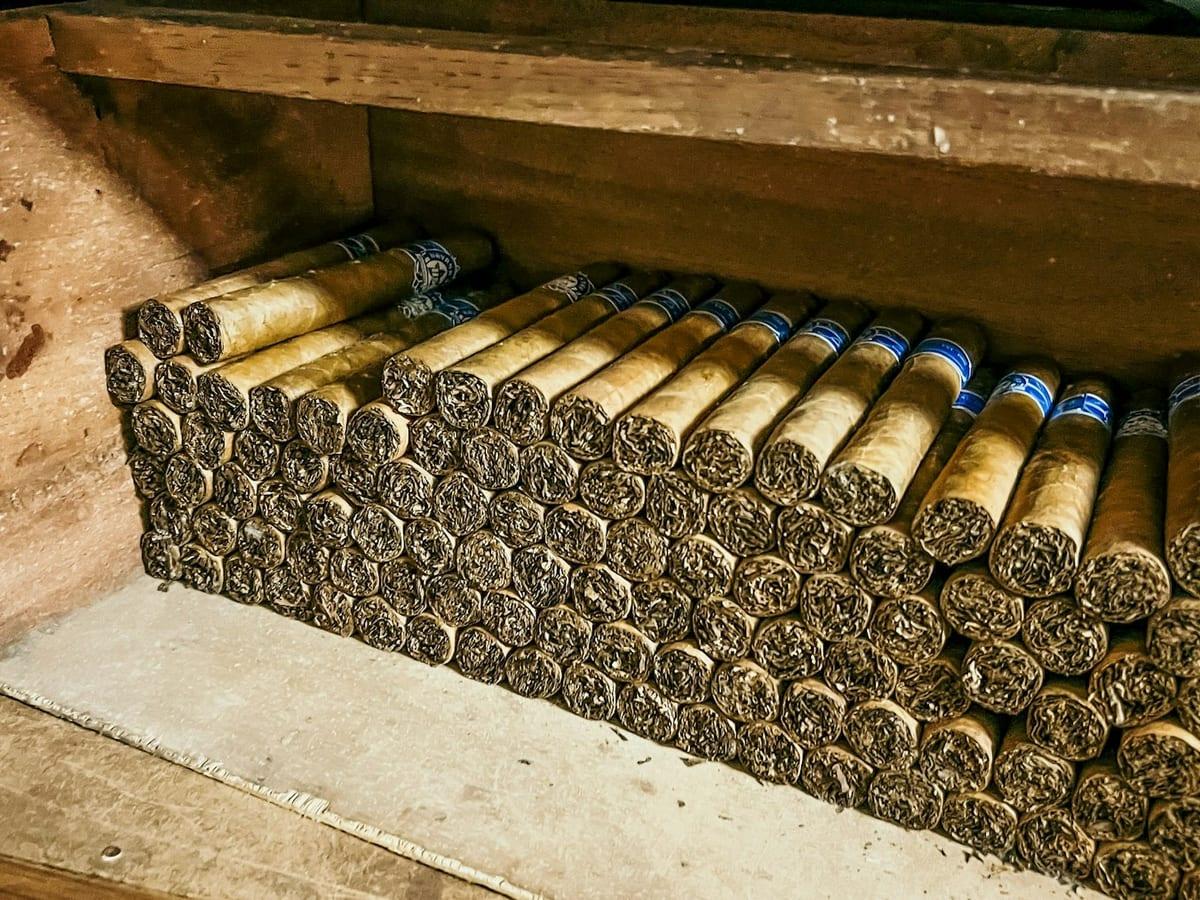
Box aging keeps cigars in the closed wooden box they were sold in. Because the cigars are packed close and share one small volume of air, they age as a set, all of them passing through the same conditions at the same rate, and the box damps the room's swings so the change runs slow and even. A collector who keeps a full, sealed box is keeping one brand and usually one box code together, and the cigars come out tasting like a matched set rather than a dozen separate smokes.
Humidor aging takes the cigars out of their boxes, or keeps them as individual singles, in the open air of a well-kept humidor. The cigars sit in moving, shared air and exchange aromas with whatever else is in there, and a single can be lifted out, inspected and smoked without disturbing the rest. That openness is convenient for the smoker who wants to taste one now and one next year, but it is less settled than a closed box: the humidor follows the room more, every opening changes its air, and unlike cigars kept side by side trade a little of their character.
Spanish cedar
Both containers usually carry the same wood. Spanish cedar, cedro in Spanish, is the wood of nearly all cigar boxes and humidors. It is a marketing name for *Cedrela odorata*, a tree of the mahogany family that grows across the tropics; it is not a true cedar, and it is quite different from the red or aromatic cedar sold for closets and chests, which should never be used in a humidor or a cigar box. Makers like it because it holds and releases moisture gently, so it helps keep the air inside stable, and because it lends tobacco a soft woody note. It also mops up a little of the ammonia a young cigar gives off, which is one reason a cigar aged in its box, surrounded by cedar, can come out cleaner than one aged in a container that has none.
Box or humidor: a comparison
The table sets the two methods side by side.
| Box aging | Humidor aging | |
|---|---|---|
| The container | The original closed box, usually Spanish cedar | Singly or loose, in a shared humidor |
| Air and moisture | Slow and enclosed; the box damps the room's swings | Open to the room and to every opening of the lid |
| The cedar | The box itself, close around each cigar | The humidor's cedar liner, more diffuse |
| What ages together | One brand, one box code | Different brands and blends side by side |
| Sampling | Opening the box disturbs the set | One can be lifted out and the rest left alone |
| Best suited to | Years of undisturbed aging of a uniform box | A mixed collection, sampled as it goes |
Read down the table and the two methods are not rivals but different tools. A box is for patience: the collector who buys a uniform box and means to leave it shut. A humidor is for use: a changing collection of different brands, some to smoke now and some to lay by. Many smokers keep both, leaving full boxes closed and keeping their everyday and mixed cigars as singles in the humidor. The practical rule for either is the same—steady temperature and humidity, and, for a box that will age for years, opening it as seldom as possible.