The binder shows the difference between Cuban and New World cigar making more clearly than any other leaf. A Cuban blender works with one country's tobacco, and the binder reaches the factory already chosen by the sorting house. A blender in Estelí or Santiago can choose a binder from half a dozen countries, and that choice is one of the main tools of the blend. Each approach follows from how its industry is organized. This lesson describes both and then compares them.
Cuba: one crop, one system
Every Habano is made of Cuban leaf from Cuba's registered growing zones, under the rules of its protected designation of origin. For long-filler Habanos, all of the filler and all of the binder come from Vuelta Abajo, in the province of Pinar del Río, the only zone in Cuba that grows every kind of leaf; within it, the district of San Juan y Martínez is especially known for filler and binder. Semi Vuelta, next door, grows binder and filler mainly for the short-filler Habanos. Binder and filler grow on the same sun-grown plants of Criollo type, so the binder is not bought in from elsewhere. It is sorted out of the same harvest as the filler.
The sorting happens at the escogida. The leaves are moistened and aired so they can be handled, then sorted into the four filler classes and into binder. Habanos' glossary describes the binder as the largest and finest volado leaves, from the lower part of the plant, and seco leaves serve as binder too. Only about half of all the leaves pass this selection. Volado and binder, the thinnest leaves, are only aired at this stage, and at the despalillo, the stripping house, the despalilladoras partly remove the stem of binder and filler leaves alike before pressing them between boards.
Fermentation follows the weight of the leaf. All leaves go through a final fermentation in covered piles, lasting 15 to 25 days for volado and binder, 45 to 60 days for seco and about 90 days for ligero and medio tiempo. The binder is then packed with the filler in pacas to age. Habanos ages its lightest leaves the least, but for its special releases the binder ages as long as the rest of the blend: at least two years for an Edición Limitada, three for a Reserva and five for a Gran Reserva.
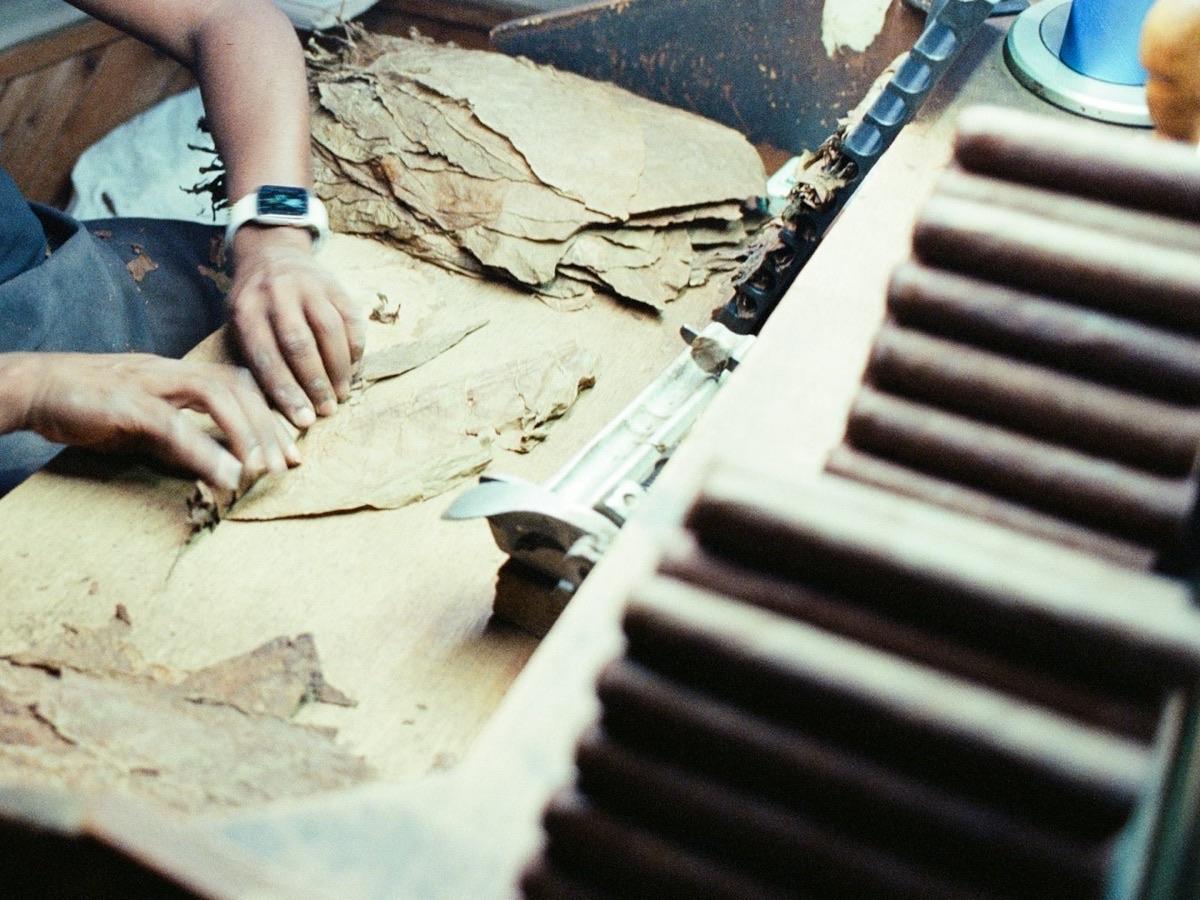
In the factory, the master blender sets how much of each kind of leaf goes into each brand and size, and the blending department issues the day's leaf to every torcedor, binder included. A Habano is made from up to six kinds of leaf: two to four of the filler classes, the binder and the wrapper. The torcedor lays two, sometimes three, half leaves of binder for each cigar and rolls the filler into them by hand. In Cuba, then, the binder is chosen twice, by the sorting house and by the master blender, but always from Cuban leaf grown alongside the filler.
The New World: the binder as a blending tool
Outside Cuba the binder is a choice. Factories in Nicaragua, the Dominican Republic and Honduras grow and buy leaf from many countries, and the binder is one of the places where a blender can change a cigar without changing how it looks. Mixing origins is an old habit. American factories bound their cigars with Connecticut and Wisconsin leaf for generations, as The Binder explains, and most premium cigars today blend leaf from several farms, regions or countries.
Makers choose a binder for three reasons. The first is the burn. General Cigar says it mostly uses Connecticut Broadleaf and Mexican San Andrés binders because they blend well and help the cigar burn. The second is strength, which binder from Estelí or of Connecticut Broadleaf adds, as Types of Binder and Binder Sorts shows. The third is flavor. José Blanco, a Dominican blender, describes Connecticut Broadleaf binder by its sweetness and San Andrés as "also sweet, but a completely different sweetness." A binder can also make up for what a wrapper lacks: Hendrik Kelner, who blended Davidoff's cigars, has said that a cigar with a neutral wrapper, such as Cameroon, can be given more flavor and aroma through its binder and filler.
Supply plays a part too. Davidoff's tobacco companies in the Dominican Republic grow about half of the binder they use and import the other half. Some makers grow the binder they need: Alec Bradley planted Connecticut Broadleaf seed in Honduras for its Double Broadleaf. And New World makers are freer to change the binder itself, using two binders of different tobaccos in one cigar, as Types of Binder and Binder Sorts describes.
Freedom of choice does not mean every New World cigar mixes origins. Some of the most celebrated are puros, with wrapper, binder and filler from one country: the Padrón 1964 Anniversary Series from Nicaragua, the Fuente Fuente OpusX from the Dominican Republic and the Camacho Corojo from Honduras.
Side by side
The table compares how the binder is chosen and used in Cuba and in the main New World producing countries.
| Cuba | Nicaragua, Dominican Republic, Honduras | |
|---|---|---|
| Where the binder grows | Cuba only; for long-filler Habanos, Vuelta Abajo | Any country, often a different one from the wrapper or the filler |
| Which plants | The same sun-grown Criollo-type plants as the filler | Wrapper plants whose leaf fails on looks, or plants grown for filler |
| Who chooses it | The sorting house, then the master blender | The blender, choosing among origins |
| Binder in each cigar | Two or three half leaves of one binder | Usually one half leaf; some blends use two different binders |
| Who lays it | The torcedor who makes the whole cigar, by hand | Usually a buncher (bonchero), by hand or with a Lieberman |
| What the label says | Nothing needed: the binder is Cuban | Most makers name the binder's origin |
Both systems want the same thing from a binder: a leaf that holds the bunch, burns evenly and supports the blend. What differs is where the choice is made. In Cuba it is made within one harvest, at the sorting table, and a blender changes a blend mainly through the proportions of the filler classes. Elsewhere it is made across countries, at the blender's table, and the binder is one of the blender's main tools. That is why a New World cigar lists the origin of its binder as a feature, and a Habano has no need to.