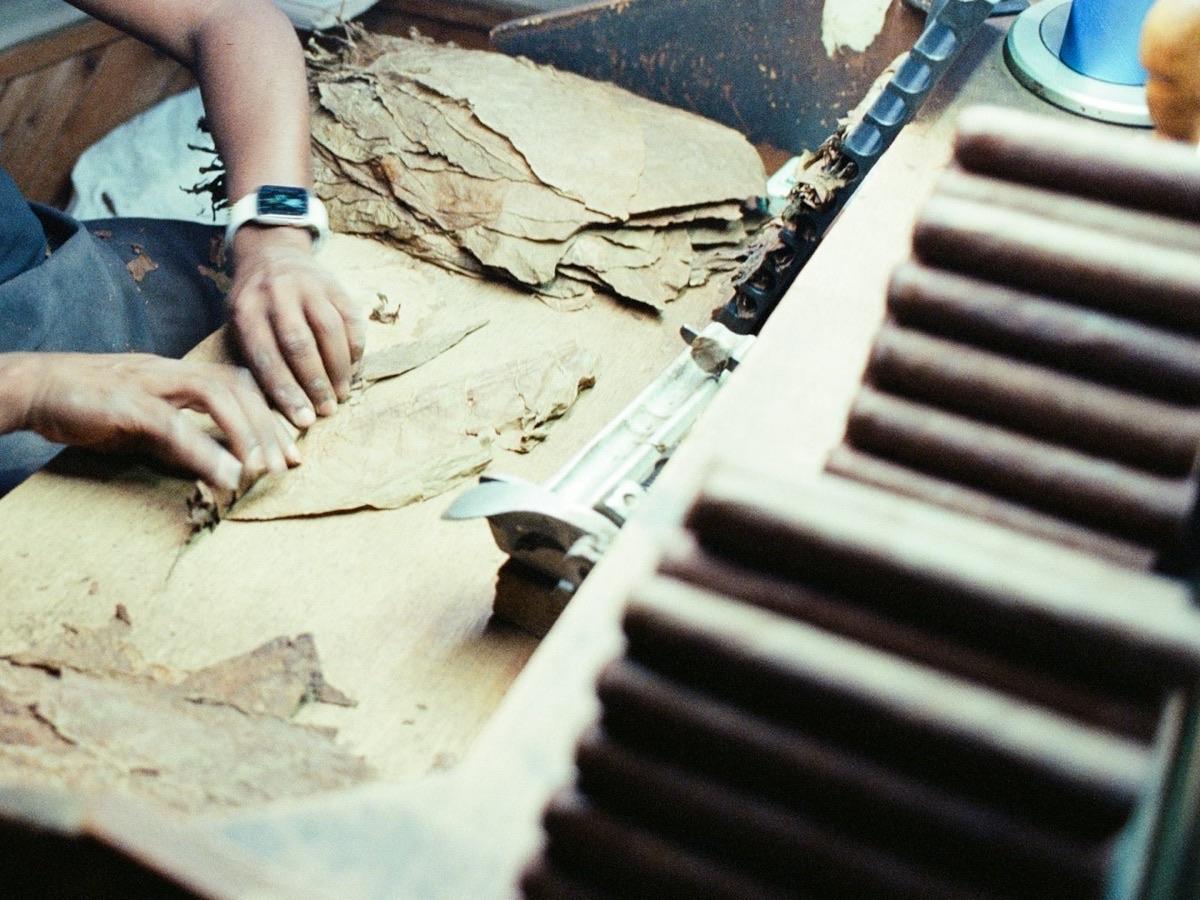
Of the three kinds of leaf in a premium cigar, the binder is the one a smoker never sees. It lies directly under the wrapper and around the filler, and with the filler it forms the bunch (bonche), the cigar as it stands before the wrapper goes on. Its Spanish name is capote, and some makers also call it the banda. The Anatomy of a Cigar, in the Cigar Anatomy topic, introduces the binder alongside the filler and the wrapper. This lesson looks at it more closely: what it does, what makes a good binder leaf, where binders come from, how the binder of a premium cigar differs from that of a machine-made one, and how much it adds to the smoke.
What the binder does
The binder's first job is to hold the filler. A gathered handful of folded filler leaves has no shape of its own. Rolled into the binder, it becomes a firm cylinder of the right length and diameter that can be pressed in a mould, tested for draw and then covered. Habanos describes the binder as the leaf that wraps around the filler, "defining the shape of the Habano". Because the binder holds the bunch together, the wrapper does not have to. It only needs to be stretched over a bunch that already keeps its shape, and the binder gives it a smooth, even surface to lie on.
The binder's second job is to burn well. It touches every other leaf in the cigar, the filler on one side and the wrapper on the other, so it has to burn at a pace that matches theirs. Of the three leaves, the filler has the strongest influence on how evenly a cigar burns, as burn tests by US government scientists showed as early as 1906. The same tests found that the binder has a marked effect on the ash, and a binder that burns well helps the filler to burn evenly. When the leaves burn at different speeds, the burn goes out of line, and Construction Defects, in the Cigar Anatomy topic, explains the canoeing and tunneling that can follow. How freely a cigar draws depends mostly on how firmly the filler is packed inside the binder, which Binder Elasticity and Torcedor Skill explains.
What makes a good binder leaf
A binder leaf needs three qualities. It must be elastic and supple enough to stretch around the bunch without tearing, sturdy enough to hold the filler in place, and combustible enough to burn slowly and evenly. It must also be sound, with no holes. Its looks hardly matter, because the wrapper hides it: color, spots and heavy veins that would ruin a wrapper do no harm underneath one.
That is why so much binder starts out as wrapper leaf. A leaf grown for wrapper that is sound but mottled, uneven in color or too heavily veined cannot go on the outside of a cigar, but it can still do a binder's job. Litto Gomez, of La Flor Dominicana in the Dominican Republic, puts it simply: the binder is "the same exact leaf, but isn't perfect in appearance." Not all binder is wrapper leaf, though. In Cuba the binder comes from the same sun-grown plants as the filler, and at the escogida, the sorting house, the largest and finest volado or seco leaves are classed as binder. Some makers elsewhere also take binder from plants grown for filler.
Before it reaches the rolling table, binder leaf is fermented and aged like the filler, and its central vein is stripped out, which splits each leaf into two half leaves of binder. Each cigar takes one or more of these halves. Types of Binder and Binder Sorts follows the leaf from the field to the bale.
Where binders come from
In Cuba the binder, like everything in a Habano, is Cuban, and for every long-filler Habano it comes from Vuelta Abajo, the same zone as the filler. Makers elsewhere choose binder from many countries. Nicaragua, the Dominican Republic and Honduras all grow binder, and Connecticut Broadleaf, the San Andrés valley of Mexico, Brazil, Indonesia, Ecuador and Cameroon supply it too. Types of Binder and Binder Sorts covers these origins with cigars that use them, and Cuban Binder Philosophy & New World Binder Strategy compares the Cuban and New World ways of choosing a binder.
Binder was once a crop of its own. The US government's official tobacco grades still have a class of cigar-binder types: Connecticut Valley Broadleaf, the Havana Seed tobacco of Connecticut and Massachusetts, the Havana Seed of New York and Pennsylvania, and the binder types of southern and northern Wisconsin. Before 1955, about two thirds of the binder in American cigars came from the Connecticut Valley and nearly a quarter from Wisconsin.
Whole leaf and sheet binder
Premium cigars use a binder of whole leaf. Most mass-market machine-made cigars do not. From 1955, American factories began to bind their cigars with homogenized, or processed, tobacco: leaf ground and re-formed into a sheet whose thickness and elasticity are set in the factory. General Cigar developed the first such sheet. Within two years about a fifth of all American cigars used it, and it eventually replaced natural binder on about 90 percent of the cigars made in the United States. Connecticut's growers of binder tobacco cut their acreage by half in 1956, and between 1950 and 1971 Connecticut's binder acreage fell by about 95 percent. By 2006 northern Wisconsin's binder tobacco was no longer grown at all, and Connecticut Broadleaf is grown today mainly for the wrapper and binder of premium cigars.
The difference is now part of how a premium cigar is defined. In the United States, the definition of a premium cigar that a federal court applied in 2023, when it set aside FDA regulation of premium cigars, requires a wrapper of whole tobacco leaf and a binder of 100 percent leaf tobacco, along with filler that is at least half long filler by weight, rolling by hand and nothing but tobacco, water and vegetable gum.
How much the binder adds to the taste
Makers disagree about how much the binder contributes to flavor. Hendrik Kelner, who blended Davidoff's cigars in the Dominican Republic, said in 1993 that within normal limits the binder contributes no less than 20 percent of a cigar's taste, while warning against taking the figure too literally. Ernest Gocaj, who buys tobacco for General Cigar, has said that because the binder never touches the palate, it gives little flavor of its own, though some binders add strength.
Both agree that the binder affects the smoke. A cigar with a neutral wrapper, Kelner said, can be given more flavor and aroma through its binder and filler, and blenders choose binder from Estelí, in Nicaragua, or of Connecticut Broadleaf to make a blend stronger. The binder's share also depends on the size of the cigar. Like the wrapper, it is a skin around the filler, so it makes up a larger share of a slim cigar than of a thick one, and a slim cigar gives more of its flavor to its wrapper and binder. Consistency & Variation, in the Shapes & Sizes topic, explains the geometry.
What a smoker can see of the binder
The binder stays hidden, but it shows itself in a few ways. The firmness of the ash and the evenness of the burn reflect it. When a wrapper cracks or lifts, the binder underneath is what keeps the filler together, which is why such a cigar can often still be smoked gently. And makers outside Cuba usually publish the origin of the binder along with the wrapper and the filler, so a smoker who knows the character of each origin can read a good deal from the blend before lighting it.