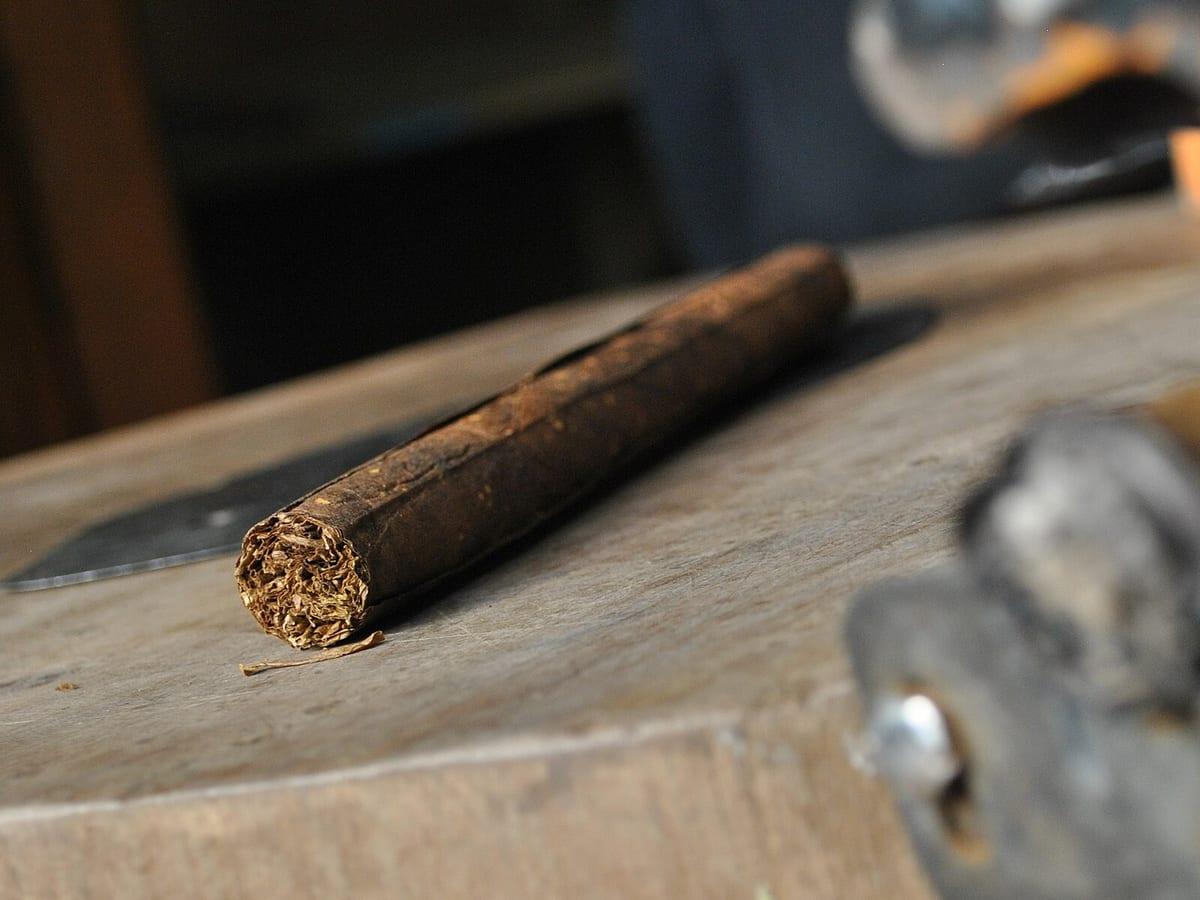
The cap is the last thing a roller makes and the first thing a smoker cuts. Small as it is, it does three jobs. It locks the wrapper, whose last turn would otherwise come loose; it gives the head enough strength to take a clean cut and an hour or more between the lips; and, once cut, it frames the opening the smoke passes through. Experienced smokers look at it first, because a cap shows a roller's skill more plainly than any other part of the cigar.
The names need a little care. In Cuba, the head of the cigar is the perilla and the cap that closes it is the gorro. The strip of wrapper wound over the head before the cap goes on is the pañuelo, literally the handkerchief, called the flag in English. Many smokers outside Cuba use perilla for the cap itself, and the title of this lesson uses the word in that sense.
How the cap is made
Before the wrapper goes on, the head of the bunch is cut square with a guillotine. The roller then rolls the wrapper from the foot toward the head and, when the leaf reaches the head, trims its end into a narrow strip, the flag, and winds it over the open end to close it. To finish, the roller cuts a small disc from the leftover wrapper with the casquillo, a small cylindrical cutter whose name means cartridge, and fixes it over the head with goma, a tasteless, odorless vegetable gum, usually tragacanth. Because the flag and cap come from the same leaf as the rest of the wrapper, their color and texture match.
A good cap is tight, symmetrical and flush with the wrapper, with seams that are barely visible and no gum showing. Too much gum makes the head stiff and leaves a hard ring that fights the cutter; too little lets the cap lift. Above all, the head has to be strong enough to hold up in the mouth and to take the cut without unraveling.
Styles of head
Rollers close a head in four main ways, and the differences are easy to see once you know where to look. The table compares them.
| Style | How it is made | Where you see it |
|---|---|---|
| Flag and cap | A flag of wrapper closes the head, and a small round cap is glued on top | Most premium cigars today |
| Triple cap | A teardrop-shaped piece is woven into the flag and a round cap laid on top, leaving three seams | The traditional Cuban finish |
| Flag head | The trimmed end of the wrapper alone closes the head, with no cap | Cigars made to show the roller's skill |
| Pigtail | The flag is rolled into a tight scroll and tied into a curl or knot on top, with no cap | The Cuban brand Trinidad, and some cigars from smaller makers elsewhere |
The flag and cap is the usual finish: the flag holds the wrapper, and the cap reinforces the head and gives it a clean look. The triple cap adds one more piece for strength and neatness, and its three seams, visible as lines around the head, are a mark of Cuban rolling. A flag head is harder to make than it looks, because there is no cap to hide a mistake. The pigtail is more decoration than function and is snipped off before the cut; Trinidad has finished its cigars this way since the brand went on general sale in the late 1990s.
Cigars with a pointed head, such as torpedoes, pyramids and belicosos, need a finish of their own, worked by hand to a point. A well-made point is firm and even, and closed right to the tip. The shapes themselves are covered in Shapes & Sizes.
Cutting the cap
The aim of the cut is an opening wide enough for an easy draw that still leaves enough of the cap to hold the wrapper. On a round head, Habanos advises cutting just above the line where the cap meets the wrapper, which in practice usually means a couple of millimeters from the end. Cut below that line and the cap comes off entirely, and the wrapper can start to unravel. On a pointed head, Habanos suggests cutting about 3 mm from the point. Whatever the shape, it is wiser to cut too little than too much, because a second, slightly deeper cut is always possible and a lost cap is not. A pigtail or a flag head is cut the same way, once the twist has been snipped off.
The tool matters less than its edge. Habanos names the single- or double-bladed guillotine as the most popular cutter, along with cigar scissors and the punch, which bores a round hole in the cap and cannot cut a pointed head. It advises against V-cutters, which can tear the cap, and against piercing the head with a match or a cocktail stick. A dull blade of any kind crushes the head and tears the cap instead of slicing through it, so a quick cut with a sharp blade matters more than the choice of cutter. The Cutters & Lighters lessons Guillotine, Punch, V-Cut and How to Cut and Light Without Charring compare the tools and techniques in detail.
What the cap tells you
Before the cut, the cap says a good deal about how a cigar was made and kept. A symmetrical cap with smooth, tight seams and no visible gum shows a careful roller; a lopsided head, a smear of gum or a cap that stands proud of the wrapper shows haste. Storage leaves its marks here too. A cap that is brittle or cracks when cut points to a cigar that has dried out, and one that feels soft and spongy to a cigar kept too humid. A cap that lifts, splits or starts to unravel after cutting tends to get worse as the cigar warms, so such a cigar is best smoked gently; Construction Defects explains the causes and when to give up on it.