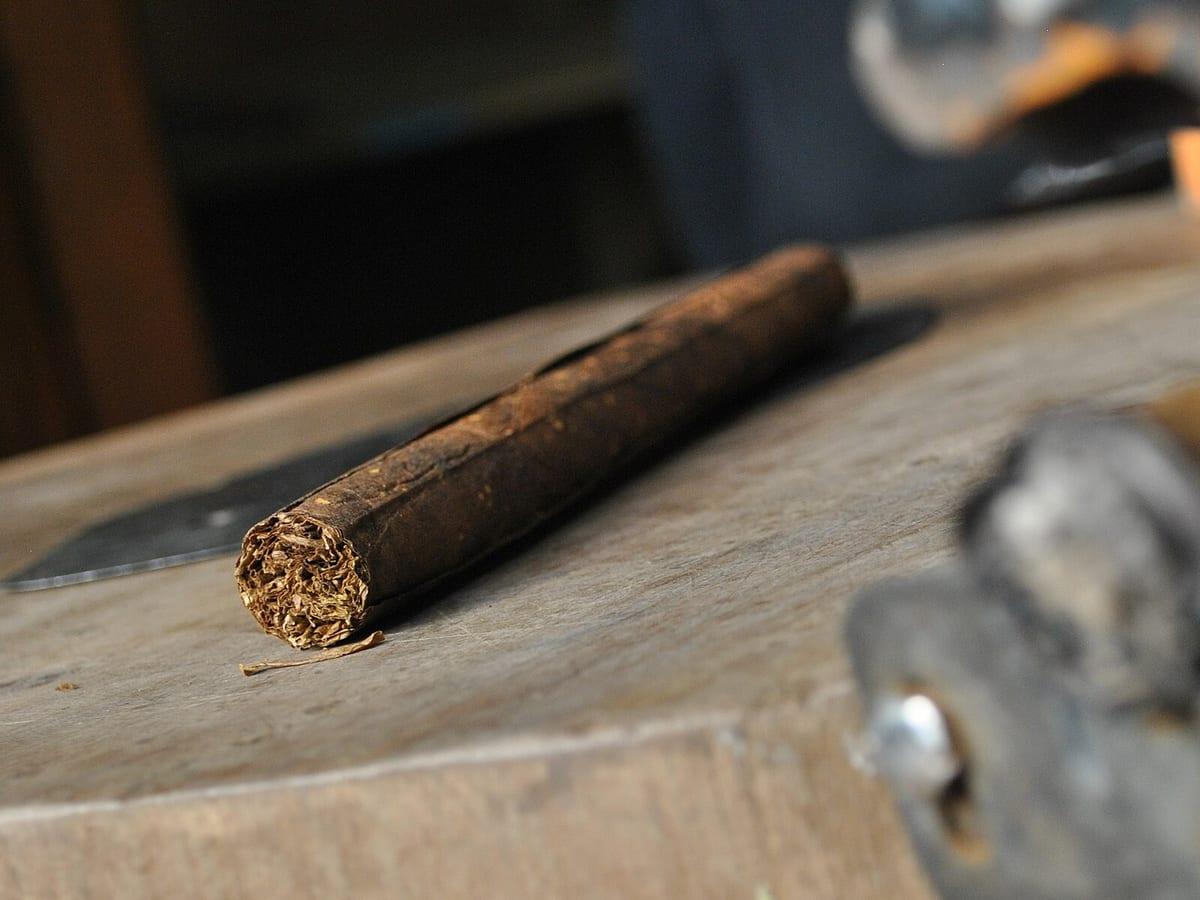
The foot is the end of a cigar that you light, and the only place where the filler can be seen. Before the first puff it tells you how the cigar was bunched and how it has been stored; at lighting it decides how evenly the cigar will burn. In Spanish it is the pie, and in Cuba it is also the boquilla.
How the foot is made
The foot is where the making of a cigar begins. The torcedor places every filler leaf with its lighter-flavored tip toward the foot, so the first part to burn is the mildest, and starts rolling the wrapper from there. Once the head has been capped, the cigar goes into a guillotine with a stop set to its exact length, and one stroke cuts the foot to a clean, flat face where filler, binder and wrapper end together.
Styles of foot
Most cigars have a straight-cut foot: a clean, flat face that shows the filler and is the easiest to toast and light evenly. Torpedoes, pyramids and belicosos taper at the head, not the foot, so they light like any straight-cut cigar.
A perfecto tapers at both ends, and its foot narrows to a small tip, often closed with wrapper. Because so little tobacco burns at first, the first puffs are concentrated, and the full blend arrives only as the cigar widens. Closing a perfecto's foot is careful hand work. At La Aurora in the Dominican Republic, for example, the roller leaves the foot unfinished at first, then cuts a small teardrop-shaped piece from the wrapper and weaves it into the leaf to close the tip. The Arturo Fuente Hemingway cigars, made in the Dominican Republic since 1983, are a well-known example of the shape.
A shaggy foot is left untrimmed, so the ends of the leaves stick out loosely beyond the cut. Makers use the name for two slightly different finishes: on some cigars the wrapper runs on past the filler and binder, and on others the filler pokes out beyond the wrapper. Either way, the first puffs give a taste of the loose leaf on its own. Smokers either light the loose leaf and let it burn down to the body of the cigar, or pull it off and toast the foot as usual. A closed, or covered, foot folds the wrapper over the end, fully or in part, so the first puffs come through the wrapper alone and the foot needs a longer toast. Both styles are found mostly on cigars from outside Cuba, such as the JFR Lunatic Shaggy Foot from Casa Fernández in Nicaragua.
Reading the foot before you light
Because the filler is exposed at the foot, this is the best place to judge how a cigar was bunched. The leaves should look evenly packed across the whole face, with no gaps or dense knots. Gaps mean loose spots that will burn hot and fast, and a dense knot can mean a plug that blocks the draw. In many cigars the layout of the blend is visible too, with darker leaf toward the center, the ligero, and lighter leaf around it.
The foot also shows how a cigar has been kept. A foot that crumbles or cracks when touched points to a dry cigar, and one that feels damp or spongy to a cigar kept too humid; fuzzy spots are mold. And the foot is the one place where you can smell the filler directly. It should smell of clean tobacco, never musty.
Toasting and lighting
Lighting a cigar well means heating the whole foot evenly before drawing on it, so that the entire face catches at once. Habanos recommends these steps:
- Use an odorless flame: a butane lighter, a wooden match once its head has burned off, or a spill, a thin strip of cedar. Petrol lighters, wax matches and candles leave their smell in the tobacco.
- Hold the foot at a right angle to the flame, just above its tip, and rotate the cigar until the whole face is evenly charred.
- Put the cigar to your lips and draw gently, with the flame about a centimeter from the foot, still rotating, until the foot catches.
- Blow gently on the foot to check the light. The whole face should glow evenly; touch up any dark spot before settling in.
Patience at this stage pays off for the whole cigar. Pushing the foot into the flame or puffing hard to speed things up scorches the leaf, gives a bitter start and often an uneven burn, a common cause of canoeing. The Cutters & Lighters lessons Matches vs Torch vs Soft Flame and How to Cut and Light Without Charring compare flames and techniques, and Relighting Etiquette, in the Cigar Etiquette topic, covers a cigar that has gone out.