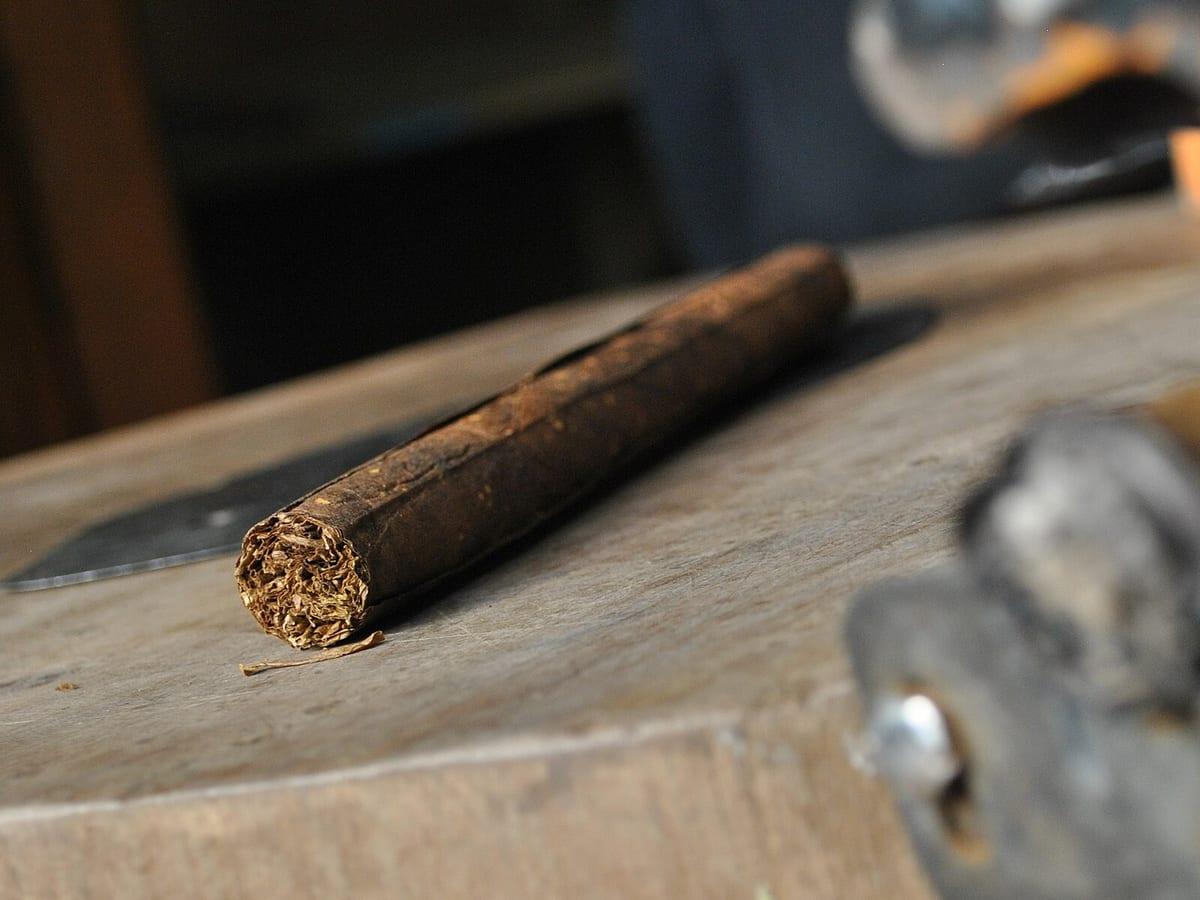
Every premium cigar is made the same way: a core of filler leaves, held in shape by a binder leaf and covered by a wrapper leaf. The idea is simple, but how those three leaves are grown, chosen and put together decides how a cigar looks, how freely it draws, how evenly it burns and how it tastes. Much of the vocabulary is Spanish, because the craft took shape in Cuba and travelled with Cuban growers and rollers to Nicaragua, the Dominican Republic and Honduras, where most of the world's premium cigars are now made. This lesson names the parts of a cigar, follows each of the three leaves from the field to the rolling table, and shows how cigars are put together in Cuba and in the other producing countries.
The parts you can see
From the end you smoke to the end you light, a cigar has a head, a body and a foot. The head is the closed end that you cut and draw through. Its Spanish name is cabeza, but in Cuba it is the perilla. The head is sealed by the cap, a small piece of wrapper leaf that locks the wrapper in place so the cigar cannot unravel. Cuban rollers call the cap the gorro, while many smokers elsewhere call the cap itself the perilla, so the same word can name the whole head in Cuba and only its cap in other countries. Just below the head, the shoulder is the curve where the head meets the body.
The body (cuerpo) is the long stretch between head and foot, and it is where most of the smoking happens. In tasting, body has a second meaning, how full and rich the smoke feels, which the Strength vs. Body topic explains. The foot (pie; in Cuba, boquilla) is the open end you light, and the only place where the filler shows. Near the head, most cigars carry a band (anilla), a printed paper ring that names the brand.
A cigar's length, its diameter and its shape together make up its vitola. The diameter is given as the ring gauge, in 64ths of an inch, so a 50 ring is 50/64 inch, about 19.8 mm, across. The Shapes & Sizes topic, starting with What Is a Vitola, covers formats and measurements. The cap and the foot each have a lesson of their own in this topic, and the band is covered at the end of this one.
Three leaves, three jobs
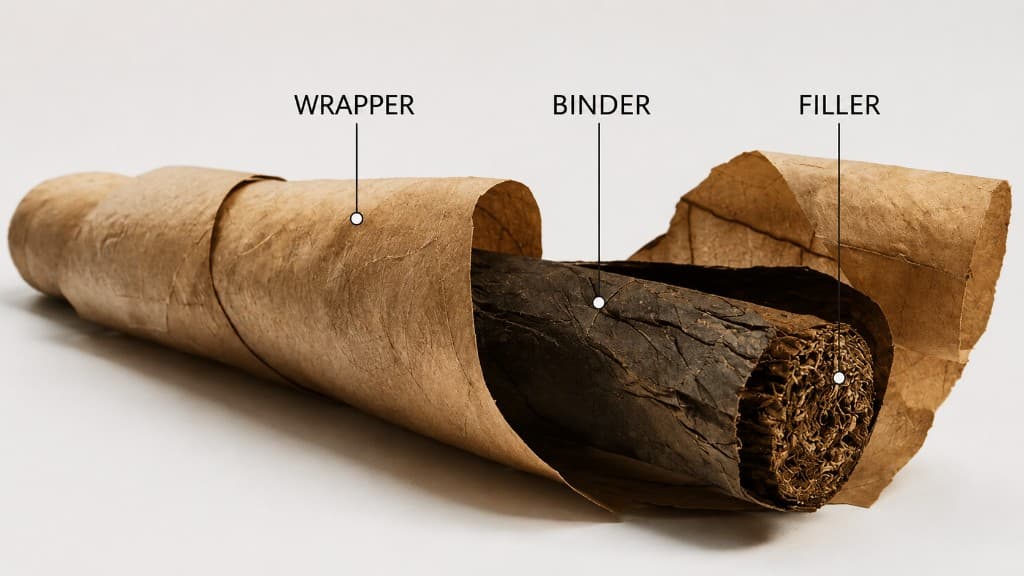
Cut a cigar along its length and three layers appear. At the center is the filler, a bundle of folded leaves that runs the full length of the cigar. Around it is the binder, which holds the filler in its final shape; the two together, before the wrapper goes on, are called the bunch (bonche). Outside is the wrapper, a single thin leaf rolled around the bunch in a spiral. Each layer is chosen for a different job, and each can come from a different farm, region or country.
The wrapper (capa)
The wrapper is the outermost leaf and the only one you see. It gives the cigar its color, sheen and texture, it is the first leaf to touch the lips, and it burns all along the outside of the cigar, so its oils and sugars color every puff, even though most of the strength and body come from the filler. Wrapper's Influence on Body, in the Strength vs. Body topic, explains how much a wrapper can change a blend. A wrapper has to be thin enough to burn evenly with the leaves inside it, elastic enough to be stretched around the bunch without tearing, and smooth enough to look good doing it. That combination is hard to grow, which is why wrapper is the costliest tobacco in a premium cigar.
Much of the world's wrapper is grown in shade, which softens the sun and keeps the leaf thin, smooth and elastic, with fine veins. In Cuba, wrapper grows under muslin cloth, a method called tapado, mainly in the Vuelta Abajo and Partido regions, while Cuban filler and binder grow in full sun. In the Connecticut River Valley, farmers first raised cloth tents over tobacco in 1900, to grow the pale, silky leaf now known as Connecticut Shade. Ecuador grows wrapper from Connecticut, Sumatra and Habano seed under a natural cloud cover that filters the sun much as cloth does, and has become one of the industry's main sources of wrapper.
Other wrapper is grown in full sun, which makes a thicker, oilier leaf with bolder flavor: sun-grown Habano and Corojo-type leaf from Nicaragua and Honduras, Connecticut Broadleaf, the dark leaf of Mexico's San Andrés valley, and Brazil's Mata Fina and Arapiraca. Thick sun-grown leaf is the usual choice for dark maduro wrappers, because it stands up to the longer fermentation they need. Cameroon, in Central Africa, grows a thin leaf with a fine, bumpy texture called tooth. The Dominican Republic grows little wrapper of its own. Good wrapper was long thought impossible there, until the Fuente family harvested the first shade-grown Dominican wrapper at Chateau de la Fuente in 1992, for its Fuente Fuente OpusX. The Wrappers topic covers each origin in depth.
Only the best leaves become wrapper. Factories grade them by color, size and texture, and leaves that are sound but too veined or uneven in color are often used as binder instead. In Cuba, wrapper leaves are graded into some 50 categories at the escogida, the sorting house. Each wrapper leaf is then split along its central vein into two halves, and each half wraps a separate cigar, so one leaf usually wraps only two cigars. Once the cigars are rolled, Cuban factories add a final check. The escogedores, color graders who work in pairs, sort the finished cigars into 60 or more shades: the first sorts a batch by color and shade, and the second arranges each box so that any slight differences in tone run from dark to light, left to right. Habanos stresses that the color of its wrappers is entirely natural; upper leaves are darker to begin with and darken further in fermentation.
A good wrapper shows itself to the eye and the fingers. Its color is even along the whole cigar, with a natural sheen from the leaf's oils, and its veins are fine and lie flat. The seams, where one turn of the leaf overlaps the next, are tight and even, with no lifting edges, and the leaf is supple, never cracked or papery. Small white spots or green patches are natural marks of the leaf and do not affect the smoke. Color and veins come from the field and the sorting table, while tight seams and an intact leaf come from the roller, so together they show how much care went into the cigar.
The binder (capote)
The binder is the leaf directly under the wrapper. Its first job is structural: it holds the filler in its final shape and keeps the bunch firm while the wrapper is rolled on. Its second is to burn in step with the leaves around it, because a binder that burns too slowly or too fast pulls the whole cigar out of line and can cause canoeing or tunneling, the burn faults described in Construction Defects. Binder is therefore chosen for strength, elasticity and the way it burns rather than for looks.
In Cuba, binder comes from the largest and finest volado or seco leaves of the sun-grown plant. A Cuban torcedor uses two, sometimes three, half leaves of it for each cigar, laid with their veined undersides facing in.
Outside Cuba, the binder often comes from a different country than the wrapper or the filler, chosen for how it burns and how it blends. Nicaraguan, Dominican, Honduran and Ecuadorian leaf are all common binders, and so are thicker leaves such as Connecticut Broadleaf, Mexican San Andrés, Brazilian Mata Fina and Indonesian Sumatra and Java. The Liga Privada No. 9, made in Estelí, Nicaragua, is a typical international blend: a Connecticut Broadleaf wrapper over a Brazilian Mata Fina binder, with Nicaraguan and Honduran filler. A few blends use two binder leaves of different origins, called a double binder, for extra structure and another layer of flavor; the Alec Bradley Double Broadleaf, made in Honduras, pairs a Honduran and a Nicaraguan binder. Two binders make an even burn harder to achieve, which is one reason the practice is uncommon.
The binder's flavor is quieter than the wrapper's or the filler's, but it is not neutral. Changing the binder alone can shift how a blend tastes, especially in slim cigars, where wrapper and binder make up a larger share of the tobacco. The Binder topic covers the leaf and its varieties in depth.
The filler (tripa)
The filler is the core of the cigar and the source of most of its strength, body and complexity. Its leaves are sorted by where they grew on the stalk, because the higher a leaf grows, the more sun it receives and the thicker, oilier, stronger and slower-burning it becomes. A blender, the ligador, shapes a cigar's character largely by choosing how much of each class to use. The table runs from the bottom of the plant to the top.
| Leaf | Where it grows | What it brings to the blend |
|---|---|---|
| Volado | The lowest leaves | Light flavor and an easy burn; it keeps the cigar alight |
| Seco | The middle of the plant | Medium flavor and most of the aroma |
| Viso | Between seco and ligero | More depth than seco, less power than ligero |
| Ligero | The upper leaves | Dark, oily and slow to burn; most of the strength and much of the body |
| Medio tiempo | The top two leaves, on some plants only | The fullest flavor; rare and used sparingly |
Read from top to bottom, the table runs from the mildest leaf to the strongest. The names differ a little from country to country. In Cuba the classes are called tiempos, or fortalezas, and numbered by strength, from fortaleza 1 for volado to fortaleza 4 for medio tiempo, and a Habano blends two, three or four of them. Viso is a name used mainly in the Dominican Republic, Nicaragua and Honduras. Some growers call the topmost leaves the corona, the crown of the plant, and medio tiempo grows on so few plants that some makers treat the name as little more than a label for the thickest ligero. Strength: Nicotine and Ligero, in the Strength vs. Body topic, follows the same leaves through the blend, and Filler Leaf Positions (Primings), in the Fillers topic, covers them in depth.
Seed and soil matter as much as position on the plant. Cuban cigars use only Cuban leaf, from Criollo-type plants for filler and binder and Corojo-type plants for wrapper, most of it grown in the province of Pinar del Río. In the Dominican Republic, the main filler varieties are Piloto Cubano, a Cuban-seed tobacco known for strength, and Olor Dominicano, a native variety known for mildness and aroma. Nicaragua and Honduras grow mostly Cuban-seed hybrids such as Criollo '98 and Corojo '99, and in Nicaragua the region changes the leaf as much as the seed does: leaf from Estelí is prized for its strength, leaf from Condega is more medium-bodied, and leaf from Jalapa is subtle enough to be grown for wrapper.
Most premium cigars blend leaf from several farms, regions or countries. A cigar whose wrapper, binder and filler all come from one country is called a puro, like the Nicaraguan Padrón 1964 Anniversary Series or the Dominican Fuente Fuente OpusX, and every Habano is a puro by definition.
Long, short and mixed filler
In premium cigars the filler is long filler (tripa larga): whole leaves running the full length of the cigar. Because every leaf runs from foot to head, the cigar burns evenly, draws smoothly and holds the same blend from the first puff to the last. Short filler (tripa corta), sometimes called picadura, is chopped leaf and trimmings. It burns faster and hotter, with a simpler flavor, and is used mostly in machine-made cigars. Cuba also makes a few short-filler cigars entirely by hand, from the trimmings of long-filler bunches mixed with other chopped leaf. Machine-made Cuban cigars, produced since the 1950s, are not Habanos at all. Mixed filler, sometimes called a Cuban sandwich, wraps chopped tobacco inside a few long-filler leaves and is found in less expensive hand-rolled cigars.
How a cigar is put together
Every premium factory follows the same basic sequence. The filler is gathered and rolled into the binder to make a bunch, the bunch is pressed in a mould to set its shape, the wrapper is rolled on, the head is closed with a cap, and the cigar is cut to its exact length. Where countries differ is in who does each step and with what help.
In Cuba, one roller, the torcedor, makes each cigar from start to finish, and most torcedores today are women, torcedoras. Habanos describes the work in this order:
- The torcedora lays out the binder, two or three half leaves, on her wooden board.
- She gathers the filler, folding and aligning each leaf so the smoke will have a straight path. The strongest, slowest-burning leaves, ligero and medio tiempo, always go in the center, and every leaf is placed with its lighter-flavored tip toward the foot.
- She rolls the filler into the binder to the exact diameter the size requires, keeping the compression even along its length, and cuts the head of the bunch square with a guillotine.
- The bunches are pressed in a wooden mould for 30 minutes or more to set their shape, and are then tested for draw on a suction machine.
- She lays a moist half leaf of wrapper on the board with its veined side up, so the smooth face will end up outside, trims it with the chaveta, the roller's crescent-shaped blade, and rolls it on under even tension.
- She closes the head with a strip cut from the spare wrapper, the flag (pañuelo), and a small disc of wrapper cut with a casquillo, fixed with goma, a tasteless vegetable gum.
- Finally, she cuts the cigar to its exact length with the guillotine.
A skilled torcedor makes between 60 and 150 cigars a day, depending on the size and difficulty of the shape. Cuban rollers are ranked in four grades, and only the top grade may make the largest and most complicated sizes.
Many factories in Nicaragua, the Dominican Republic and Honduras divide the same work between two people. The buncher, or bonchero, gathers the filler and rolls it into the binder; once the bunches are pressed, the roller, or rolero, puts on the wrapper, closes the head and cuts the cigar to length. Bunchers fold the filler leaves by one of three methods, book, accordion or entubado, which Three Ways of Preparing La Tripa, in the Fillers topic, compares. Many Dominican factories bunch with a Lieberman, also called a Temsco, a hand-cranked device with a leather or canvas apron that rolls the filler into the binder. It is used almost everywhere in the Dominican Republic, less in Central America and not at all in Cuba. Moulds and presses set the shape everywhere, and the most careful factories test the draw of their bunches by machine, as Cuba does.
The table sets the two ways of working side by side.
| Cuba | Nicaragua, Dominican Republic, Honduras | |
|---|---|---|
| Who makes the cigar | One torcedor does every step | Usually a buncher (bonchero) and a roller (rolero) |
| Bunching | By hand | By hand, or with a Lieberman, above all in the Dominican Republic |
| Draw testing | A suction machine in every factory, since 2001 | A draw machine in many of the best factories |
| What the box says | Totalmente a mano: every step by hand | "Handmade" or hecho a mano, with no agreed definition |
The difference shows most on the box. Totalmente a mano, "totally by hand", is a phrase created in Havana to set Cuban practice apart from the semi-mechanized methods used elsewhere. Outside Cuba, "handmade" has no agreed definition, and much of the trade counts a cigar bunched with a Lieberman as handmade, because its wrapper and cap are still put on by hand.
Two details of the craft hold everywhere. The two halves of a wrapper leaf are rolled in opposite directions, the right half from right to left and the left half from left to right. And only the most skilled rollers make figurados, the tapered shapes, which is one reason they cost more than parejos, the straight-sided cigars. The Cigar Construction topic follows each step in more detail, from Bunching the Filler to Pressing and Finishing.
Why the ligero sits in the middle
The order of the leaves inside the bunch is deliberate. The ligero is the thickest leaf and burns slowest, so it needs the heat of the leaves around it to keep burning, while the easier-burning leaves around it keep the whole cigar alight. Put the ligero at the edge and the cigar burns unevenly; pack too much of it together and it struggles to stay lit. Placing every leaf with its lighter-flavored tip toward the foot means the first puffs are gentler and the flavor builds as the cigar burns down. Because the leaves run the full length of the cigar, the blend is the same from foot to head; why a cigar still grows stronger as it burns is explained in How Strength Builds During the Smoke.
The band (anilla)
The band is the one part of a cigar that is not tobacco: a printed paper ring that names the brand and often the line. It is glued only to itself, with a dab of gum where its ends overlap, not to the wrapper. In Cuba the band is the anilla. In Spain the word for it is vitola, and collecting bands is called vitolphilia.
Bands began as protection against counterfeits. In the 19th century, German factories sold their own cigars under famous Cuban names, and in the 1830s Gustave Bock, a European-born cigar maker in Havana, began putting a paper ring with his signature on every cigar he exported. By 1855 almost every major Cuban exporter was banding its cigars and registering its bands with the government. The popular story that Catherine the Great invented the band to keep her fingers clean has no evidence behind it, and historians call it a fairy tale. Bands soon became decoration as well as protection, and around 1900 collecting them became a craze, encouraged by companies that offered gifts in exchange for bands.
Many cigars now carry a second band. Habanos adds one to its special releases: an extra band on every Edición Limitada, a black and silver band on Reserva cigars and a black and gold one on Gran Reserva. Makers elsewhere use a second band, often near the foot, to name a line, a size or an anniversary.
Whether to remove the band is a matter of taste. Habanos advises leaving it on, so as not to damage the wrapper. Smokers who prefer to take it off wait until the cigar has burned for a few minutes, when the heat has loosened the gum and the band slides away without tearing the leaf. A band alone never proves that a cigar is genuine, because bands are among the easiest things to copy; the box and its seals matter more, as Certification and Security, in the Cigar Boxes topic, explains.
Judging a cigar before you light it
Most of what this lesson describes can be checked before the first puff. Look along the wrapper for an even color, fine veins and tight seams. Press the cigar gently between thumb and finger along its whole length: a well-made cigar feels firm but springy, with no soft or hard spots. Smell the foot, where the filler is exposed, for clean tobacco with nothing musty about it. After cutting, take a cold draw, a gentle puff before lighting; the air should pass with light, even resistance. Construction Defects explains what each problem means and what to do about it.