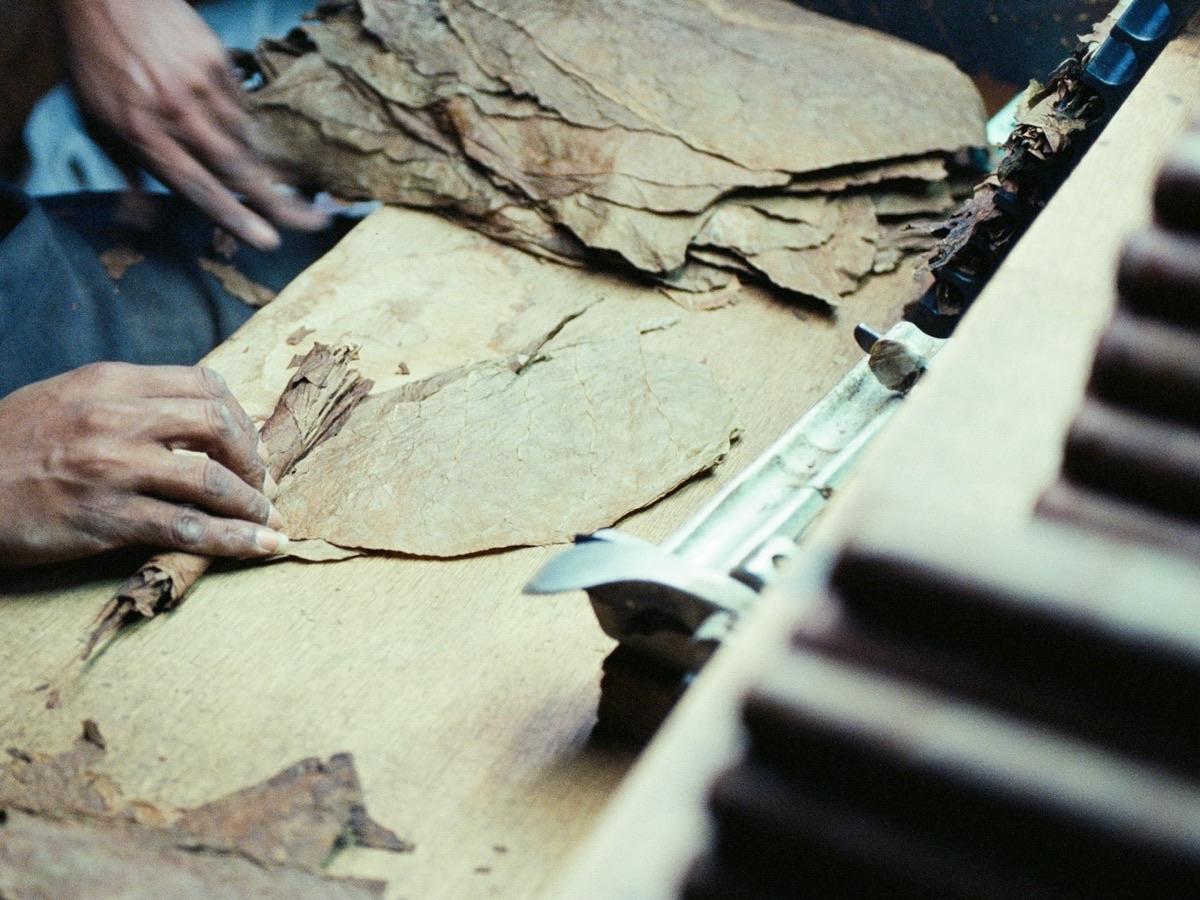
The wrapper is on and the cigar looks finished, but it is not. It has picked up moisture from the leaves and from the roller's hands, its shape has only just been set, and no one has yet checked whether air will pass through it. This lesson follows the cigar from the rolling table to the box: the mould and the press, the draw test, the checks of size and weight, the rest in the conditioning room, and the final grading, banding and boxing. It ends the topic, so it also gathers up where the earlier lessons and the related topics meet.
The mould and the press
The bunch and wrapper take their final shape in a mould, the molde: a block of wood or plastic with slots cut to one format, and usually a press, the prensa, to hold the cigars in under pressure. Factories typically press bunches for 30 to 45 minutes, giving the mould a quarter turn at intervals, and in Cuba the bunches sit in a wooden mould for at least 30 minutes. The pressure settles the filler and smooths the wrapper onto the binder, and it is here that a binder's strength is tested, since it has to hold the filler under pressure without splitting; a worn wooden mould can tear the binder when the bunches are turned or taken out. The mould is why a cigar keeps its shape and its exact diameter.
Pressing can also be used for a look of its own. A box-pressed cigar, prensado in Spanish, is a round parejo pressed into a squarish section with flat sides, and the modern fashion for it began in Nicaragua when Padrón launched its 1964 Anniversary Series in 1994, with every size squared off as a tribute to the old Cuban habit of packing cigars tightly in a box, an idea of the company's founder, José Orlando Padrón. Geometry & Smoke Dynamics, in the Shapes & Sizes topic, explains box-pressing and trunk-pressing in full.
The draw test
Out of the press, and before any wrapper would be spent on a bad bunch, the most careful factories test the draw. A draw machine draws air through the pressed bunch by suction to measure how freely it passes, and it catches a cigar that would be plugged or too loose before the wrapper goes on. Every Cuban factory has used one since the end of 2001, sampling each day's work, and use of such machines was rare outside Cuba around 1990 but is now common in the best factories. The payoff is large: at Tabacalera de García in La Romana, in the Dominican Republic, which makes cigars such as the non-Cuban Montecristo, the share of cigars rejected as plugged fell from about 35 percent in the late 1980s, before the factory had a draw machine, to 2 or 3 percent after it. Perdomo, in Estelí, Nicaragua, says it draw-tests every cigar.
Checking size, weight and color
Finished cigars are checked against their format with a cepo, a wooden gauge with a hole for the ring gauge and a notch for the length; the Spanish word cepo also means a cigar's diameter. Cigars are weighed too, because one that is heavier than it should be usually holds too much filler and draws tight. In Cuba, quality-control technicians check weight, length, girth, construction and appearance, with close attention to the wrapper and the cap, and samples of each roller's work are regularly taken apart to see how they were built and that the blend is right. The look that matters most is the color. The escogedores sort the finished cigars into 60 or more shades so that every box matches, and arrange each box dark to light, left to right. Until the 1970s some Cuban factories marked a box's color, CCC for claro, CC for colorado claro and C for colorado.
Resting in the escaparate
A fresh cigar is too damp to smoke, because the leaves were moistened so they could be rolled, so the factory rests the finished cigars before they are boxed. In Cuba they go to the escaparate, a conditioning room kept at 16 to 18 degrees Celsius and 65 to 70 percent relative humidity, where they lie in cedar-lined drawers and shed the moisture gained in rolling. Habanos says a Habano is smokeable after a week there and better the longer it stays. Factories elsewhere rest their cigars as well, often longer, so the leaves within each settle together. This rest is the factory's version of the ageing a smoker's humidor later provides, and Why Humidity Matters, in the Storage & Humidity topic, explains the conditions.
Banding, wrapping and boxing
Only now is the cigar dressed. The band, the anilla in Cuba, is a printed paper ring glued to itself rather than to the wrapper, and it names the brand and usually the line; the second bands of special releases mark the aged leaf. Outside Cuba most premium cigars are individually wrapped in cellophane, a clear sleeve often called cello, which protects the wrapper when cigars are handled in a shop, and smokers disagree about whether to leave it on in a humidor. Cuban Habanos are the exception: they are packed in cedar boxes without cellophane, in labeled dress boxes for the box-pressed formats and cabinets or other boxes for round cigars. The Cigar Boxes topic covers the boxes and seals in detail.
Not every cigar makes it this far. Cuban rollers are paid by the piece, so cigars that fail a check are rejected and deducted from the roller's daily quota, while each factory's tasters, the catadores, taste every day and score cigars for draw, burn, aroma, flavor, strength and quality. Outside Cuba, overweight or misshapen cigars are rejected the same way, and factories such as La Aurora, in the Dominican Republic, run tasting panels that can pull a cigar from inventory if it falls short. Construction Defects, in the Cigar Anatomy topic, takes up the faults that still slip through, and how to spot them before lighting.