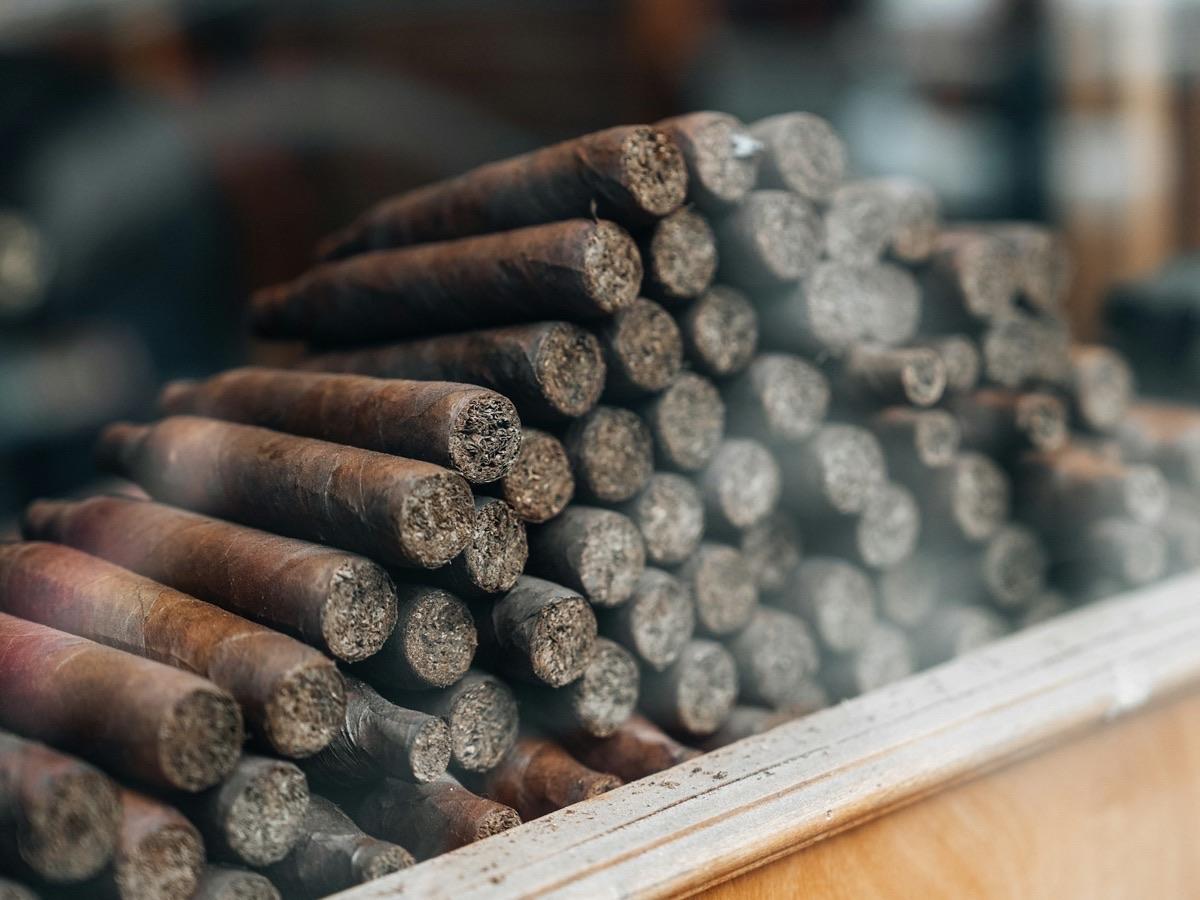
The blend of a cigar is decided before the roller sits down. The ligador, the master blender, chooses which leaves go into each brand and size and in what proportions. What the roller controls is how those leaves become a bunch: how each one is folded, where it sits, how tightly the leaves are packed and how much filler goes in. Once the wrapper is on, none of this can be seen, but it decides whether the cigar draws freely, burns evenly and tastes the way the blender intended. A cigar can be made from excellent tobacco and still smoke badly if its filler was badly bunched.
Who handles the filler
In Cuba, one torcedor makes each cigar from start to finish, filler included, and most torcedores today are women, torcedoras. New rollers train for about nine months before they roll for production. Rollers are then ranked in four grades, and only the top grade may make the largest and most complicated sizes. A skilled torcedor makes between 60 and 150 cigars a day, depending on the size and shape.
In Nicaragua, the Dominican Republic and Honduras, the filler is usually the job of the buncher, the bonchero, who works beside a roller, the rolero. The buncher gathers and folds the filler and rolls it into the binder; once the bunches have been pressed, the roller puts on the wrapper and closes the head. Many factories cap how many cigars a team may make in a day, to keep the work careful; Rocky Patel, for example, limited each of its rollers in Honduras to 250 cigars a day in 2005. In the Dominican Republic many bunchers use a Lieberman, a hand-cranked device that rolls the filler into the binder, which Three Ways of Preparing La Tripa describes.
Placing the leaves
Habanos describes how its torcedoras handle the filler. Each leaf is gathered, folded and aligned so that the smoke will have a straight path through the finished cigar. The strongest, slowest-burning leaves, ligero and medio tiempo, always go in the center, where the heat of the leaves around them keeps them burning, and the easier-burning seco and volado surround them. Every leaf is laid with its tip, the lighter-flavored end, toward the foot, so that the first puffs are gentler and the flavor builds as the cigar burns.
The leaves must be folded, not twisted or knotted. A folded-over or twisted leaf, or a knot of filler, can stop almost all of the draw, a fault called a plug. How each leaf is folded, rolled into a scroll, pleated or laid flat like the pages of a book, is the subject of Three Ways of Preparing La Tripa.
Getting the amount right
Every size has its own amount of filler, and the roller has to hit it with every cigar. With too little filler, a cigar is soft, draws too easily and burns hot and fast. With too much, it is hard to draw, gives little smoke and keeps going out. Habanos asks that the compression of the filler be the same at every point along the bunch, and that the bunch be rolled to the exact diameter its size requires. Soft or hard spots in a finished cigar show that this went wrong.
Factories check the work in several ways. The bunches are pressed in wooden or plastic moulds to set their shape, and in many factories each bunch is then tested on a draw machine, which measures how easily air passes through it before the wrapper goes on. Every Cuban factory has done this since 2001, and makers elsewhere, Perdomo among them, say they draw-test every cigar. The effect can be large: at Tabacalera de García in La Romana, in the Dominican Republic, the share of cigars rejected as plugged fell from about 35 percent in the late 1980s, before the factory had a draw machine, to 2 or 3 percent after it. Finished cigars are weighed as well, because a cigar that is too heavy usually holds too much filler. In Cuba, samples of each roller's cigars are regularly taken apart to check how they were built and that the blend is right.
Size and shape
A blend has to be rebuilt for every size. A slim cigar holds only a few leaves, so each leaf counts for more and every error shows. A Cuban laguito No. 1, the 192 mm by 38 ring format of the Cohiba Lancero, may hold only two or three filler leaves with a third or a quarter of a half leaf of ligero, while a robusto takes four or five leaves and at least a quarter leaf of ligero. Thin cigars need much less ligero than thick ones, so the proportions of a blend change from size to size, and slim sizes are among the hardest to roll well.
Figurados, the tapered and bulging shapes, are harder still. The buncher has to shape the bunch as well as fill it, often combining folding methods, and a single misplaced leaf can plug a pointed head. That is why only the most skilled rollers make them.
What the smoker notices
Most of what goes wrong with a cigar starts in the bunch. A tight draw, a plug, soft spots that burn fast and a burn that canoes because the filler was packed unevenly all come from how the filler was handled. Construction Defects, in the Cigar Anatomy topic, explains how to spot these faults before lighting and what to do about them. A well-bunched cigar is less dramatic to describe: it draws with light, even resistance from the first puff, burns straight and tastes of the same blend from the foot to the head.