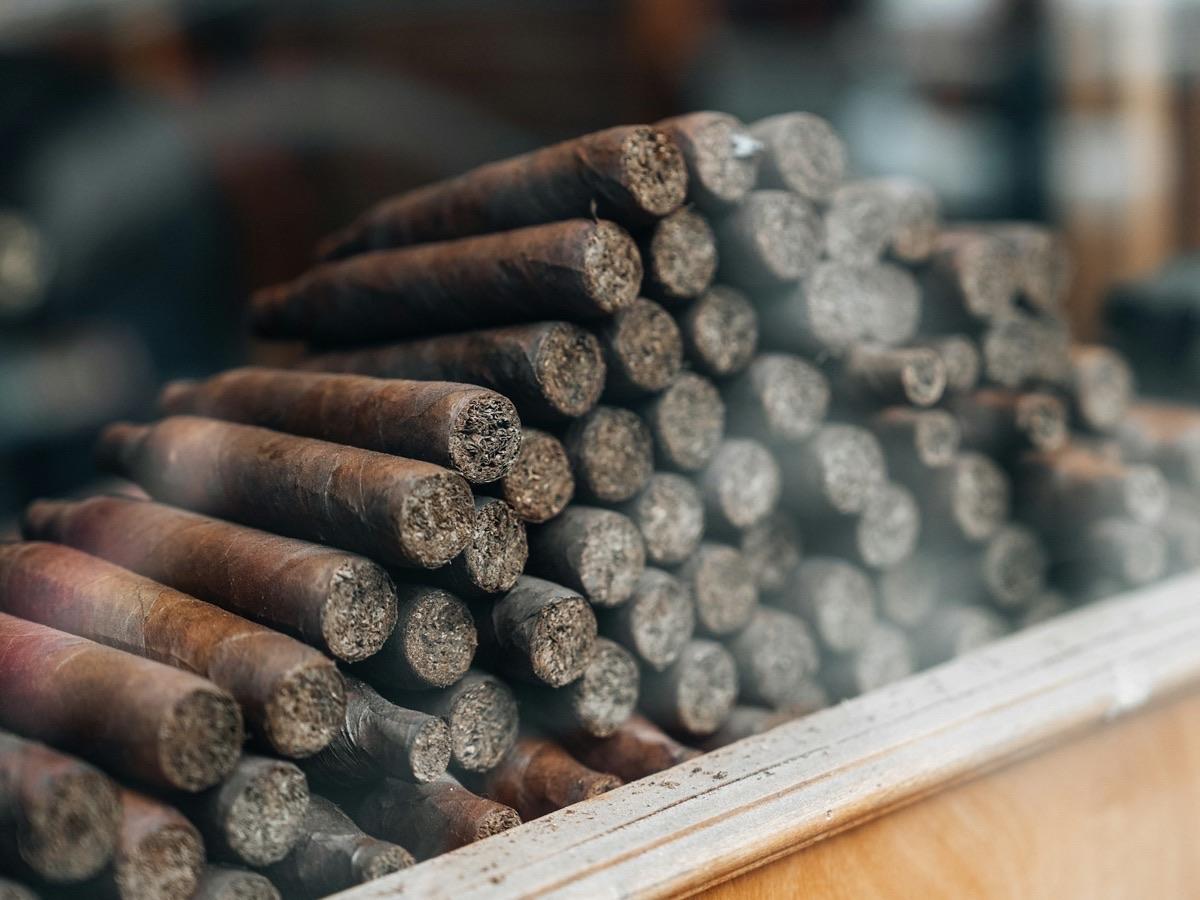
Before asking where a cigar's filler grew, it is worth asking what shape the leaf is in. Long filler (tripa larga) is whole leaves, folded and gathered so that each runs from the foot to the head. Short filler (tripa corta, also called picadura) is chopped leaf: trimmings from long-filler production, broken leaves and cut tobacco. Mixed filler combines the two. The choice changes how a cigar is made, how it burns and tastes, and what it costs.
Long filler
Every premium hand-made cigar is made with long filler. Because each leaf runs the full length of the cigar, the smoke follows the channels between the leaves from the foot to the head, which gives an even draw, and the leaves burn down together, which gives an even burn. The blend is also the same at every point. The ligero at the center and the seco and volado around it run from one end to the other, so the last third of the cigar holds the same leaves as the first.
Long filler asks the most of the people who make the cigar. Each leaf has to stay whole through curing, fermentation and sorting, and then be folded and placed by hand, which is one reason premium cigars cost what they do.
Short filler
Short filler is the main tobacco in machine-made cigars. It costs less, because the leaf need not be whole and a machine can form the bunch quickly, and it smokes differently: chopped leaf burns quicker and hotter than whole leaf, and its flavor is usually simpler. It also shows in the hand. The foot of a short-filler cigar shows small pieces of leaf rather than the folded edges of whole leaves, and loose bits of tobacco can fall from the head when it is cut.
Short filler is not always machine-made. Cuba makes a few cigars entirely by hand with short filler, from the trimmings of long-filler bunches mixed with other chopped leaf, and sells them as totalmente a mano, tripa corta: totally by hand, short filler. The José L. Piedra brand is made this way, from tobacco grown around Remedios, in central Cuba.
Mixed filler
Mixed filler wraps chopped tobacco inside a few long-filler leaves. It is sometimes called a Cuban sandwich, and it is found in less expensive hand-rolled cigars and bundle cigars, where it gives a use to the trimmings left over from premium production. Some makers state the proportions. Orishas, rolled by hand in Russia, makes its Underground line from 70 percent long and 30 percent short Nicaraguan filler.
Where the line falls
The kind of filler is often what separates a premium cigar from the rest, and in the United States it now decides how a cigar is regulated. After years of dispute in court over which cigars the Food and Drug Administration may regulate, a federal court in Washington adopted an eight-part definition of a premium cigar in 2023 and confirmed it in April 2026. One of its tests is the filler: at least half of it, by weight, must be long filler. The other tests ask for a wrapper of whole leaf, a binder of 100 percent leaf tobacco, rolling by hand, no filter, tip or mouthpiece, no flavor other than tobacco, nothing in the cigar but tobacco, water and vegetable gum, and a weight above 6 pounds per 1,000 cigars, about 2.7 grams a cigar. Under that definition a mixed-filler cigar can still count as premium, as long as at least half of its filler is long.
Telling them apart
The maker often says. Habanos states for each of its brands whether it is made totally by hand with long filler, totally by hand with short filler, or by machine, and many makers elsewhere print "long filler" on their boxes or in their descriptions. On the cigar itself, the foot is the best evidence: whole, folded leaves show as layered edges, chopped leaf as a jumble of small pieces. Price is a rough guide, since long filler costs more to make, but not a proof.