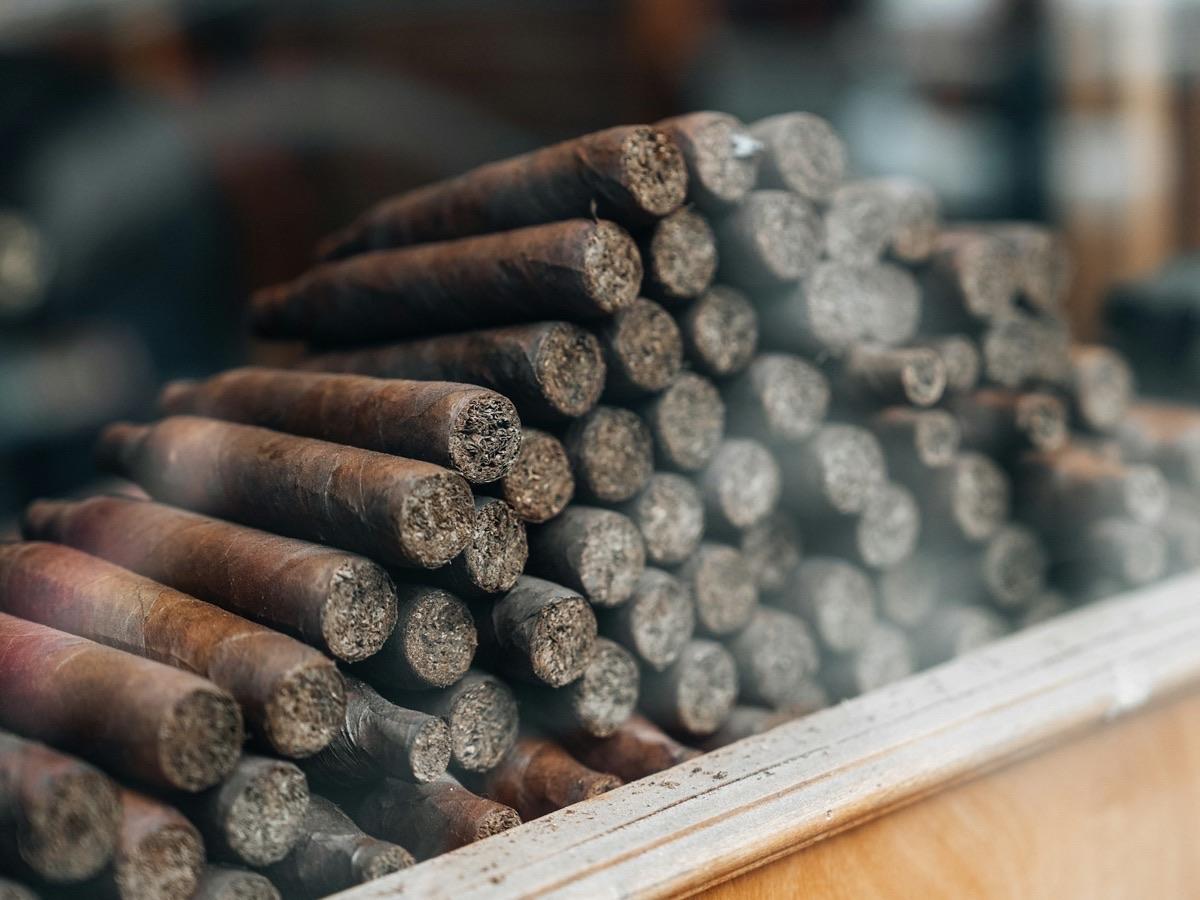
Strength, fortaleza in Spanish, is the physical effect of the nicotine a cigar delivers, and it is decided mainly inside the cigar. The wrapper colors the flavor and the first impression, but it adds little nicotine; the filler, which is most of the tobacco, carries most of it. Strength: Nicotine and Ligero, in the Strength vs. Body topic, explains what strength is and how it differs from body. This lesson looks at how blenders build strength into the filler.
Ligero, the source of strength
Nicotine rises toward the top of the tobacco plant, and the upper leaves, the ligero, are the main source of a cigar's strength. Ligero is the thickest leaf in most blends, dark, oily and slow to burn, and it adds body as well as nicotine. It is a position on the plant, not a variety: any tobacco grown for filler has ligero at the top.
Growers can push the strength of the ligero in the field. Topping the plant, removing its flower bud, sends its energy into the leaves, and the lower the cut, the fewer the leaves and the stronger each becomes. Litto Gomez of La Flor Dominicana started growing his own tobacco in the Dominican Republic because the ligero he could buy was not strong enough for him, and he has asked farmers to take four to six more of the top leaves off their plants, so that the rest grow stronger, a request farmers resist. Demand for ligero is high: David Perez of ASP Enterprises, who grows tobacco in Estelí, Nicaragua, aims for 35 to 45 percent of each year's crop to be ligero.
How much ligero goes into a cigar
Less than its reputation suggests. Cuban blenders traditionally use a half or a quarter of a ligero leaf in a cigar that may hold three to five filler leaves in all. A robusto might take at least a quarter leaf of ligero with four or five other leaves, a slim laguito No. 1 only a third or a quarter of a half leaf with two or three. Some blends use none at all. A tobacco expert once described the Hoyo de Monterrey Double Corona then in production as almost all seco, with a little volado and no ligero, and the Illusione Epernay was blended from viso seco and viso ligero, without true ligero.
At the other extreme, some lines are built around the leaf. In the early 2000s Litto Gomez put the word ligero on his bands, then "double ligero", for a blend with twice the usual share of it, and La Flor Dominicana's Ligero and Double Ligero lines did much to make the word known to smokers. The Oliva Serie V is blended with a specially fermented ligero from Nicaragua's Jalapa valley. In Cuba, the Cohiba Behike, launched in 2010, adds medio tiempo, the rare leaf above the ligero, as one of the six leaves in every cigar.
Too much ligero brings problems of its own. It burns slowly and needs the heat of the leaves around it, so a blend overloaded with it draws hard, burns unevenly and keeps going out. Making a strong cigar that still draws and burns well is one of the harder tasks in blending, and few cigars, if any, are made of ligero alone: they would be overpowering as well as hard to keep lit.
Where the ligero grew
The strongest cigar is not always the one with the most ligero, because ligero from different places differs in strength. Ligero from Estelí, in Nicaragua, is counted among the strongest leaf in the trade, while leaf from Jalapa is gentler. In the Dominican Republic, the hot, dry climate of La Canela makes its tobacco stronger and spicier than most of the Cibao Valley's, and Piloto Cubano is grown for strength where the native Olor Dominicano is mild. In Mexico, the Turrent family adds Nicaraguan leaf to the dark San Andrés tobacco in its Casa Turrent 1880 to give it strength. Single-Origin vs Blended Filler describes the main filler origins.
Fermentation and age
Ligero, the thickest leaf, takes longest to process. In Cuba its final fermentation lasts about 90 days, against 45 to 60 for seco and 15 to 25 for volado, and it then ages for at least two years before it is rolled. Fermentation takes away ammonia and harshness, so a well-fermented ligero can be smooth and still strong. Growers agree that rushing it spoils the leaf: a ligero fermented too briefly stays harsh as well as strong.
Size and placement
A cigar's size changes its strength because it changes how much ligero the cigar can hold. Thin cigars need much less ligero than thick ones, so a slim cigar and a robusto from the same line seldom share exactly the same proportions. A thicker cigar holds more filler, ligero included, and over its longer smoke delivers more nicotine in total, even when each puff feels gentler.
Inside the bunch the ligero sits at the center and runs from the foot to the head, like every other leaf. That placement keeps it burning and spreads its strength along the whole cigar; it does not hold the strength back for the end. The old explanation that the ligero "takes over" in the final third does not fit how a long-filler cigar is built. Strength rises as a cigar burns because the smoke grows hotter and more concentrated as the column of tobacco shortens, because oils and nicotine collect in the tobacco ahead of the burn, and because nicotine builds up in the smoker. How Strength Builds During the Smoke, in the Strength vs. Body topic, explains the whole curve.
Reading strength from the filler
A few clues to a cigar's strength can be seen before it is lit. In many cigars the foot shows darker leaf at the center, the ligero, with lighter leaf around it, and a larger dark core usually means more of it. A band or box that says ligero, or names a strong origin such as Estelí or La Canela, signals a blend built for strength. The wrapper is a poor guide: a pale Connecticut wrapper can cover a strong filler, and a dark maduro wrapper adds body and sweetness rather than nicotine.