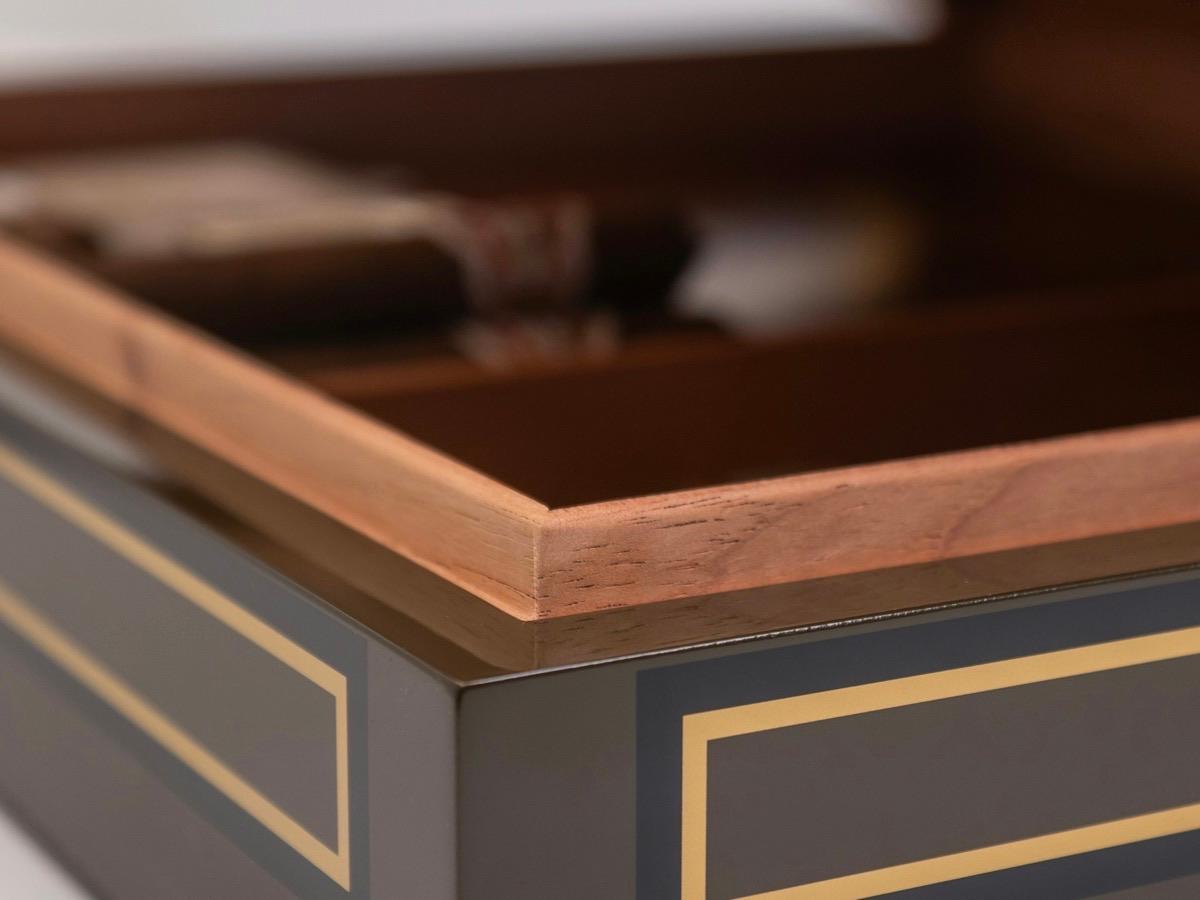
A cigar is a bundle of dried leaves, and like every dried leaf it takes up or gives off water as the air around it changes. A humidor slows that exchange to a standstill by closing the air off and by using wood that buffers humidity, so the cigars inside keep an even moisture over weeks and months. This lesson sets out the kinds of humidor, what each is for, and the two things every one of them shares, a Spanish-cedar lining and a seal. Why Humidity Matters, in the Storage & Humidity topic, explains the level itself, and the Cigar Boxes topic covers the cedar boxes cigars are sold in.
What a humidor does
A humidor is defined by a stable relative humidity, written RH. The wood or plastic closes off the room's air, and a humidifier adds or removes a little moisture so the air inside settles at the right level; a hygrometer shows it. The figure the trade keeps repeating is about 65 to 70 percent relative humidity, with the numbers a leading trade magazine gives for the target, and many guides widen the band to 65 to 72 percent. Habanos, for its own cigars, recommends 16 to 18 degrees Celsius and 65 to 70 percent humidity, held steady, and the classic shorthand for a room-temperature box is the "70/70 rule", about 21 degrees Celsius (70 degrees Fahrenheit) at 70 percent. Why Humidity Matters lays out why that range, and none other, keeps a cigar elastic, aromatic and slow-burning.
Desktop humidors
The desktop humidor is the everyday box: a small, sometimes lacquered or veneered cabinet that sits on a desk or shelf and holds from 25 to about 100 cigars, the count printed on the box by its maker. The great names of the craft are woodworkers as much as shops. Elie Bleu, the French cabinetmaker making humidors since 1976, builds lacquered pieces in the tradition of fine French furniture, and Daniel Marshall, the California maker working since 1982, lines his boxes with Spanish cedar and a humidifier of his own design; Davidoff makes humidors alongside its cigars. What the buyer is paying for in a fine desktop box is two things: a thick, well-fitted body that closes tight, and a lining of Spanish cedar.
Cabinet humidors and walk-ins
A cabinet humidor is the same idea at the size of furniture. It holds from a few hundred to thousands of cigars on shelves and drawers, usually for a serious collection or the stock of a shop or lounge, and it needs more than a small passive humidifier: a larger reservoir, electric humidification with a fan and sensor, or the climate system of a whole walk-in room. Humidification Methods, in the Storage & Humidity topic, explains the passive and active equipment, and Air Circulation explains why a tall cabinet or a walk-in must mix its air so no shelf dries out while another stays damp.
Travel humidors and cases
A travel humidor carries a few cigars, sometimes as many as a couple of dozen, through airports and weather while keeping them whole and moist. The body is rigid and crush-resistant, the seal is airtight, and a small humidifier, usually a pack, keeps the air right. The trade calls a hard travel humidor a herfador, from "herf", cigar slang for a gathering of smokers. It is built for a trip, not for aging: it protects against crushing and quick swings in humidity and temperature, in the way Travel Storage, in the Storage & Humidity topic, describes.
Coolers, wineadors and tupperdors
Three improvised humidors fill the spaces the boxes don't. A coolerdor is a sealed picnic cooler fitted with humidification, used for boxes or a large loose collection; a wineador is a thermoelectric wine cooler that both cools and humifies, and it is popular where a house runs warm, because cigar tobacco is safest below about 23 degrees Celsius (73 degrees Fahrenheit), the temperature at which tobacco beetle eggs can hatch, as Cigar Anatomy explains. At the other end of the price scale a tupperdor is a clean, airtight plastic food container with a humidity pack dropped in, the cheapest reliable way to keep a handful of cigars. The table brings the family together.
| Type | Typical capacity | What holds the humidity | Notes |
|---|---|---|---|
| Desktop humidor | 25 to 100 cigars | Spanish-cedar lining, a small humidifier, a tight lid | The everyday box; makers include Elie Bleu, Daniel Marshall, Davidoff |
| Cabinet humidor | Hundreds to thousands | A larger or active humidifier; fans and sensors in big ones | Furniture-sized, for collections, shops and lounges |
| Travel humidor, or herfador | A few to a few dozen | An airtight, crush-proof seal and a small pack | For a trip, not for aging |
| Coolerdor | Boxes or a large collection | A sealed picnic cooler with humidification | Inexpensive and roomy |
| Wineador | Boxes or a large collection | A thermoelectric wine cooler holding a pack or humidifier | Cools and humifies in warm rooms |
| Tupperdor | A handful to a few dozen | A sealed plastic box with a humidity pack | Cheap, airtight and reliable |
Read down the table and the types split by purpose and price. The desktop box and the cabinet are built for steady, long-term storage in Spanish cedar, the travel humidor for a short, protected trip, and the cooler, wineador and tupperdor for capacity or simplicity at low cost. Whichever is chosen, the seal and the humidity source do the real work.
Spanish cedar and the seal
Almost every wooden humidor is lined, floor, walls and lid, with Spanish cedar. The wood is not a true cedar at all: it is *Cedrela odorata*, called cedro in Spanish, a tree of tropical America and the Caribbean in the mahogany family. It earned the cedar name from its aroma and from a fragrant, insect-repelling resin in its heartwood, and it resists rot and termites. For cigars it does two jobs. It absorbs and releases moisture slowly, buffering the swings that open air would bring, and it lends the tobacco the cedar note that appears so often in a cigar's aroma. The Cigar Boxes topic tells how the same wood lines the boxes cigars are sold in.
The seal matters as much as the wood. A good lid closes with light, even resistance, a small cushion of air as it seats, and no gap where it meets the body; glass-topped boxes, common and inexpensive, are the usual culprits that leak, and humidor makers warn that a solid hardwood body holds far better than one of pressed fiber. The standard trade guidance to store at 65 to 70 percent only works if the box, cedar and all, can be held there.