This lesson describes what cigars mean to the Dominican economy: what the country earns from them and where they go, how the industry grew, who works in it and on what terms, where the leaf is grown, and the tax regime and risks that shape it. The number of Dominican cigars sold in the United States, and Nicaragua's place as the largest supplier there since 2016, are covered in Global Market Trends; the country's tobacco and growing districts are described in the Tobacco Regions lessons The Dominican Republic and Cibao Valley (Dominican Republic). Economic Impact in Nicaragua covers the other great producer, and the two lessons are built to be read side by side.
What the figures measure
The Dominican Republic publishes several cigar figures, and they do not cover the same goods. The export and investment agency (Centro de Exportación e Inversión de la República Dominicana, ProDominicana) reports cigars (cigarros puros) as one product line, built from customs records of the Dirección General de Aduanas. The tobacco institute (Instituto del Tabaco de la República Dominicana, INTABACO), the state body that regulates the crop and the trade, reports a wider total for "tobacco and its products", which adds leaf, cigarettes and other tobacco goods to the cigars. The free-zone council (Consejo Nacional de Zonas Francas de Exportación, CNZFE) counts companies and jobs in the free trade zones, the zonas francas, where companies export almost everything they make in exchange for tax relief, but its yearly reports seen for this lesson do not give a cigar export figure. The central bank (Banco Central de la República Dominicana) publishes free-zone and national export totals without a separate cigar line. A count of cigars rather than dollars comes from INTABACO and, for the American market only, from the United States' own import records.
The figures therefore name their source and year, and they are best read as trends. Neither the agency nor the institute separates handmade premium cigars from machine-made ones, which the Dominican Republic also makes in large numbers for the mass market.
What cigars earn
Cigars are one of the largest single items the country sells abroad. ProDominicana put cigar exports at $947.0 million in 2022, 7.6 percent of all Dominican exports, and its trade-intelligence unit at $1,024.6 million in 2023. In 2024 cigars reached $1,055.4 million, the highest figure reported, and ranked third among the country's exports behind raw gold ($1,471.8 million) and medical and surgical instruments ($1,223.7 million); total exports that year were $12,925.1 million, so cigars made up about 8.2 percent. In 2025 cigar exports fell by 8.9 percent to $964.4 million, while total exports rose by 13.4 percent to $14,645.2 million on the strength of gold, and the cigars' share dropped to about 6.6 percent. The growth rates published for single years do not always match the totals, because the figures are revised after first release.
The free-zone figures of earlier years tell the same story at a lower level. Customs counted $798.4 million of tobacco manufactures exported from the free zones in 2017, $877.6 million in 2018 and $931.7 million in 2019, when tobacco was 15.8 percent of all free-zone exports. Over the five years to 2020, by the central bank's account, tobacco made up about 15 percent of free-zone exports and 8 percent of all Dominican exports.
INTABACO's wider total is larger and moved the other way in 2025. It reported $1,340 million of tobacco and tobacco products exported in 2024 and $1,359 million in 2025, a rise of 1.4 percent, against about $934 to $940 million in 2019. In the first half of 2026 the institute counted more than $802 million, 99.5 percent of it made in free zones. The difference between the two series, about $400 million in 2025, is the leaf, cigarettes and other products that the institute counts and the agency's cigar line does not. That the agency's cigar figure fell in 2025 while the institute's total rose fits what happened in the United States, where Dominican premium cigar shipments fell by about 12 percent that year, as Global Market Trends describes.
Where the cigars go
The United States buys most Dominican cigars, a share at least as large as it takes of Nicaragua's. In 2024 the country exported 181,158,993 premium cigars, according to the government, to 148 countries: 88 percent of them to the United States and 10 percent to the European Union. By value ProDominicana counted $895.6 million of cigar exports to the United States in 2024, about 85 percent of the total. INTABACO's wider series gives the United States 78.5 percent of tobacco exports in the first half of 2026, a lower share because leaf and cigarettes go to other markets.
Outside the United States the largest buyers of Dominican tobacco in 2024 were China, about $74 million, Germany, $60 million, and Belgium, $26 million, followed by Nicaragua and Puerto Rico. Much of what goes to China and Nicaragua is leaf rather than cigars: Chinese cigar factories rely heavily on imported Dominican leaf, as Chinese Influence in the Habanos S.A. topic notes, and Nicaraguan factories blend Dominican tobacco into their cigars. In Germany cigars were the single largest Dominican export in 2024, about a third of all Dominican sales there. Russia was a market for the larger makers until March 2022, when Oettinger Davidoff, then the leading exporter of Dominican cigars to Russia, suspended its business there.
INTABACO said in 2026 that the country exports more than 196 million handmade cigars a year to 148 countries and remains the world's largest exporter of premium cigars. That figure covers every destination and cannot be checked against the American count, which in 2025 gave 93.7 million Dominican premium cigars against 258.4 million from Nicaragua; Global Market Trends explains why the two sources disagree.
The main figures side by side
The table brings together the export and employment figures used in this lesson. The sources measure different things, cigars counted in the United States, dollars recorded by customs, jobs counted by the free-zone council, so each row is best compared only with rows from the same source.
| Year | Measure | Figure | Source |
|---|---|---|---|
| 1977 | Dominican cigars exported | about 5.8 million | Trade press |
| 1981 | Dominican cigars exported | about 33.7 million | Trade press |
| 1995 | Premium cigars exported from Santiago | about 65 million | Trade press |
| 2017 | Free-zone exports of tobacco manufactures; free-zone tobacco jobs | $798.4 million; 27,272 jobs | Customs; CNZFE |
| 2018 | Free-zone exports of tobacco manufactures; free-zone tobacco jobs | $877.6 million; 29,831 jobs (58.6 percent women) | Customs; CNZFE |
| 2019 | Free-zone exports of tobacco manufactures | $931.7 million (15.8 percent of free-zone exports) | Customs |
| 2021 | Free-zone tobacco jobs (January to October) | 38,713 | CNZFE |
| 2022 | Cigar exports | $947.0 million (7.6 percent of all exports) | ProDominicana |
| 2023 | Cigar exports | $1,024.6 million | ProDominicana |
| 2024 | Cigar exports; free-zone tobacco jobs | $1,055.4 million (about 8.2 percent of all exports); 39,005 jobs | ProDominicana; CNZFE |
| 2024 | Tobacco and tobacco products exported; premium cigars exported | $1,340 million; 181.2 million cigars (88 percent to the United States) | INTABACO; government |
| 2025 | Cigar exports; free-zone tobacco jobs | $964.4 million (about 6.6 percent of all exports); 38,622 jobs (61.7 percent women) | ProDominicana; CNZFE |
| 2025 | Tobacco and tobacco products exported | $1,359 million | INTABACO |
Read down the rows and two things stand out. Cigar earnings rose by about a third between 2017 and 2024 and then fell in 2025, while free-zone employment in tobacco rose by about 12,000 jobs to 2021 and has stayed close to 39,000 since. The industry earns more than it did, but it no longer adds workers.
Tobacco before the cigar factories
Tobacco was a Dominican crop for centuries before it became an industry. In the north of the country, in the Cibao valley around Santiago de los Caballeros, small peasant farmers grew it, and in the early nineteenth century they sold much of it as crude cigars and andullo, leaf pressed into a long roll, which is still made for local use. By the 1840s German ships were carrying raw Cibao leaf to Hamburg and Bremen, and the trade took the shape it kept for a century: farmers sold to dealers in Santiago, where the leaf was graded and packed, and merchant houses shipped it from Puerto Plata, often lending growers money against the crop. The historian Michiel Baud, who has written the standard account, shows how this trade bound the Cibao's peasants to the German market. It also exposed them to its prices: when Brazil and Sumatra flooded the world market in the late 1870s, Dominican leaf lost value and many farmers turned to cocoa.
Cigar making on a commercial scale began in the twentieth century. La Aurora opened in 1903 in Guazumal, near Tamboril, and moved into Santiago in 1912; it calls itself the oldest cigar company in the country, as the lesson La Aurora explains. In 1962 the state created INTABACO, and in the same year Cuban-seed Piloto Cubano tobacco arrived from Cuba's Vuelta Abajo, the beginning of the Cuban contribution described below.
Exiles, free zones and the move from the Canary Islands
The modern industry was built between the 1960s and the 1980s from three sources. The first was the Cuban revolution of 1959. Cuban growers and makers who left the island looked for places with the soil, climate and labour to make cigars for the American market, from which Cuba was shut out by the embargo of 1962; a few Cuban families settled in the Dominican Republic in the 1960s, at first mainly as leaf dealers. One was the Quesada family, which made the Fonseca brand in Santiago from 1974; Manuel Quesada made the first handmade non-Cuban Romeo y Julieta at his MATASA factory in 1978, as the Romeo y Julieta and My Father Cigars lessons describe.
The second source was the free trade zone. The first Dominican industrial free zone opened in 1969 at La Romana, on the south-east coast, developed by the American conglomerate Gulf + Western. In 1973 the state created a second zone at Santiago and handed its management to a non-profit corporation of northern businessmen. The parks let companies import leaf, Connecticut wrapper from the United States and filler from elsewhere, without duty, as long as they exported the cigars, and they drew factories that could no longer make cigars cheaply elsewhere. By one count the companies in the country's first three parks grew from 15 in 1973 to 101 in 1983.
The third source was the Canary Islands. After 1959 the Menéndez and García families, former owners of Montecristo and H. Upmann, made cigars there through the company they founded in 1961, and in 1972 Consolidated Cigar, then owned by Gulf + Western, bought a controlling interest in it. Rising wages and taxes in the islands in the late 1970s and early 1980s made that production too expensive, and Consolidated closed its Canary operations in the early 1980s, which had employed almost 800 people and made about 15 million cigars a year, and moved them to La Romana. Its factory there, now Tabacalera de García, had opened in 1969 to sort Connecticut wrapper, made its first handmade cigars in 1972 and began making the American Montecristo in 1984, as the Montecristo lesson explains. General Cigar followed a similar route from Jamaica: it moved its American Partagás to Santiago in 1979, a year after starting it in Kingston, and the rest of its Jamaican production, the Macanudo, in 2000.
The country grew fast as a supplier. Trade figures put Dominican cigar exports at about 5.8 million in 1977 and about 33.7 million in 1981, and within about a decade of the first free zones the Dominican Republic had overtaken the Canary Islands and Jamaica as the leading source of cigars for the United States. Families displaced by the Nicaraguan revolution added to the industry: the Fuentes, whose Estelí factory burned in the uprising, opened their Santiago factory on 4 September 1980, as the Arturo Fuente lesson tells, and Davidoff moved its production from Cuba to Santiago in 1990.
The boom of the 1990s and after
The American cigar boom of the 1990s, described in Cigar Boom (90s) in the Cigar History topic, fell hardest on the Dominican Republic, then the largest supplier. Santiago alone exported about 65 million premium cigars in 1995, by one estimate more than Cuba, and it had 19 cigar factories, most in its free-zone parks. Large makers hired as fast as they could: Arturo Fuente grew from about 1,000 to 1,600 workers between 1993 and 1996, and General Cigar added 300 rollers. New companies, many of them started by Cubans from Miami or Honduras, opened alongside. When demand collapsed in 1998, many of the boom's factories closed, and back orders, common at the height of the boom, were largely unheard of from 1998 to 2001.
The established makers survived and the industry grew again on a firmer base. By 2004 trade figures put Dominican cigar exports at about 160 million a year, and the Dominican Republic supplied more than half the handmade cigars sold in the United States. Its leaders then were the three largest factories, Tabacalera de García, General Cigar Dominicana and Fuente, each making tens of millions of cigars a year; Fuente alone rolled more than 30 million by hand in 2012. In the United States market Nicaragua passed the Dominican Republic in 2016, and its lead has widened since, but the Dominican Republic has remained the second supplier there in most years since.
Santiago and the Cibao, the industry's centre
Santiago de los Caballeros is the capital of the trade. The country's second city lies in the middle of the Cibao valley, and most of the factories, the leaf warehouses and the growing districts lie within a short drive of it: Tamboril, Villa González, Navarrete and the farmland of Santiago province, which grows about half of all Dominican tobacco. The province of Santiago is also where many of the free-zone parks are, and the north of the country held 37.6 percent of all free-zone jobs in 2021. Tamboril, just outside the city, promotes itself as the world capital of the cigar and has held a cigar festival under that name since 2022.
The rest of the industry is spread more thinly. Officials named Santiago, La Romana and Puerto Plata as the cigar-manufacturing provinces in 2025. La Romana, far from the Cibao on the south coast, is the exception that the industry's history explains: it is the home of Tabacalera de García, which grew from the Canary Islands move into one of the largest cigar factories in the world, with about 3,000 workers in 2004 and about 5,000 by 2019. Around the factories have grown the businesses that serve them, box makers, printers of bands and labels, and transport.
Jobs and the people who do them
The free-zone council gives the only regular count of cigar jobs, and it covers factories rather than farms. It counted 27,272 people working for free-zone tobacco companies in 2017 and 29,831 in 2018. In January 2020 the figure was 31,986; the pandemic cut it to 20,248 in April 2020, more than a third lower, before it recovered by more than 70 percent by the end of the year, when demand for cigars rose in the United States. The council counted 38,713 tobacco jobs in the first ten months of 2021, 39,005 in 2024 and 38,622 in 2025, when tobacco was the largest employer among the free zones' industries, with 19.3 percent of their 200,237 jobs, and 170 of their companies.
Officials give much larger totals for the whole industry: more than 100,000 people in 2020, more than 110,000 direct jobs according to the trade ministry in October 2025, and more than 122,000 according to the president in July 2025. Those figures include farm workers, curing and leaf-processing staff and companies outside the free zones, and no published count shows how they are built. They are best read as estimates of everyone whose living depends on tobacco, and the council's figure as the count of factory jobs.
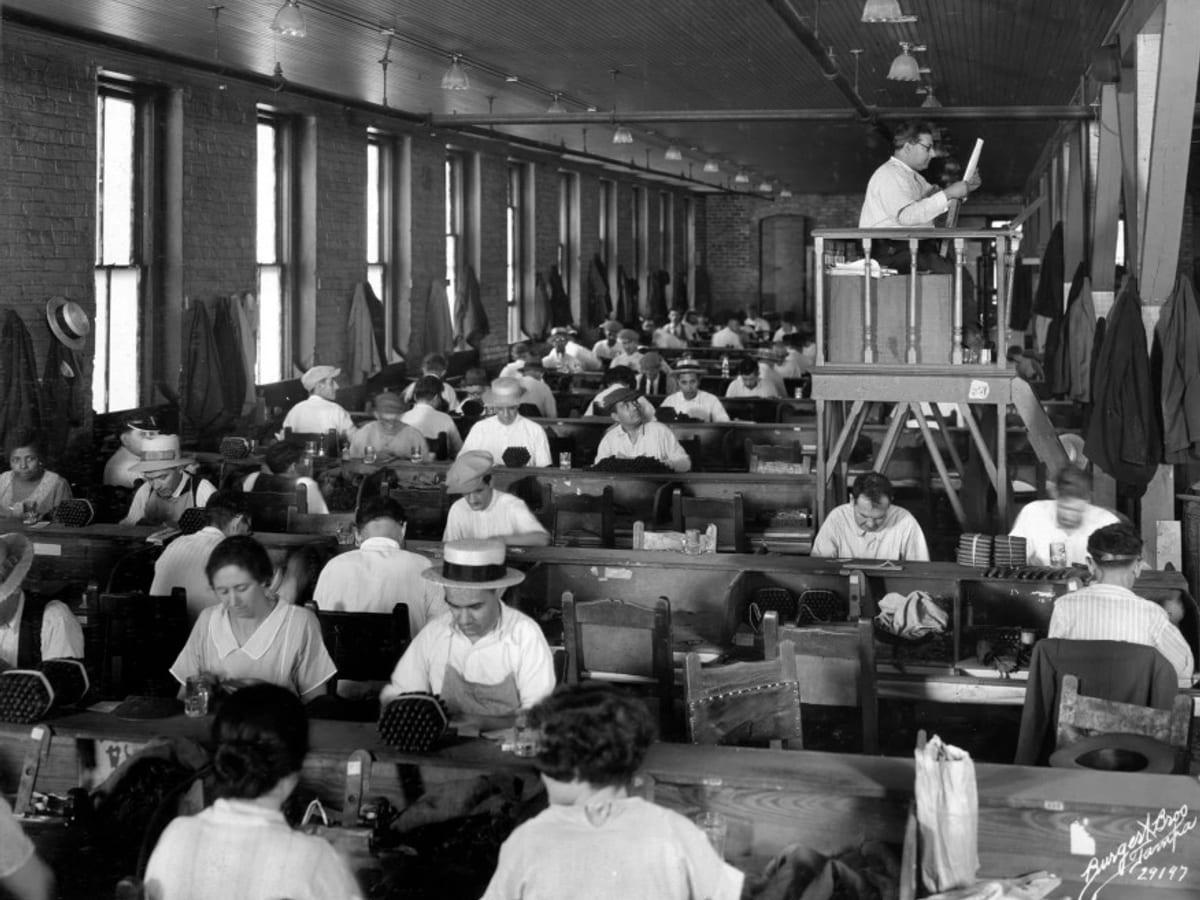
Most of the factory workers are women. The council counted 17,489 women among the 29,831 tobacco workers of 2018, 58.6 percent, and 23,818 among the 38,622 of 2025, 61.7 percent; officials quoted a share of 62 to 63 percent in 2025 and 2026. Women hold most of the jobs in stripping and sorting the leaf, which the Workers topic describes as traditionally women's work, and many work at the rolling tables. As in Nicaragua and Honduras, Dominican factories usually divide the rolling between two people, a buncher (bonchero) who makes the bunch and a roller (rolero) who puts on the wrapper, rather than one person making the whole cigar as in Cuba; the Workers topic describes each job.
Pay and working conditions
Wages in the factories follow the free-zone minimum, which the national wage committee (Comité Nacional de Salarios) sets separately from the rest of the economy. In April 2025 it approved a rise of 25 percent in two steps, 13 percent from 1 June 2025 and 12 percent from 1 June 2026, which brought the free-zone minimum to 20,875 pesos a month, about $340 at the exchange rate of October 2026. Farm workers are covered by a separate minimum of 714.60 pesos for an eight-hour day from 1 February 2026. What rollers earn above the minimum, through output bonuses or skill, is rarely published; in 1996 an experienced roller in Santiago earned about $330 a month, against an average Dominican wage of about $225.
Child labour has not been documented in Dominican cigar factories or tobacco farms in the sources reviewed. The United States Department of Labor rated the Dominican Republic's efforts against child labour in 2024 as "minimal advancement" and reported that children work in agriculture, naming coffee, rice and tomatoes, but not tobacco, and Dominican tobacco is not on its list of goods produced with child or forced labour. The documented problem on the farms is a shortage of hands. Much of the field and curing work, including stringing leaves into sartas, the strings that hang in the curing barns, has been done by Haitian migrants, and growers in the Cibao reported that the mass deportations of Haitians begun in October 2024 left them short of workers; the immigration authority said in August 2025 that the deportations would continue.
The leaf
The Dominican Republic grows most of the filler and binder it rolls, but very little of its wrapper. Its two classic tobaccos are Olor Dominicano, a mild, aromatic native leaf with local strains such as Quin Díaz and Olor San Víctor, and Piloto Cubano, the stronger Cuban-seed leaf that arrived in 1962; San Vicente, a hybrid bred in the country, gives more leaves a plant. INTABACO lists 21 varieties in five groups, and it released its own disease-resistant variety, Intabaco T13, in 2022. The Tobacco Regions lesson The Dominican Republic and the Seed to Leaf topic describe them.
The area under tobacco has grown with the cigar trade. The tarea, the Dominican land unit, is about 629 square metres, so 16 tareas make roughly a hectare. Officials put the area at under 100,000 tareas, about 6,300 hectares, in 2019, and at about 150,000 tareas, some 9,400 hectares, in 2025; INTABACO reported more than 160,000 tareas planted for the 2025–26 season, about 10,000 hectares. Production rose from 278,634 quintales, the hundredweight of 100 pounds, in 2019 to about 330,000 quintales, some 15,000 tonnes, in 2024–25, and the institute projected more than 400,000 for 2025–26. Santiago province grows about half of it, followed by Valverde, Monte Cristi and Espaillat in the north, and there is smaller planting in Azua and San Juan in the south, much of it for andullo. More than 3,500 producers in 15 provinces receive technical help from INTABACO each year, and the state agricultural bank lends to them for the season. Those farms are small set beside the large makers' own plantations, such as the Fuente family's Chateau de la Fuente near Bonao, which grows the country's best-known wrapper.
What the country does not grow, it imports, and the imports are large. The industry estimates that more than 90 percent of the wrapper (capa) used in Dominican cigars is imported, mainly from Ecuador, with Connecticut shade and broadleaf from the United States and leaf from Cameroon and Brazil also in common use. The free-zone council counted $650.4 million of imports by the tobacco industry's free-zone companies in 2024, which equals about half of what the industry exported. That figure covers boxes and other materials as well as leaf, and the council does not divide it, but it shows that a Dominican cigar is usually a blend made in the Dominican Republic from several countries' tobacco rather than a Dominican puro, a cigar made entirely from one country's leaf.
The free-zone regime and taxes
The free-trade-zone regime is the legal frame of the export industry. Free zones were first set up under a law of the late 1960s, Law 299, and the regime in force today is Law 8-90 on the promotion of free zones, of January 1990. It exempts free-zone operators and the companies in them from income tax, import duties on materials and equipment, the value-added tax (ITBIS), municipal taxes and taxes on exports, for 15 years from the start of operations, or 20 years in zones near the Haitian border, and the council can extend those periods. A company may sell up to 20 percent of its output in the Dominican market after paying the full taxes on it. The tobacco crop and trade outside the free zones are regulated by INTABACO under Law 34-18 of 2018.
The regime explains a good deal about the industry's shape. It drew American, European and Dominican capital into large factories built for export, and it means that the state collects little direct tax from cigar makers; the country's gain comes from wages, purchases of local leaf and services, and foreign currency. It is also why nearly all tobacco exports, 99.5 percent in the first half of 2026, come from free-zone companies.
Risks: tariffs, sanctions and labour
The industry's greatest risk is a change in the terms on which it sells to the United States, and that risk became real in 2025. Dominican cigars had entered the United States free of duty under the Central American free-trade agreement (CAFTA-DR). In 2025 the American government imposed a tariff of 10 percent on Dominican goods under emergency powers, as Global Market Trends describes. On 20 February 2026 the United States Supreme Court ruled that those powers did not allow tariffs, and the government replaced them with a temporary tariff under another law, which expired on 24 July 2026. From that day new tariffs under Section 301 of the Trade Act of 1974, which followed investigations opened in March 2026 into whether trading partners keep out goods made with forced labour, set 12.5 percent on goods from the Dominican Republic and Nicaragua and 10 percent on goods from Honduras. Trade sources reported no exemption for cigars. As of November 2026 American cigar associations were still asking for premium cigars to be exempted, and the duty that Dominican cigars will pay in 2027 had not been settled.
A second risk comes from the ownership of one factory. After the United States sanctioned the businessman Chen Zhi, the reported main owner behind the Spanish group Tabacalera, in October 2025, Altadis U.S.A. stopped buying from Tabacalera's Dominican factory, Tabacalera de García in La Romana, which had made much of its supply. Trade reporting said about 600 rollers were laid off, and Dominican premium shipments to the United States fell so far that Honduras passed the Dominican Republic in the first quarter of 2026, until licences issued in May 2026 let trade resume. Chinese Influence in the Habanos S.A. topic tells the story.
The industry's other risks are familiar ones. Hurricanes can destroy a crop and its curing barns, as Georges did in September 1998 at Chateau de la Fuente; the shortage of farm labour since the deportations of 2024 and 2025 raises the cost of growing leaf; and falling consumption in the United States and Europe, and tobacco taxes and rules in the markets that buy Dominican cigars, described in Regulation and Legal — USA, EU, Russia, limit how far the industry can grow. Its strengths are its large, long-established factories and its trained workforce; Oettinger Davidoff, one of the largest makers, doubled its Dominican production capacity in February 2025.