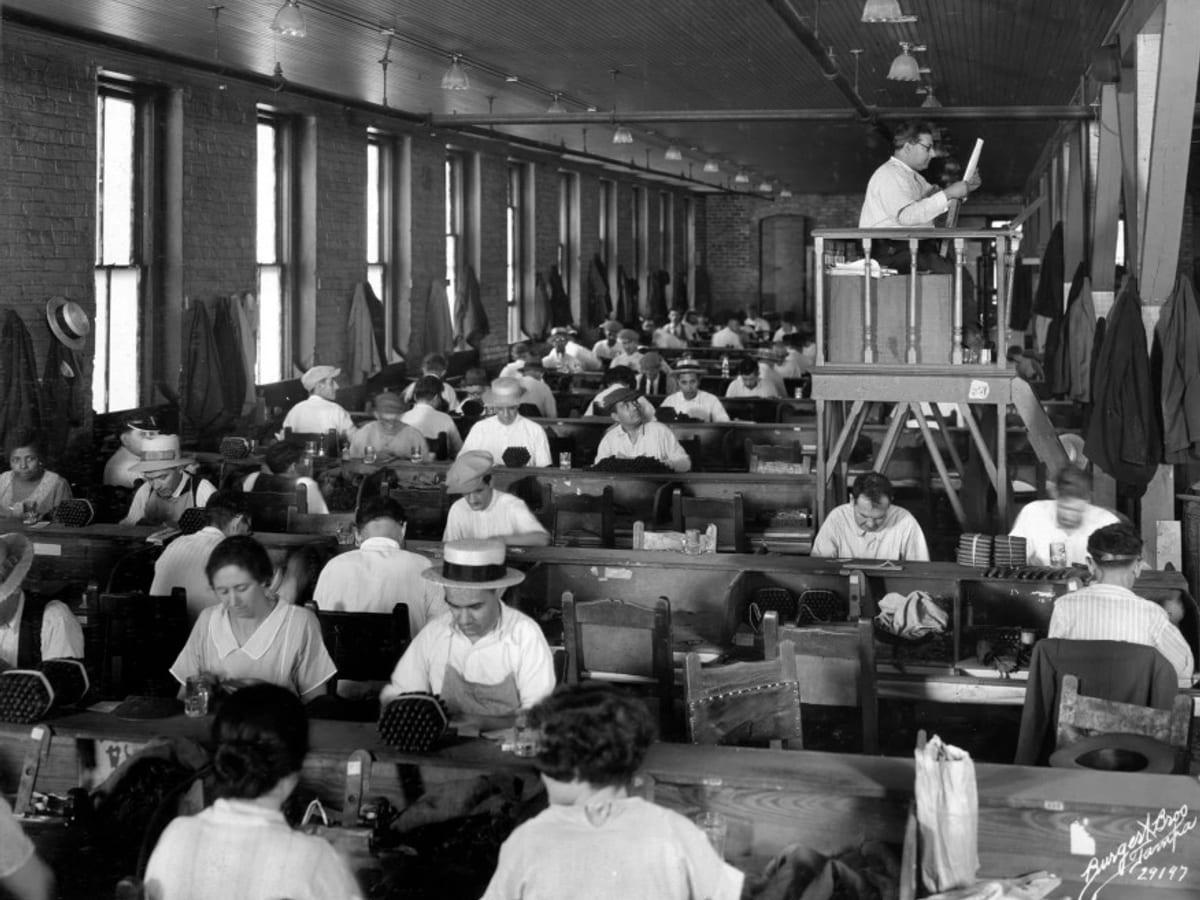
Cigars are unusual among luxury goods in being made partly at industrial scale and partly entirely by hand, often by very different kinds of companies. This lesson lays out the two structures and then works through the main producers: Scandinavian Tobacco Group, Habanos S.A., Altadis and its parent Imperial Brands, Swisher and Villiger, and the family makers such as Plasencia, A.J. Fernández, Drew Estate, Fuente and Padrón. Major Cigar Brands covers the individual brands themselves.
Two structures
The industry divides into global corporate producers and independent premium makers. The corporate producers own long lists of brands and compete on scale, distribution and retail reach. The premium makers are typically family businesses that own one or a few brands and compete on reputation for quality. Many of the largest brands in a humidor belong to one of the two global giants, while much of what a connoisseur prizes comes from the family houses. Both matter, and they feed each other: the giants buy tobacco and factory time that the family growers and factories supply.
Scandinavian Tobacco Group
Scandinavian Tobacco Group is one of the world's largest cigar makers by volume. It is based in Copenhagen and traces its modern form to 1961, when three Danish tobacco companies merged as Skandinavisk Tobakskompagni; in 2010 it combined with the cigar and pipe-tobacco business of Swedish Match, which brought it the American subsidiary General Cigar and the online retailer Cigars International. It now employs about 8,100 people and has production in the Dominican Republic, Honduras, Nicaragua, Indonesia, the Netherlands, Belgium, Denmark and the United States. Through General Cigar it controls well-known non-Cuban versions of brands such as Macanudo and CAO, and it has built its American reach by buying retailers and a long list of smaller cigar companies, among them the machine-made brand Lane Limited, the handmade maker Toraño, the retailers Thompson Cigar and PipesandCigars.com, Peterson pipe tobacco and, in 2020, the Dutch producer Royal Agio. It went public on the Copenhagen stock exchange in 2016. Scandinavian Tobacco Group represents the modern corporate premium model: traditional hand-rolling married to industrial logistics and a global retail channel.
Habanos S.A., Cuba
Habanos S.A. is the company that promotes, distributes and exports every Cuban cigar. It was formed in 1994 and is owned half by the Cuban state, through Cubatabaco, and half by Tabacalera S.L. of Madrid, owned by Allied Cigar Corporation, which bought that half from Imperial Brands in 2020; the Spanish tobacco group Altadis had bought it in 2000. It holds a worldwide monopoly on the sale of Cuban cigars and owns the trademarks of all of them abroad; it sells to only one distributor in each country, so that Hunters & Frankau acts for Britain and Ireland and a single firm acts for each other market, a system designed to control distribution and fight counterfeiting. Its range runs to 27 handmade brands, led by Cohiba, Montecristo, Romeo y Julieta and Partagás. In 2024 it reported revenue of $827 million, up 16 percent on the year before, on sales focused on Spain, Switzerland, the United Kingdom and China. Habanos is the opposite of the corporate Western model: state-linked, origin-protected and tied to national identity, its value resting on terroir, hand-rolling and limited supply rather than volume.
Altadis and Imperial Brands
Altadis was formed in 1999 by the merger of Tabacalera, the former Spanish tobacco monopoly, with SEITA, the former French tobacco monopoly. It became one of the largest producers of both mass-market and premium cigars in the world: through its American subsidiary it owned the non-Cuban versions of brands such as the Dominican-made Romeo y Julieta and Montecristo, and in September 2000 it bought a 50 percent share of Habanos S.A. In 2008 Altadis was acquired outright by the British tobacco group Imperial Tobacco, now Imperial Brands. In 2020 Imperial sold its premium cigar business in two parts: the American subsidiary, Altadis U.S.A., went to Gemstone Investment Holding, and the rest, including the half of Habanos, went to Allied Cigar Corporation of Madrid, which trades under the old Spanish name Tabacalera. Altadis represents the heritage-brand model, in which a historic cigar name is made in several countries for several different markets under one corporate roof.
Swisher, Villiger and the mass-market makers
Swisher represents the other end of the cigar trade. Founded in 1861 in the United States, it is one of the largest cigar makers in the world by volume, producing billions of machine-made cigars and cigarillos a year under names such as Swisher Sweets. These are everyday tobacco products sold through convenience stores, a different business from the humidor trade, with different scale, pricing and rules. Villiger shows another route: founded in Switzerland in 1888 and still family-owned, it makes both cigars and cigarillos and runs its own factories in several countries, including the Dominican Republic and Indonesia, scaling globally while staying independent.
The family premium makers
Below the giants sit the family houses that drive the premium market's character. Many are tied to a single country and a handful of farms. In Nicaragua and Honduras, the Plasencia family grows large amounts of the region's tobacco and rolls cigars under their own name and for others, from fields in Jalapa and elsewhere; A.J. Fernández grows broadleaf and Cuban-seed tobacco on his farms near Estelí and runs factories there; and Drew Estate, also in Estelí, built a following on bold and flavored lines such as Liga Privada and Acid. Davidoff, the Swiss house founded by Zino Davidoff in Geneva, left Cuba and has made its cigars in the Dominican Republic since 1990, at the blender Henke Kelner's Tabadom factory. In the Dominican Republic and Nicaragua, families such as Fuente, Padrón and Perdomo maintain their own farms and factories and stake their names on consistency. These companies own fewer brands and less shelf space than the giants, but they own the reputation the giants rely on, and their persistence is what keeps hand-rolling at the center of the industry.