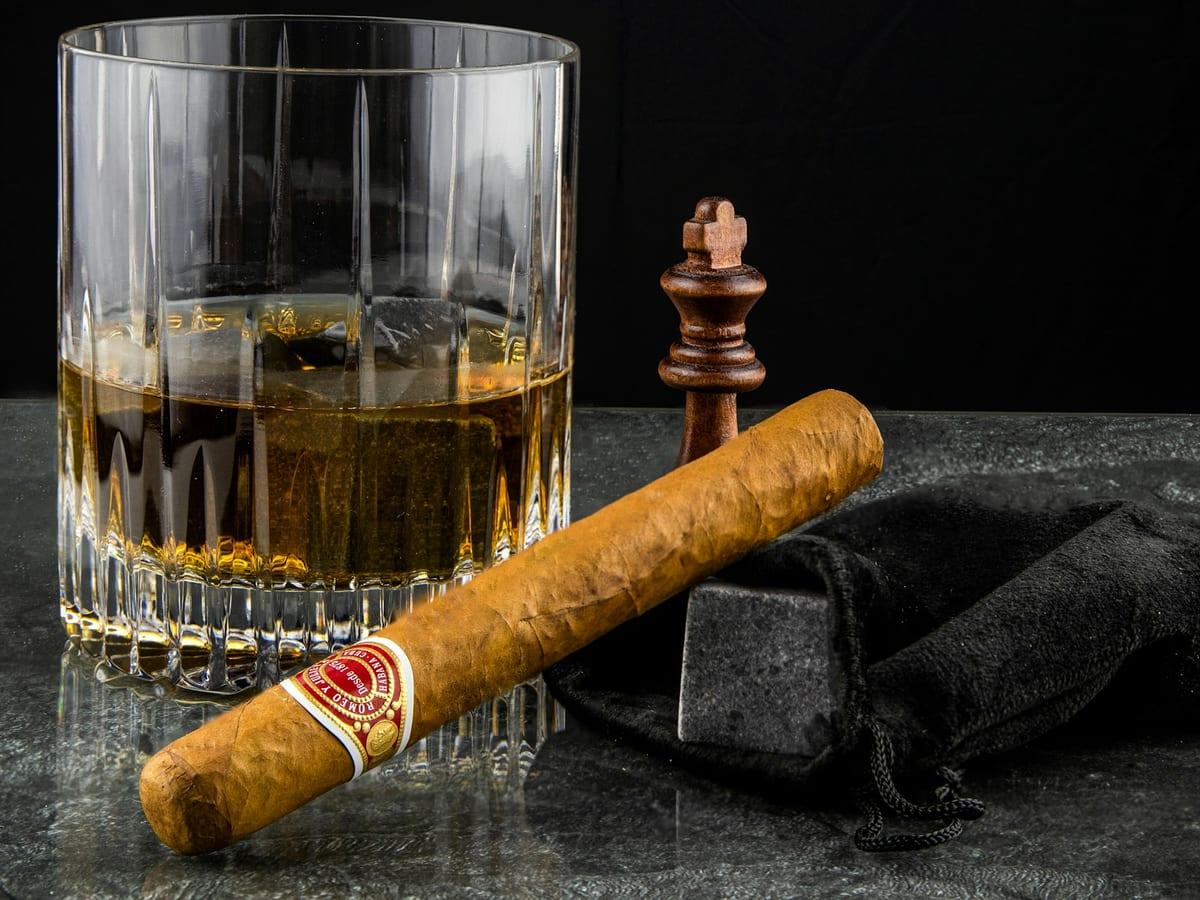
A distilled spirit is a cigar's natural companion, and for a plain reason: both are built by fermentation and then by slow aging in wood, so both carry the same deep vocabulary of caramel, vanilla, oak, spice, dried fruit and smoke. Where a spirit has more alcohol than wine or beer, it can meet a full cigar as an equal, and its finish can run the length of a slow draw. This lesson looks at whisky, rum, cognac and brandy, and tequila and mezcal, with what each brings and what each suits. Introduction to Pairing sets out the mechanisms behind them, and the health caution about alcohol is there for the whole lesson.
Whisky
Whisky, whisky in Scotland and Ireland and whiskey in the United States, is the widest of the pairing families because it spans almost the whole cigar scale, and it is usually the safest place to start. It is grain spirit, usually malted barley, maize, rye or wheat, aged in oak, and its family is broad enough to meet almost any cigar.
What the barrel gives is the key to the match. Oak aging deposits caramel, vanilla and coconut in the spirit, and those sweet notes sit comfortably against the natural sweetness of a cigar, while the wood itself echoes the cedar that lines a cigar's box. Bourbon, the sweet, maize-based American whiskey, brings the most vanilla and caramel of the family and is the common recommendation with a medium to full Nicaraguan cigar, whose earthy, spicy leaf it rounds off. A Speyside or Highland malt Scotch, lighter, honeyed and malty, suits the softer, creamier Dominican blends. A peated Islay malt, smoky with a medicinal, iodine edge from malt dried over peat smoke, is heavy enough to meet strong, earthy cigars, its smoke against their smoke on equal terms. Rye whiskey, dry and spicy, is a contrast pour for a creamy, cocoa-forward cigar. Whisky is the one family a taster can reach for through almost the whole body range, so long as the pour is matched to the cigar, a principle Strength vs. Body: Common Confusion explains when it warns that a dark wrapper does not by itself make a strong cigar.
The match can be seen in a maker's own list. Davidoff, whose pairing guide pairs its cigars with named spirits, sets its mild, creamy Signature line beside the Classic Laddie, an unpeated Islay single malt, and its fuller Winston Churchill line beside The Dalmore's Cigar Malt Reserve, a single malt made with a cigar pairing in mind, and its richest expressions beside an aged Dalmore and long-aged cognacs. The pattern is the one this lesson states: the heavier and sweeter the cigar, the older and heavier the whisky.
Rum
Rum is the cigar's partner from the other half of the map. It is distilled from sugar cane, molasses or cane juice, and because it is born sweet, it is the most forgiving of the spirits and the usual first choice for a newcomer and the customary pour of the Caribbean. Light, unaged rum is gentle enough for a mild cigar with a Connecticut wrapper; aged and dark rums, their sweetness concentrated and their oak weight added by years in a tropical warehouse, stand up to a medium or full cigar. A solera-aged rum, blended and reblended through a long line of casks so that old and young rum mix year by year, brings a rich, raisin-and-cocoa depth that suits a complex cigar with chocolate and coffee notes. Because rum's sweetness suppresses the sense of bitterness, a sweet, aged rum is also the classic contrast against a peppery, strong cigar, softening the pepper while the pepper makes the sweetness seem brighter.
Cognac and brandy
Cognac is the spirit of the long, dressed-up smoke, and it dominates cigar pairing in the European and high-end lounge tradition. It is a brandy, a spirit distilled from wine, and by law it must be twice distilled in copper pot stills and aged in oak in the Cognac region of France, with its grades fixed by how long the youngest component has spent in cask: VS, or Very Special, at least two years, VSOP, or Very Superior Old Pale, at least four, and XO, or Extra Old, at least ten since the grade was tightened in 2018. The grape base plus the oak gives cognac dried fruit, leather, vanilla and spice, so its character runs close to a well-aged cigar; the two often talk the same language. The grade shapes the pairing. A VS or VSOP, younger and brighter, suits a medium cigar, while an XO, round, deep and long, suits a full-bodied cigar, where its weight meets the smoke instead of burying it. The same rule holds for other brandy, Armagnac above all, and it is the priciest pairing habit in the topic, one many tasters keep for a celebration. Davidoff's guide pairs its long, premium Royal Release with the Rémy Martin 1738 and its Winston Churchill Late Hour with the Rémy Martin XO, the older spirit against the fuller cigar.
Tequila and mezcal
The agave spirits are the newest of the four families on the cigar list, and they are growing fast in smoke lounges. Both are distilled from the cooked agave plant of Mexico; tequila from the blue agave, mezcal from other agaves and often cooked in earthen pits that give it a smoky, earthy edge. They run by age. A blanco tequila, unaged and crisp with a clean, herbal bite, suits a mild cigar and the daytime smoke; a reposado, rested a few months in oak, rounds into the middle and suits a medium cigar; an añejo, aged a year or more and carrying vanilla and spice from the barrel, suits a full-bodied cigar. Mezcal's smoke and earth make it a direct match for earthy, strong cigars, its smoke echoing the smoke of the cigar itself. Because the agave spirits are drier and more herbal than whisky or rum, they work most often as a contrast to the cigar's sweetness, which is one reason they feel modern beside the older, sweeter pairings.
How to pour it
The table gathers the four families on what each brings and what each suits.
| Spirit family | What it brings | Cigars it suits |
|---|---|---|
| Whisky | Oak sweetness, caramel and vanilla; smoke in peated malt | Almost the whole range: bourbon with medium-to-full Nicaraguan; Speyside and Highland malt with Dominican; peated Islay with strong, earthy; rye with creamy, cocoa |
| Rum | Natural cane sweetness; oak and dried fruit when aged | Light rum with mild Connecticut; aged and solera rum with medium to full; sweet aged rum as a contrast with peppery |
| Cognac and brandy | Grape fruit, leather, spice, long oak finish | VS and VSOP with medium; XO with full-bodied |
| Tequila and mezcal | Herbal, mineral, earthy; smoke in mezcal; oak in añejo | Blanco with mild by day; reposado with medium; añejo with full; mezcal with earthy, strong |
Read down the middle column and the rule repeats itself: the more barrel and age a spirit carries, the heavier the cigar it suits. A long-finish spirit works best with a long-finish cigar, so that one does not drop away while the other is still building; this is why the oldest spirits are matched to the slowest, fullest smokes.
Two practical cautions, both in the "how" rather than the "what". First, keep high-proof spirits away from mild cigars, since the alcohol drowns a light smoke completely. Second, pace the glass: a spirit drunk too fast numbs the palate and turns the pairing into a contest neither side wins. Sip after you set the smoke down, wait, then draw. And because a cigar's effect builds through the smoke, as Strength: Nicotine and Ligero explains, the same glass lands harder in the final third than it did in the first, so it is worth slowing both the cigar and the pour as the two go on.