Every variety in the previous lesson is the result of genetics and of people's choices: seed saved from the best plants, flowers crossed by hand, offspring grown and judged for years. This lesson explains where the tobacco plant comes from, how its flowers pollinate, how growers and breeders have changed it by selection and by crossing, what a hybrid is, and how resistance to disease has been bred into cigar tobacco. Seed and Varietals describes the varieties themselves, and Seed Preservation how seed is grown and kept.
One species, two ancestors
All the world's cultivated tobacco, cigar tobacco included, belongs to Nicotiana tabacum. It is not a wild plant but a natural hybrid of two wild tobaccos, Nicotiana sylvestris and Nicotiana tomentosiformis, that crossed, probably in the Andes, within the last 200,000 years. Each ancestor had 24 chromosomes, and the hybrid kept both sets, so tobacco has 48. Biologists call such a plant an allotetraploid: it carries two complete sets of chromosomes from each of two different ancestors.
That double inheritance gives the species great variety. In 2025 researchers in China published genetic data for 5,196 samples of cultivated tobacco held in a seed collection.
How tobacco pollinates
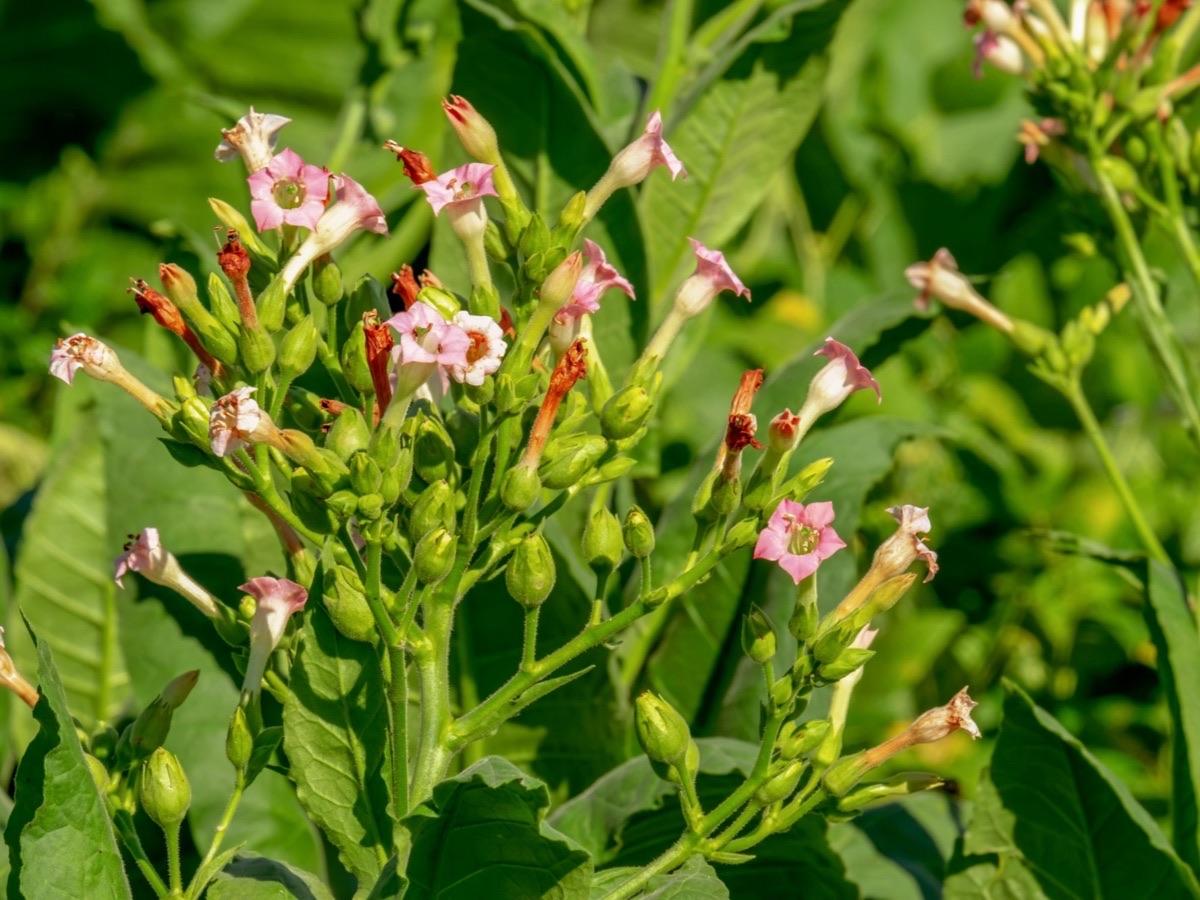
A tobacco flower is a long tube with five stamens, which carry the pollen, around a single pistil. Just before the flower opens the pistil stands above the stamens, but as soon as the pollen sacs open, the stamens grow rapidly and push them up past the tip of the pistil, the stigma, dusting it with the flower's own pollen. Tobacco is therefore naturally self-pollinating. A drop of nectar at the base of each flower draws bees, bumblebees and hummingbirds, though, and they carry pollen from plant to plant; the stigma stays ready to take pollen for three or four days, long enough for many visits.
Self-pollinated seed gives plants like their parent. Crossed seed gives a mixed crop, some plants like one parent, some like the other and many in between. A U.S. study of tobacco breeding in 1907 put most of the unevenness in growers' fields down to such chance crossing, which is why seed plants have long been covered with bags, as Seed Preservation explains.
Selection
The oldest way to improve tobacco is to choose the best plants and sow only their seed. Selection can change a variety quickly. In U.S. breeding trials in the early 1900s, two years of choosing seed plants and saving their seed under bags raised the number of leaves on Sumatra-seed shade tobacco from an average of 19 or 20 a plant to 23 or 24, without making the plants taller. The same work showed that plants whose leaves ripened evenly from the bottom to the top could be found and bred, as Leaf Maturity explains.
Selection also fits a variety to a new place. Cuban seed grown in Connecticut at first gave a crop in which a third of the plants were freaks, branching plants with small, pointed, coarse leaves of no use for wrapper; two generations of seed chosen from the best plants and saved under bags gave a uniform crop. Some growers still rely on selection alone. The Eiroa family in Honduras develops its Corojo this way rather than crossing it with other tobaccos.
Crossing
Crossing brings together the qualities of two varieties. The 1907 study described how it was done, and breeders still work much the same way. On the mother plant, every flower and pod is removed except the buds due to open within the next 12 to 15 hours. In the afternoon each of these is opened and its stamens are cut away with fine scissors and forceps before they shed pollen, and the flower head is covered with a thin paper bag. The next morning, when the stigma turns sticky, pollen from the father plant is laid on it with the point of a scalpel, and the bag goes back on until the seed has set. Dry pollen keeps for weeks; the researchers mailed it more than 1,000 miles and it still worked.
The offspring of a cross are uneven, so a breeder grows them on, lets the best pollinate themselves and selects again, generation after generation, until a line breeds true. Corojo 2012 shows the timescale. Its parents were crossed at the San Juan y Martínez experiment station in the 2001–02 season, and after five generations of self-pollination and selection the station had seven resistant varieties, of which Corojo 2012 was one. Breeders can also cross back. Habana 2000 began as a cross between Corojo and a mild Cuban cigarette tobacco, Bell 61-10, and the result was crossed with Corojo again, so that the new variety would keep Corojo's character while holding on to the resistance of the other parent.
A tobacco pod holds 4,000 to 8,000 seeds and a plant several hundred thousand, which helps the breeder. A single plant gives enough seed to test a new line on a large scale the following year.
Hybrids
The trade uses the word hybrid loosely. Most varieties called hybrids, such as Criollo 98, Corojo 99 or Corojo 2012, began with a cross but have been self-pollinated and selected until they breed true, so a grower can save their seed. A first-generation hybrid, or F1, is different: it is the direct offspring of two parent lines, and since its own seed would give an uneven crop, the cross has to be made again every year. Seed producers make F1 seed in quantity by using mother plants that make no pollen, called male-sterile plants, so that no flowers have to be opened by hand. The Ecuadorian grower A.S.P. grows its experimental hybrids only from such plants, so that no one can reproduce its work from a stolen flower.
First-generation hybrids are usually vigorous, but in tobacco their extra yield is modest; in a 1980 Korean trial of 21 burley hybrids, the best outyielded a standard variety by 2 to 11 percent. For cigar leaf, vigor alone has rarely been enough. Connecticut tried several hybrids in the early 20th century. The Halliday hybrid, popular around 1900, was soon given up because its plants were not uniform; a cross of Havana Seed and Broadleaf known as Mongrel yielded heavily but found few buyers, because it was neither one nor the other; and Roundtip, which the station bred from Sumatra and Broadleaf and first grown commercially in 1920, resisted root rot and yielded well but did not please the trade, and by 1934 no one grew it. The station concluded in 1934 that crossing usually gave a hybrid that was vigorous and high-yielding but lacking in quality, and that cigar makers wanted large amounts of uniform leaf rather than new types.
Breeding for disease resistance
Most cigar tobacco bred since the 1980s was bred first of all to resist disease. The table compares the main diseases with the sources of resistance breeders have used.
| Disease | Cause | Sources of resistance | Resistant cigar varieties |
|---|---|---|---|
| Tobacco mosaic virus | A virus spread mainly on workers' hands | The N gene, from the wild Nicotiana glutinosa | Cuba's Criollo 98, Corojo 99 and Corojo 2012; Connecticut Broadleaf "33" |
| Black shank | A soil-borne water mold, Phytophthora nicotianae | The Ph genes, from the wild Nicotiana plumbaginifolia and Nicotiana longiflora; a partial resistance carried by many genes in Florida 301, an old cigar variety | Every Cuban variety in the previous lesson; no Connecticut Broadleaf |
| Blue mold | A mildew, Peronospora tabacina | In Cuba, R x T, a Polish tobacco | Habana 92 and Sancti Spíritus 96, and varieties bred from Habana 92 such as Criollo 98 and Corojo 99; Intabaco T-13 |
| Environmental necrosis | Ozone in the air | Bred into Cuban varieties | Habana 92, Corojo 99, Corojo 2012 |
The table shows how often resistance comes from outside cigar tobacco. Mosaic resistance came from a wild species in 1938, when an American plant pathologist, Francis Holmes, showed that a single dominant gene, which he named N, controlled it and bred it into tobacco. Black shank resistance came both from wild species and from Florida 301, a cigar tobacco whose partial resistance, spread across many genes, has been used widely. The Ph genes guard only against one race of black shank, race 0, and not against race 1. The Ph genes have nothing to do with blue mold, a different disease; Cuba's resistance to blue mold came from the Polish R x T.
Resistance can come at a price. A gene taken from a wild plant brings neighboring pieces of the wild plant's chromosome with it, which breeders call linkage drag. Varieties carrying the N gene have often yielded less and given poorer leaf, and breeders in China reported in 2025 that they had cut the wild piece around the gene down to make resistant lines without the loss. Cuban breeders made the leaf's quality a condition of every new variety: their program was set to resist blue mold, black shank and environmental necrosis while keeping the taste and aroma of the old Cuban leaf.
Who breeds cigar tobacco
Cuba's Tobacco Research Institute breeds all of Cuba's cigar tobacco, at stations across the island; Corojo 2006 and Corojo 2012 came from its station at San Juan y Martínez. In the Dominican Republic, Intabaco breeds for the country's growers. Connecticut's agricultural experiment station bred and selected cigar tobacco from the 1900s, while in Kentucky and Tennessee today there is little variety work on Connecticut Broadleaf, and the dealers supply the seed. Private growers breed for themselves and keep their work secret: Davidoff and A.S.P. created a hybrid together, and Padrón calls its seed proprietary.