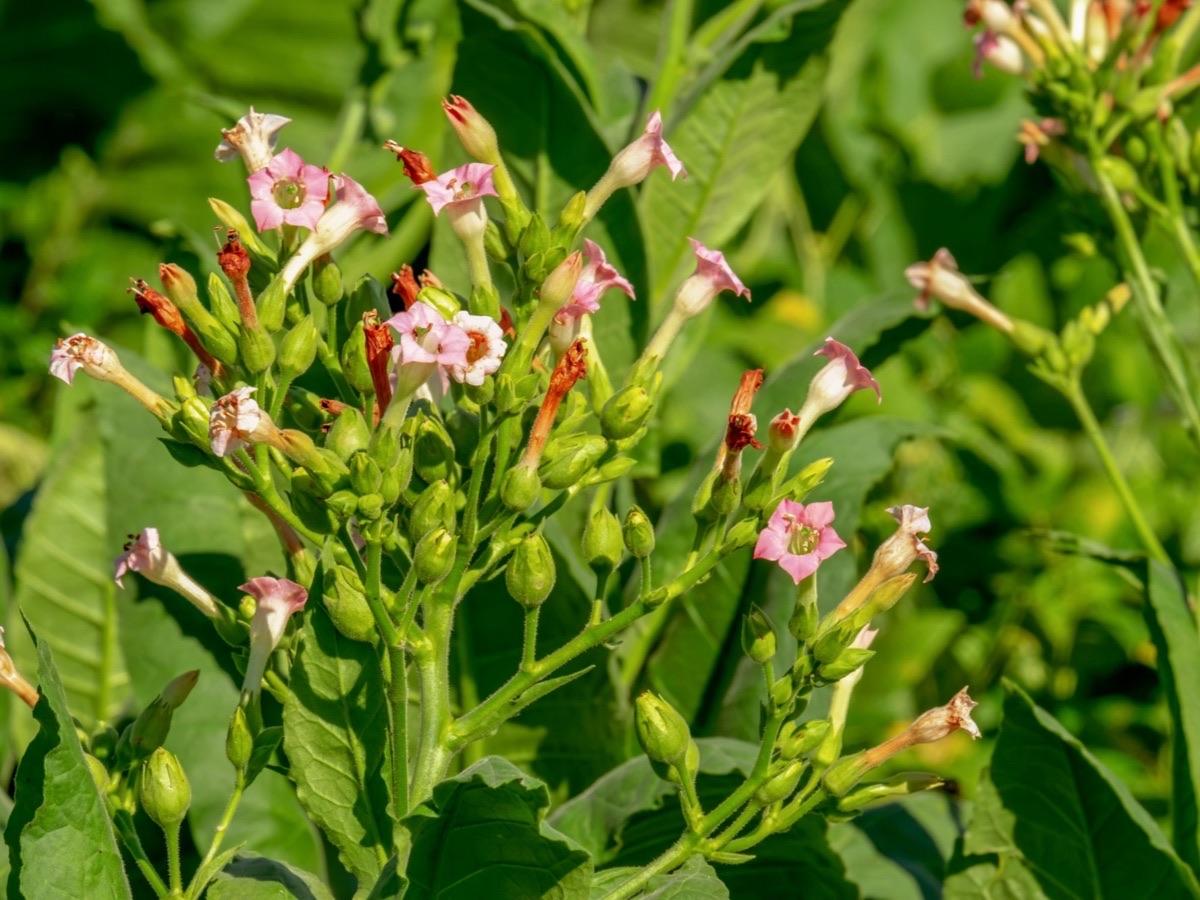
A grower who keeps good seed keeps the character of a crop from one year to the next. Seed saved carelessly gives a field of mixed, uneven plants; seed stored badly sprouts poorly or not at all. This lesson follows seed from the choice of the seed plant through bagging, harvesting and cleaning to storage, and looks at how long tobacco seed lives, at the seed banks that keep old varieties, and at who keeps cigar seed today. Seed Genetics and Hybridization explains why the flowers must be protected.
Choosing seed plants
Seed plants are chosen in the field before topping. A guide written for Connecticut growers in 1905 advised walking the field during cultivation and topping with a pocketful of tags and tying one to each plant that came nearest the grower's ideal. A chosen plant is left untopped so that it can flower. The same guide advised picking its top leaves down to where it would have been topped and breaking off the large lower branches of the flower head, leaving only the central cluster to bear seed. A plant can't give its best leaves and its best seed at once: the more and larger leaves a plant carries, the less seed it makes.
The leaves of a seed plant tell the grower what its seed is worth. The 1905 guide suggested curing and fermenting the leaves of each seed plant separately, labelled, and judging their burn, color and texture before deciding whose seed to sow. In Cuba, seed is grown on fields set aside for it: in 2026 the municipality of San Juan y Martínez, which supplies about 80 percent of the country's tobacco seed, planned 31.5 hectares of seed plants.
Bagging the flowers
The flower heads of seed plants are covered before any flower opens, so that only their own pollen reaches them, and any flower that has opened is picked off first. Connecticut growers in 1905 used the common manila grocery bag, preferring one with a roof-shaped bottom that shed the rain, tied around the stalk below the flower head firmly enough to keep out insects without hurting the plant. As the plant grew, the bag was moved up so that the flowers did not press against it, and late in the season the dead flowers were shaken out.
Bagging makes a visible difference. On a Connecticut shade farm in 1905, the grower saved seed in the open from the same field where researchers had saved seed under bags. The crop from the bagged seed was uniform; the crop from his own seed had as many freak plants as a crop grown from newly imported seed.
Harvesting and cleaning the seed
A tobacco pod holds 3,000 to 8,000 seeds, by the counts of the early U.S. researchers, and a plant some 500,000 to a million; a single bagged plant gave them one to fourteen ounces of seed. The pods on one head do not all ripen at once, and the seed is ready when they have all turned brown. Cutting the heads too early mixes immature seed with the ripe, and immature seed tends to sprout early in the bed and give weak, uneven plants. The 1905 guide advised cutting the ripe heads with their bags, hanging them in a dry, airy place, and in spring threshing the best pods.
Threshed seed is full of chaff and of light seed, and the light seed is the problem. The Connecticut researchers found that about half the seed growers were planting in 1905 was light, and that light seed sprouted earliest in the bed and gave the freak plants that topped out too early and spoiled the crop. They separated it with a current of air, blowing the seed up a glass tube five feet long with a foot bellows so that chaff, light seed and small seed blew out and heavy seed stayed. Floating the seed in water, which some recommended, did not work well, because bubbles of air kept much of the heavy seed from sinking. Today tobacco seed companies coat much of their seed in clay pellets for the float trays described in Nurseries and Seedbeds.
Keeping seed alive
Dryness and cold keep tobacco seed alive. In India, seed dried until it held 5 to 6 percent moisture or less and stored at room temperature with a drying agent, anhydrous calcium chloride, still sprouted after 24 years, its moisture held below 4.5 percent; seed stored without the drying agent took up moisture to 6 to 7 percent and was dead within 24 months. Drums of 50 kilograms of seed stored the same way kept it alive for 17 years.
Cold adds decades. A study of tobacco seed held in seed banks in Poland and Germany, published in 2025, found that lowering the storage temperature from 20 °C to 0 °C lengthened the time seed stayed alive, counted as more than 75 percent sprouting, from about 10 years to about 30, and that freezing it at −18 °C added about another 20. Seed kept in an ordinary room also suffered from the seasonal swings in humidity. Even seed buried in soil can last: in an experiment begun in Virginia in 1902, tobacco seed dug up 39 years later still sprouted, 17 to 22 percent of it.
The table compares storage conditions from these studies with how long the seed lived.
| How the seed was kept | Seed moisture | How long it stayed alive |
|---|---|---|
| Room temperature, no drying agent (India) | 6 to 7 percent | Less than 2 years |
| Room temperature, with calcium chloride (India) | Below 4.5 percent | At least 24 years |
| Room, about 20 °C (Poland and Germany) | About 10 years on average | |
| 0 °C, in vacuum-sealed jars (Poland) | 4 percent | About 30 years on average |
| −18 °C, in sealed jars (Germany) | 6 percent | About 50 years on average |
| Buried in soil (Virginia, from 1902) | Some still alive after 39 years |
Read from top to bottom, the table shows two rules: the drier the seed and the colder the store, the longer it lives, and moisture matters as much as temperature. Seed that is dry and sealed lives for decades even at room temperature, while seed left to take up moisture can die in two years.
Before sowing, growers test their seed by counting how much of a sample sprouts. In a greenhouse trial in Kentucky, 91 to 93 percent of the seed sprouted within 14 days in float trays, and U.S. growers in the tobacco industry's Good Agricultural Practices program must record the lot number of the seed they sow.
Seed banks and seed systems
Seed banks keep varieties no longer grown. The U.S. collection of tobacco, kept by North Carolina State University, held about 1,900 varieties of cultivated tobacco and 224 samples of 59 wild Nicotiana species in 2007. Cuba keeps its national seed bank of dark, Virginia, Burley and Oriental tobacco at the Tobacco Research Institute's station at Cabaiguán, and the institute produces the original seed from which the country's seed for farmers is multiplied.
Outside Cuba, seed has long been precious and easy to carry. In 1902, when shade tobacco spread across the Connecticut Valley from 41 acres to more than 700, growers bought seed in Florida, without much care for its quality, at $2 an ounce. Piloto Cubano came to the Dominican Republic in 1962 and Corojo to Honduras in the late 1980s or in 1997, as Eiroa family accounts differ, carried out of Cuba as seed. Today makers who grow their own leaf keep their seed as a trade secret, and some protect it further by growing hybrids from plants that make no pollen, as Seed Genetics and Hybridization explains.