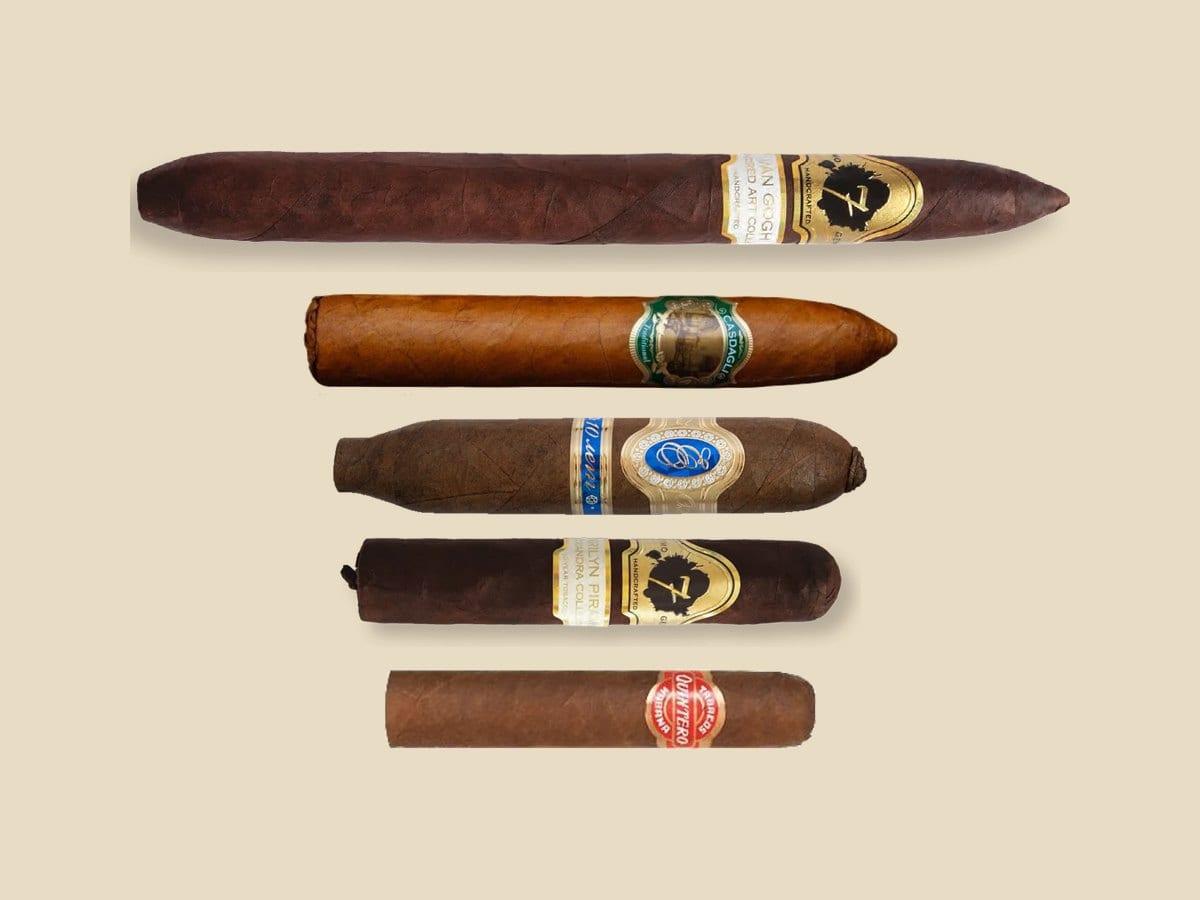
Shape is the part of a vitola you notice first. Two cigars of the same length and ring gauge can look and smoke quite differently if one is round and the other pressed square, or if one has a rounded head and the other a sharp point. This lesson describes the two families of shape, with examples from Cuba, the Dominican Republic, Nicaragua and Honduras, then explains how shape, thickness and length change the smoke, and how to cut and light each shape.
Parejos
A parejo, from the Spanish for even, has straight, parallel sides, a rounded head closed by a cap, and an open foot. Most cigars made in every country are parejos, including all the classic sizes in What Is a Vitola. Because its diameter stays the same from foot to head, a well-made parejo draws and burns at an even pace from the first puff to the last, and the only cut it needs is at the head.
Box-pressed cigars
A parejo can be round or box-pressed, prensado in Spanish: squared off, with flat sides and rounded edges. The shape began in Cuba as a by-product of packing, because round cigars packed tightly into a box take on a squared look. Today makers press cigars on purpose, in two main ways. In box-pressing, round cigars are packed tightly into boxes, which are stacked and pressed, and the result sits somewhere between a circle and a square. In trunk-pressing, wooden slats are placed between the cigars, and each cigar is turned and pressed again on its other sides, which gives a sharper, boxier shape. Makers call a gentle version, with well-rounded corners, a soft press. The Box Types and Styles lesson in Cigar Boxes explains how pressed and round cigars are packed.
Whatever the method, a pressed cigar is still a parejo. Pressing changes the cross-section, not the family, and a pressed torpedo is still a figurado. Whether pressing changes the smoke is disputed. Some say it packs the tobacco tighter, so the cigar burns cooler and more slowly; others point out that a pressed cigar is usually made with a little less tobacco, to keep its draw open, and see its appeal mainly in the look and the feel. It certainly sits differently in the hand and between the lips.
The modern fashion for pressed cigars began in Nicaragua. In 1994 Padrón launched its 1964 Anniversary Series to mark the company's 30th anniversary, with every size squared off as a tribute to the old Cuban tradition of box-pressing, an idea of the company's founder, José Orlando Padrón. Padrón's 1926 Serie is pressed as well. Pressed cigars have since been named the best cigar of the year in each of the three big producing countries outside Cuba. The Alec Bradley Prensado Churchill, 7 × 48 (178 mm), made in Honduras, took the title in 2011 and is still the only Honduran cigar to have done so. The My Father Le Bijou 1922 Torpedo Box Pressed, 6⅛ × 52 (156 mm), from Nicaragua, followed in 2015; it is the only pressed size in its line. The E.P. Carrillo Pledge Prequel, a dark 5 × 50 (127 mm) from the Dominican Republic, won in 2020, and the Padrón 1964 Anniversary Torpedo, 6 × 52 (152 mm), in 2021.
Figurados
A figurado is any cigar whose diameter changes along its length: pointed at one end, or at both ends for a double figurado. Figurados are harder to roll than parejos, because the roller has to shape the taper by hand and still keep the bunch, the filler rolled in its binder, evenly filled. In Cuba only the top grade of torcedor may roll the largest and most complicated sizes. Shape alone guarantees nothing, though, and a well-made parejo smokes better than a badly made figurado.
The names of the shapes overlap and vary from maker to maker. Torpedo is the clearest case. Some makers use it for a pirámide with a sharper point, others for any cigar with a pointed head, and some glossaries for a cigar with a closed foot, a pointed head and a bulge in the middle. Habanos gives its Pirámide format the common name Torpedo, while remarking that the double figurado is perhaps the better candidate for the title. It is safer to go by the shape than by the name. The table describes the shapes you will meet most often, with examples.
| Shape | What it looks like | Examples |
|---|---|---|
| Pirámide (pyramid) | An open foot, like a parejo, and a body that tapers steadily to a pointed head, often from 52 or 54 ring at the foot to about 40 at the head | Montecristo No. 2 (Cuba, Pirámide format, 156 mm × 52); Padrón 1964 Anniversary Piramide (Nicaragua, 6⅞ × 42/52) |
| Torpedo | Usually a pirámide with a sharper point; the name is used loosely | My Father Le Bijou 1922 Torpedo Box Pressed (Nicaragua, 6⅛ × 52) |
| Belicoso | A short pirámide, often with a slightly rounded point | Bolívar Belicosos Finos and Romeo y Julieta Belicosos (Cuba, Campana format, 140 mm × 52) |
| Chisel | A pointed head flattened sideways into a wedge, like the blade of a chisel | La Flor Dominicana Double Ligero Chisel (Dominican Republic, 6 × 54) |
| Perfecto | Tapered at the head and at the foot, usually with a bulge in the middle | Arturo Fuente Hemingway (Dominican Republic, from 4 × 49 to 9 × 52); Padrón 60th Anniversary Perfecto (Nicaragua, 6½ × 56) |
| Salomón and diadema | Very large double figurados, sometimes 8 in (203 mm) long or more; a salomón's closed foot swells into a bulb that ends in a small tip | Cuaba Salomón (Cuba, 184 mm × 57); La Flor Dominicana Andalusian Bull (Dominican Republic, 6½ × 64) |
| Culebra | Three slim cigars braided together and tied with string, smoked one at a time | Partagás Culebras (Cuba, each 146 mm × 39); Kafie 1901 Culebra (Honduras, each 6 × 38) |
Read down the table and two groups appear: the first four shapes taper only at the head, while the perfecto and its larger relatives, the salomón and the diadema, taper at both ends. The culebra stands apart, three cigars sold as one.
Figurados around the cigar world
Figurados were once the norm. In the nineteenth century nearly all Cuban cigars were double figurados, and straight-sided cigars overtook them only in the mid-1930s. Perfectos stayed popular with makers in the United States through the 1920s, 1930s and 1940s, then all but vanished. Carlos Fuente Jr. has said that when his family began making cigars in the Dominican Republic in 1980, nobody was making shaped cigars.
The revival began with the Fuentes. Carlos Fuente Jr. persuaded his father to search the family's warehouse in Ybor City, the cigar district of Tampa, for the perfecto molds the company had once used, and in 1983 Arturo Fuente launched the Hemingway series: perfectos with an African Cameroon wrapper over Dominican binder and filler. The line is credited with reviving the perfecto, and the cigar boom of the 1990s spread shaped cigars across the industry. La Flor Dominicana, also in the Dominican Republic, added a shape of its own in 2003: the Chisel, whose head is flattened sideways into a wedge. Litto Gomez, who owns the company, has said the idea came from a torpedo whose head he had chewed flat while driving, and the shape is now a registered trademark. Its Andalusian Bull, a 64-ring salomón whose size came from an old mold Gomez found in Belgium, was named the best cigar of the year in 2016.
Cuba revived its own double figurados in 1996, at the Romeo y Julieta factory, with Cuaba, a brand in which every size is a double figurado, recreating the fashion of a century earlier. Its Salomón measures 184 mm (7¼ in) × 57. Cuba's best-known pointed cigar, though, is the Montecristo No. 2, made in the Pirámide format, and a classic belicoso is the Bolívar Belicosos Finos, in the Campana format.
Nicaragua has produced two of the most celebrated figurados of recent years. Oliva's Serie V Melanio Figurado, 6½ inches (165 mm) long, was named the best cigar of 2014, and Padrón's 60th Anniversary Perfecto, 6½ × 56 at its widest, the best of 2025. It is only the second perfecto Padrón has released, after the box-pressed 1926 Serie No. 80, made for José Orlando Padrón's 80th birthday. In Honduras, Kafie 1901 released a culebra in 2020.
The culebra
A culebra is three slim cigars, usually 5 to 6 inches (127 to 152 mm) long with a ring of about 38, braided together and tied with string. Some are made of three different cigars: Davidoff's limited Culebras of 2017, from the Dominican Republic, twisted together three cigars of different blends, each 6½ × 33 (165 mm). Untie the string and separate the three before cutting them, then smoke them one at a time; each is cut and lit like any slim cigar. A popular story says factories braided culebras so that their workers could not take more than their daily allowance of cigars, but it is a legend, with no document behind it. Cuba dropped its culebra from regular production, then brought back the Partagás Culebras in 2007, each cigar 146 mm (5¾ in) × 39, for its own franchised cigar shops.
How shape and size change the smoke
Shape, thickness and length each change the way a cigar smokes. These are tendencies rather than rules, because the blend, the rolling and the smoker's pace matter more, but they explain why two cigars of one blend rarely smoke alike.
Thickness is the clearest case. A thick cigar burns slowly and gives a larger volume of rounder, cooler smoke, and the bigger the cigar, the richer its taste tends to be. A slim one burns faster and hotter, especially if it is puffed hard, and concentrates its flavors on the tongue, which can make it taste a little sharper. A slim cigar also gives more of its flavor to the wrapper and binder, because there is less filler inside to balance them, which is why the wrapper's flavor is so prominent in a lancero. Consistency & Variation puts numbers on this.
Length mainly sets how long a cigar lasts. A long cigar gives the smoke more time to develop through its thirds, while a short one passes through the same changes faster. At the start, the long column of unburned tobacco cools and filters the smoke, which is one reason most cigars begin lighter and grow fuller, as the Body: Flavor, Weight, and Intensity lesson in Strength vs. Body explains.
Tapers work at either end. A tapered head narrows the opening the smoke passes through, and many smokers find that a pirámide's narrow head concentrates the smoke and lets its flavors blend on the palate. How deep you cut it sets the draw: the deeper the cut, the wider the opening and the more open the draw. A tapered foot works the other way round. A double figurado burns through its narrow tip first, where there is little filler, so its first puffs are dominated by the wrapper and binder, and the filler comes through as the burn reaches the wider body. Figurados with a tapered foot tend to change in flavor more than any other shape over the course of a smoke.
Shape and size change how strong a cigar feels far less than its blend does. There is no fixed link between a cigar's size and the strength of each puff, which comes mainly from the filler and its ligero, the strong leaves from the upper part of the plant, as the Strength vs. Body topic explains. Size does set the total, though. Large cigars typically hold between 5 and 20 grams of tobacco, and some premium cigars contain the tobacco equivalent of a whole pack of cigarettes, so over a whole smoke a bigger cigar of the same blend delivers more nicotine, even when each puff feels milder.
Cutting and lighting by shape
Shape changes how a cigar should be cut. On a round head, cut just above the line where the cap meets the wrapper. On a pointed head, Habanos suggests cutting about 3 mm from the point. Start small, take a draw, and cut a little more only if the draw is still tight, because every extra millimeter opens it further. A punch cannot cut a pointed head, so a figurado needs a straight cut, and a chisel head is cut the same way, a little at a time.
Shape changes how a cigar should be lit, too. On a perfecto only the narrow tip at the foot needs the flame. A very thick cigar, 55 ring and up, takes longer to light simply because there is more tobacco across its foot, so it needs a patient toast until the whole face glows evenly. A box-pressed cigar should be turned as it is toasted, so that the corners catch as well as the flat sides and none of them starts to canoe, burning faster down one side. The Cutters & Lighters topic covers the tools and techniques in full.