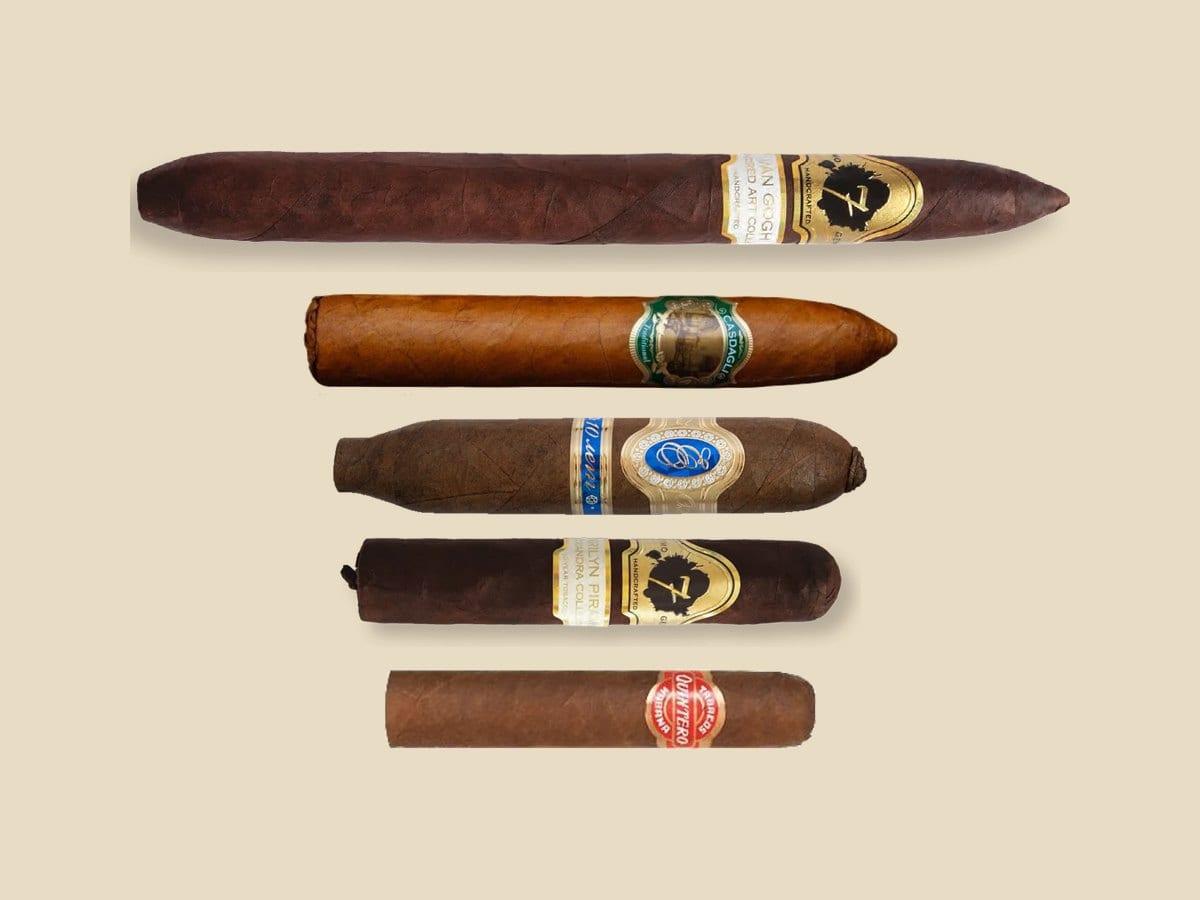
Every cigar is made to a set of measurements: a length, a thickness and a shape. Together they make its vitola, the word the trade uses for a cigar's format. The vitola decides how long a cigar lasts and how it sits in the hand, and it changes the way the blend inside it tastes, so the same tobacco can smoke quite differently in two sizes. This lesson explains how a cigar's size is measured and written, how Cuba names its formats, how makers in Nicaragua, the Dominican Republic, Honduras and elsewhere name theirs, and where the familiar names come from. Geometry & Smoke Dynamics covers the shapes, and Consistency & Variation how size changes a blend.
The word vitola
In Spanish a vitola can also be a gauge, a template for checking the size of something, and the cigar trade uses the word in a closely related sense: each of the standard formats in which cigars are made. In Cuba that is its meaning, and a cigar's vitola is simply its size and shape. In Spain the word has a second sense. There a vitola is also the printed paper band around a cigar, which Cubans call the anilla, and collecting cigar bands is known in Spanish as vitolfilia. A Spaniard and a Cuban can therefore use the same word for two different things. In English it nearly always means the format.
Length and ring gauge
A cigar's length is measured from the head, the end you cut, to the foot, the end you light. Its thickness is its ring gauge, the diameter measured in 64ths of an inch. A cigar with a 64 ring would be exactly one inch across, or 25.4 mm. A 50 ring is 50/64 of an inch, or 19.8 mm, and a 42 ring is 16.7 mm. To turn a ring gauge into millimeters, multiply it by 0.4 for a quick estimate, or by 0.397 to be exact. To go the other way, divide the millimeters by 0.397, so a cigar 20 mm across has a ring of about 50. In Spanish the ring gauge is called the cepo, the same word as the wooden gauge that factories use to check it.
The table converts the ring gauges you will meet most often and shows the sizes they usually belong to.
| Ring gauge | Diameter | Typical of |
|---|---|---|
| 26 | 10.3 mm | The thinnest Cuban panetela, the Laguito No. 3 |
| 38 | 15.1 mm | Lanceros |
| 42 | 16.7 mm | Petit coronas, coronas and lonsdales |
| 46 | 18.3 mm | Coronas gordas |
| 47 | 18.7 mm | The Cuban Churchill |
| 50 | 19.8 mm | Robustos |
| 52 | 20.6 mm | Pirámides, belicosos and many toros |
| 56 | 22.2 mm | The Cohiba Behike BHK 56 and many large sizes outside Cuba |
| 60 | 23.8 mm | Gordos, also called grandes |
Each point of ring gauge adds about 0.4 mm to the diameter, so the step from a 50 to a 52 ring is less than a millimeter, while the step from a lancero to a gordo more than doubles the area of the cigar's cross-section. These lessons use one scale throughout: a slim cigar has a ring of 42 or less, a medium one 43 to 49, a thick one 50 to 54, and a very thick one 55 or more.
How sizes are written
A size is written length first and ring gauge second. Cuban cigars are usually listed in millimeters, as in 156 × 52, although Habanos, the company that sells Cuba's cigars, gives inches as well. Most makers in Nicaragua, the Dominican Republic and Honduras give the length in inches, as in 6 × 52. Everyone gives the ring gauge in 64ths. A figurado, a cigar whose thickness changes along its length, is usually listed by its thickest point, and some makers give two numbers, the smaller one for the thinnest point. Padrón lists the Piramide of its 1964 Anniversary Series, made in Nicaragua, as 6⅞ × 42/52 (175 mm), narrowing from a 52-ring foot to a 42-ring head.
The range of sizes is wide. Cuba's regular range runs from the 90 mm (3½ in) Half Corona to the 235 mm (9¼ in) Montecristo A, and from the 26-ring Laguito No. 3 to the 58-ring Cohiba Behike BHK 58, first shown in 2025. Makers outside Cuba go further in thickness. The E.P. Carrillo INCH No. 70, from the Dominican Republic, measures 7 × 70 (178 mm), and a few cigars reach 80 ring, more than 31 mm across, such as the El Gran Loco, a perfecto in Aganorsa Leaf's JFR Lunatic Loco line from Nicaragua.
Factory names and market names
Cuba names each size twice. In the factory every format has a vitola de galera, its factory name, from the galera, the workshop where the torcedores, the cigar rollers, make cigars by hand; the word literally means galley. The vitola de galera fixes the length, the ring gauge and the shape, and it means the same thing in every Cuban factory: a Mareva is always 129 mm (5⅛ in) long with a 42 ring, whichever brand it is rolled for. On the box the same cigar carries its vitola de salida, its market name, which the brand chooses. Habanos notes that the two are sometimes the same, but not often. Its current catalogue uses more than a hundred factory names.
Because the factory list is shared, one format turns up under many market names. The Robusto format, 124 mm (4⅞ in) with a 50 ring, is sold as the Cohiba Robustos, the Partagás Serie D No. 4, the Hoyo de Monterrey Epicure No. 2, the Romeo y Julieta Short Churchills and the Bolívar Royal Coronas. The Julieta No. 2, 178 mm (7 in) × 47, is the Romeo y Julieta Churchills and the Cohiba Espléndidos, and the Pirámide, 156 mm (6⅛ in) × 52, is the Montecristo No. 2, the H. Upmann No. 2, the Partagás Serie P No. 2 and the Diplomáticos No. 2. Some formats belong to a single cigar: the Cañonazo, 150 mm (5⅞ in) × 52, is made in the regular range only as the Cohiba Siglo VI. The factory name is a useful key, because two cigars of the same format differ in their tobacco rather than their size, and smoking them side by side shows what each brand tastes like.
Habanos also gives many formats a common name, a familiar size name used across brands. The Mareva is the Petit Corona, the Julieta No. 2 the Churchill, the Prominente, 194 mm (7⅝ in) × 49, the Double Corona, the Laguito No. 1, 192 mm (7½ in) × 38, the Lancero, and the Pirámide the Torpedo. The Mareva is by far the most popular Cuban size, and Habanos notes that its 42 ring lets the blender use three filler leaves to their full.
Sizes outside Cuba
Outside Cuba there is no shared list of factory formats. Makers in Nicaragua, the Dominican Republic, Honduras and elsewhere use the familiar names, such as corona, robusto, toro and Churchill, but each sets its own measurements for them, and many give their sizes names of their own. Padrón makes its 1964 Anniversary Series in sixteen sizes. Its Exclusivo is a robusto-like 5½ × 50 (140 mm), its Diplomatico a 7 × 50 (178 mm) that most brands would call a Churchill, and the cigar it calls Toro measures 5 × 56 (127 mm), a robusto's length with a very thick ring. Arturo Fuente, in the Dominican Republic, calls its 4½ × 50 (114 mm) the Chateau Fuente, and Davidoff numbers many of its sizes: its Grand Cru No. 3, 129 mm × 43, is what Davidoff itself describes as a corona. Even when two makers use the same name, they rarely mean the same cigar. Oliva's Serie V Double Toro, from Nicaragua, is 6 × 60 (152 mm), while Alec Bradley's Prensado Double Toro, from Honduras, is 6 × 62.
The ranges overlap as a result. A robusto can be anywhere from about 4¾ to 5½ inches (121 to 140 mm) long with a ring of 48 to 52, and many Churchills made outside Cuba have a ring of 48 to 50, against 47 for the Cuban one. A yearly survey of American cigar shops counts as a toro any cigar from 5½ to 6½ inches (140 to 165 mm) long with a ring of 46 to 59. On a cigar made outside Cuba, read the numbers before the name.
No country owns a style. Factories in Nicaragua, the Dominican Republic and Honduras make the whole range, from slim lanceros to cigars of 60 ring and more, and Cuba, long known for slim and medium sizes, now makes cigars of 56 ring and more. Some of the best-known modern figurados are Dominican, and some of the most celebrated box-pressed cigars are Nicaraguan, as Geometry & Smoke Dynamics shows.
The classic sizes
The table sets the classic names side by side. The middle column gives the Cuban factory format, whose size is exact. The last column gives the range most makers elsewhere use for the same name, which varies from brand to brand.
| Name | Cuban factory format | Usual size elsewhere |
|---|---|---|
| Panetela | Laguito No. 3, 115 mm (4½ in) × 26 | 5–7½ in (127–191 mm) × 34–38 |
| Lancero | Laguito No. 1, 192 mm (7½ in) × 38 | 7–7½ in (178–191 mm) × 38–40 |
| Petit Corona | Mareva, 129 mm (5⅛ in) × 42 | About 4½–5 in (114–127 mm) × 40–42 |
| Corona | Corona, 142 mm (5⅝ in) × 42 | 5½–6 in (140–152 mm) × 42–44 |
| Lonsdale | Cervantes, 165 mm (6½ in) × 42 | 6½ in (165 mm) × 42 |
| Corona Gorda | Corona Gorda, 143 mm (5⅝ in) × 46 | About 5⅝ in (143 mm) × 46 |
| Churchill | Julieta No. 2, 178 mm (7 in) × 47 | About 7 in (178 mm) × 47–50 |
| Double Corona | Prominente, 194 mm (7⅝ in) × 49 | 7½–8½ in (191–216 mm) × 49–52 |
| Robusto | Robusto, 124 mm (4⅞ in) × 50 | 4¾–5½ in (121–140 mm) × 48–52 |
| Toro | None by that name; the Cañonazo, 150 mm (5⅞ in) × 52, is close | About 6 in (152 mm) × 50–54 |
| Gordo or Grande | None by that name | About 6 in (152 mm) × 60 or more |
Where the two columns differ, the size made elsewhere is usually the thicker: a Churchill or a double corona made outside Cuba often has a few more points of ring gauge than its Cuban model. The two names most used outside Cuba today, toro and gordo, have no Cuban factory format of their own.
Where the names come from
Many size names are plain Spanish words, although why each size received its name is seldom recorded. Robusto means sturdy, toro bull and gordo fat, and corona gorda means fat corona. Belicoso means warlike, culebra snake and lancero lancer, and panetela comes from a word for a long, thin biscuit. The corona itself has long served as the reference size against which others are measured, and its Cuban standard is 142 mm (5⅝ in) with a 42 ring.
The Lancero has a well-documented beginning. It was first rolled in the 1960s at El Laguito, the Havana factory that became the home of Cohiba, and it was the brand's first and for years its only size, made at first for Fidel Castro and for diplomatic gifts. Cohiba went on sale in 1982, and the formats that began at El Laguito carry its name: the Laguito No. 1 is the Lancero, and the Laguito No. 3 the Panetela. The Cohiba Lancero lesson in Iconic Cigars tells its story.
Two names honor people. The Lonsdale was first named by the Cuban brand Rafael González after Lord Lonsdale, an English peer; its Cuban factory format is the Cervantes, 165 mm (6½ in) × 42, and today the only Cuban cigar in that format in regular production is the Montecristo No. 1. The Churchill is named after Winston Churchill, who smoked Cuban cigars, Romeo y Julieta among them, for most of his life. Romeo y Julieta made the size before it carried his name, selling it as the Clemenceau. Habanos says his name appeared on some bands after his visit to Havana in 1946, and accounts differ on when the size itself became the Churchill: many say the late 1940s, others the 1950s. The Winston Churchill (UK) lesson in Cigar Personalities tells his story.