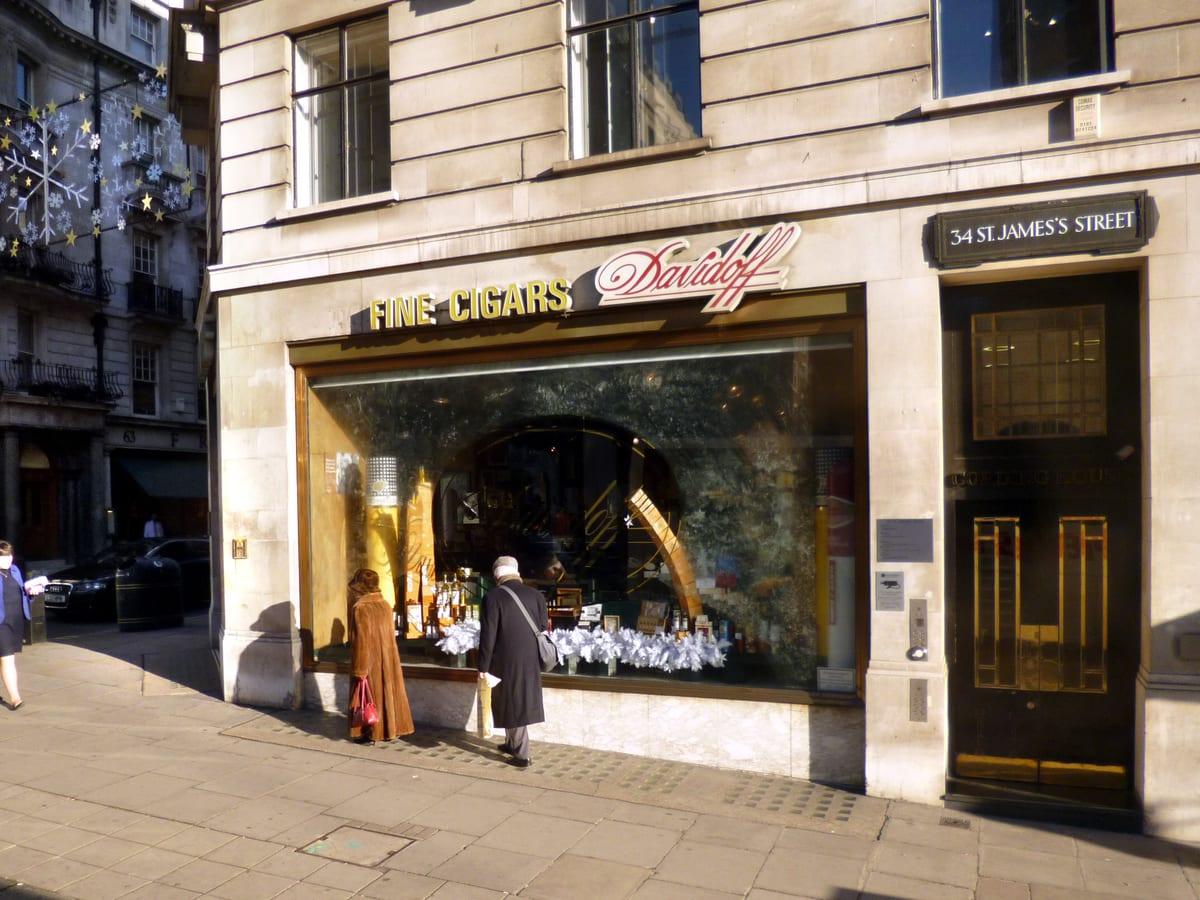
Most cigar shops are known for what they sell. Davidoff of London is known as much for its history and for the family behind the counter. It opened under the name of the most famous cigar shop in Geneva, outlived the Cuban cigars that name once stood for, and became one of the places where collectors in Britain buy, sell and store old Havanas. This lesson describes the shop: its street, its opening, how it came through Davidoff's break with Cuba, what it sells and the services it offers. The life of its founder is told in the Cigar Personalities lesson Edward Sahakian – The Gentleman of the Cigar World, and the Swiss company's own stores in Davidoff Shops, in this topic.
St James's, a street of tobacconists
St James's Street runs downhill from Piccadilly to St James's Palace, and with Jermyn Street, which crosses it, it has been a street of clubs, shirtmakers, hatters and tobacconists for more than two centuries. White's, the oldest of the London gentlemen's clubs, stands further up the same street. The clubs explain the shops: their members lived, dined and smoked nearby, and the tobacconists of St James's grew up serving them.
Two historic firms show how old that trade is. At No. 19 St James's Street a cigar merchant has traded since 1787, by its own account, first under the name of Robert Lewis. Winston Churchill was its customer for more than sixty years, from his first purchase in 1900 to an order placed in December 1964, a month before his death. In 1992 the business merged with James J. Fox, a firm founded in Dublin in 1881, and the shop took the Fox name; over the years it has held eight royal warrants, the formal appointment as a supplier to the royal household. The other is Dunhill. Alfred Dunhill opened his tobacconist's shop in Duke Street, St James's, in 1907, a short walk away, and Dunhill's shops in London and New York were the first outlets for Montecristo, as the Montecristo lesson in Major Cigar Brands explains. Edward Sahakian was a Dunhill customer himself on his business visits to London in the early 1970s, buying boxes and leaving them in the shop's care, before he had any thought of opening a shop of his own.
How the shop began
Sahakian came to London from Tehran at the end of 1978, as the Iranian Revolution closed his family's businesses, and in 1979 he decided to stay. He had been buying cigars for years at Zino Davidoff's shop in Geneva, and when his solicitor asked him what he wanted to do next, he said he wanted to open a Davidoff shop in London. The solicitor wrote to Davidoff. Sahakian met the company's president, Dr. Ernst Schneider, in London, signed an agreement with him, and Zino Davidoff gave the shop his blessing.
The agreement made the shop a franchise, a business owned and run by an independent owner that trades under another company's name and sells its products under a contract. Davidoff then belonged to the Oettinger group of Basel, which had taken over Zino Davidoff's Geneva shop and the Davidoff name in 1970, as the Davidoff lesson in Major Cigar Brands explains. According to an interview with the family, the London shop was the second Davidoff franchise in the world, after one in Hong Kong, and the first in Europe; no other source gives the ranking.
The shop opened on 29 May 1980. Zino Davidoff came on the first day with a box of 25 Davidoff Dom Pérignon cigars, inscribed "Dear Edward, smoke but don't smoke too much," and Sahakian promised to smoke one on each anniversary of the shop and to retire when the box was empty. The Cigar Personalities lesson tells how slowly he has kept that promise; in 2021 he still had seven or eight cigars left. One older account dates the shop's 25th anniversary to the spring of 2004, a year earlier than the shop's own date, but the shop itself, its anniversary releases and the other sources all give 1980.
After Davidoff left Cuba
In 1980 a Davidoff shop was a Cuban cigar shop. Davidoff's own cigars, among them the Dom Pérignon, were made in Havana, and the rest of the stock came from the other Havana brands. That changed at the end of the decade. Davidoff and Cubatabaco, the Cuban state tobacco company, disagreed over the quality of the cigars and over who owned the brand name, and in August 1989 Zino Davidoff burned about 130,000 Cuban-made Davidoffs he judged unfit to sell. Production moved to the Tabadom factory in Santiago, in the Dominican Republic, in January 1990, and the first Dominican Davidoffs reached the market that November; the company itself dates the move to 1991. The story of the break is told in the Davidoff lesson in Major Cigar Brands and in the Iconic Cigars lesson Davidoff Dom Pérignon.
The break could have ended the London shop's Cuban trade. It did not, because the shop belonged to Sahakian, not to Davidoff. The franchise covered the Davidoff name and Davidoff's products; it did not stop him buying Havanas of other brands, which in Britain come through a single licensed importer, Habanos' only distributor in the country. So the shop went on selling both: Davidoff's new Dominican cigars under the franchise, and Cuban cigars bought in Britain. Sahakian made his first trip to Cuba in 1990, the same year Davidoff's Dominican production began, one of the first British retailers to visit the island's factories and farms. No source records a later change to the shop's ownership, which has stayed with the Sahakian family throughout. Neither the shop nor Oettinger Davidoff publishes the current terms between them, and Oettinger Davidoff's own description of its retail network, 65 flagship stores and satellites and about 700 appointed merchants, does not name the London shop, so whether the original franchise still stands in its first form cannot be confirmed.
The family business
Edward Sahakian's son, Eddie, worked in the shop in the early 1990s, during the cigar boom, then spent nine years in finance in London and came back after the financial crisis of 2008. He has been a director of the business since 2012, and his sister Caroline is a co-director. In May 2012 Eddie opened a second address, the Edward Sahakian Cigar Shop and Sampling Lounge, in a hotel in Knightsbridge, at the hotel's own request; the hotel wanted a name of its own rather than an existing brand, and the family chose Edward's. Eddie also brought the business onto social media and opened its online shop. Edward still spends his days in or just outside the St James's shop, often in the chair that has stood there since 1980 and has been reupholstered twice.
What the shop sells
The shop's stock falls into three groups. The first is Cuban: the main Havana brands, among them Cohiba, Montecristo, Partagás, Bolívar, H. Upmann, Hoyo de Monterrey, Ramón Allones, Romeo y Julieta and Trinidad, together with special editions. The second is Davidoff, in its full Dominican range, from the milder Signature, Grand Cru, Aniversario and Millennium lines to Nicaragua, Yamasá, Escurio and the Winston Churchill line. The third, which the shop calls New World, covers makers in Nicaragua, the Dominican Republic and Honduras, such as Padrón and Oliva from Estelí, Arturo Fuente and La Flor Dominicana from the Dominican Republic, and Rocky Patel, which makes cigars in Honduras and Nicaragua. Alongside the cigars the shop sells whisky and other spirits, humidors, cutters and lighters from several makers, and cases, lighters and ashtrays under Edward Sahakian's own name.
Every box of Havanas the shop sells carries the EMS stamp. The letters stand for English Market Selection, a term Cuba has used for more than a century for cigars chosen for Britain, a market that in the days before the American embargo was said to favour darker wrappers than the American one. Today the stamp is applied by the British importer, which opens every box, inspects it and seals it again with a stamp whose colour changes each year. The colour shows the year the box entered Britain, not the year the cigars were made. The stamp also shows that duty has been paid and that the box carries the health warnings British law requires. The shop checks boxes again when they arrive, which is why its seals are always open.
Aged and vintage cigars
Many British smokers have long preferred their Havanas aged: kept for years at a steady temperature and humidity so that the tobacco goes on maturing in the box and the taste becomes rounder. London merchants traditionally kept large stocks for that purpose. Davidoff of London continues the practice. It buys, values and sells rare and vintage cigars, and it keeps Cubans thirty and forty years old as well as boxes of Davidoff Dom Pérignon from the 1980s, made before Davidoff left Cuba. Its offer at the Knightsbridge lounge, drawn from the family's own collection, has included the Davidoff 80 Aniversario, made in Cuba in 1986 for Zino Davidoff's 80th birthday, a near-complete range of Cuban Davidoffs, Cuban Limited Editions (Edición Limitada) from the early 2000s, and Reserva and Gran Reserva cigars, made from tobacco aged for several years before rolling. Around 2014 the family served a 1989 Cuban Davidoff No. 1 at a vintage cigar evening at the lounge.
The lounge also stores and ages customers' own cigars. A customer who leaves cigars there receives a written inventory that is kept up to date, and the cigars are kept in a locked vault at 11 °C and 68 percent relative humidity, the measure of how much moisture the air holds compared with the most it could hold at that temperature. Both figures are kept the same all year, so that the cigars age at an even pace.
Smoking in the shop
The way a London cigar shop works is shaped by law. Since 1 July 2007 smoking has been banned in enclosed public places in England, and the law makes an exception for a specialist tobacconist, defined as a shop where more than half of the sales come from cigars, snuff, pipe tobacco and smoking accessories. Such a shop may let customers sample cigars and pipe tobacco on its premises, but only in a room that is fully enclosed, does not ventilate into smoke-free premises, has self-closing doors and is clearly marked as a place where smoking is permitted. That is why the Knightsbridge address is called a sampling lounge. The same specialist status lets a cigar shop keep its stock on view: since 6 April 2015 the display of tobacco has been banned in all shops in England, but a specialist tobacconist may still show cigars inside, as long as the display cannot be seen from the street. The ban on smoking had an effect the shop could see. Members of White's, which has no outdoor space for smoking, began walking down the street after lunch to smoke a cigar at the shop.
Anniversary editions
The shop marks its anniversaries with releases of its own, made in small numbers and sold only through it. For the 25th anniversary in 2005 Davidoff made it a Dominican cigar in 250 boxes of 10, intended to come as close as possible to the blend of the Cuban Davidoff No. 2, Zino Davidoff's own cigar, and carrying a second band marked "1980 – 2005." For the 40th anniversary in 2020 the shop released 300 numbered boxes of a cigar in the No. 2 size, Edward's and Eddie's favourite, together with a single-cask Scotch whisky from the Glenrothes distillery, distilled in 1980, aged for 39 years and seven months in a former bourbon barrel and bottled in 179 numbered bottles.
Recognition
At the closing gala of the 19th Festival del Habano in Havana, in March 2017, Habanos named Edward Sahakian Habanos Man of the Year in the business category. Habanos gives these awards in three categories each year, business, communication and production, and presents them at the end of the festival; it published them as its awards for 2016. Sahakian had been nominated in the retail category in 2002 and 2004.
The following timeline sets the shop's history beside the events in the Davidoff company and on St James's Street that shaped it.
| Year | Event |
|---|---|
| 1787 | The cigar merchant later known as James J. Fox dates its founding, under the name of Robert Lewis |
| 1907 | Alfred Dunhill opens his tobacconist's shop in Duke Street, St James's |
| 1970 | The Oettinger group of Basel takes over Zino Davidoff's Geneva shop and the Davidoff name |
| 1980 | Edward Sahakian opens Davidoff of London on 29 May, as a Davidoff franchise |
| 1989 | Zino Davidoff burns about 130,000 Cuban-made Davidoff cigars in August |
| 1990 | Davidoff production begins in the Dominican Republic; Sahakian makes his first trip to Cuba |
| 2005 | 25th anniversary: 250 boxes of 10 of a Dominican Davidoff close to the Cuban No. 2 |
| 2007 | Smoking ban in England from 1 July, with an exception for specialist tobacconists |
| 2012 | Eddie Sahakian becomes a director; the Knightsbridge sampling lounge opens in May |
| 2017 | Edward Sahakian named Habanos Man of the Year in the business category, in March |
| 2020 | 40th anniversary: 300 numbered boxes of a No. 2-size cigar and 179 bottles of 1980 whisky |
The table shows how much of the shop's story was decided elsewhere. A quarrel in Havana and a move to Santiago changed what a Davidoff shop was, and an English law of 2007 changed how customers could use it. The shop's own continuity came from its ownership: a family business trading under a famous name, which kept that name when the name's cigars left Cuba and kept the Cuban trade when the name no longer covered it.