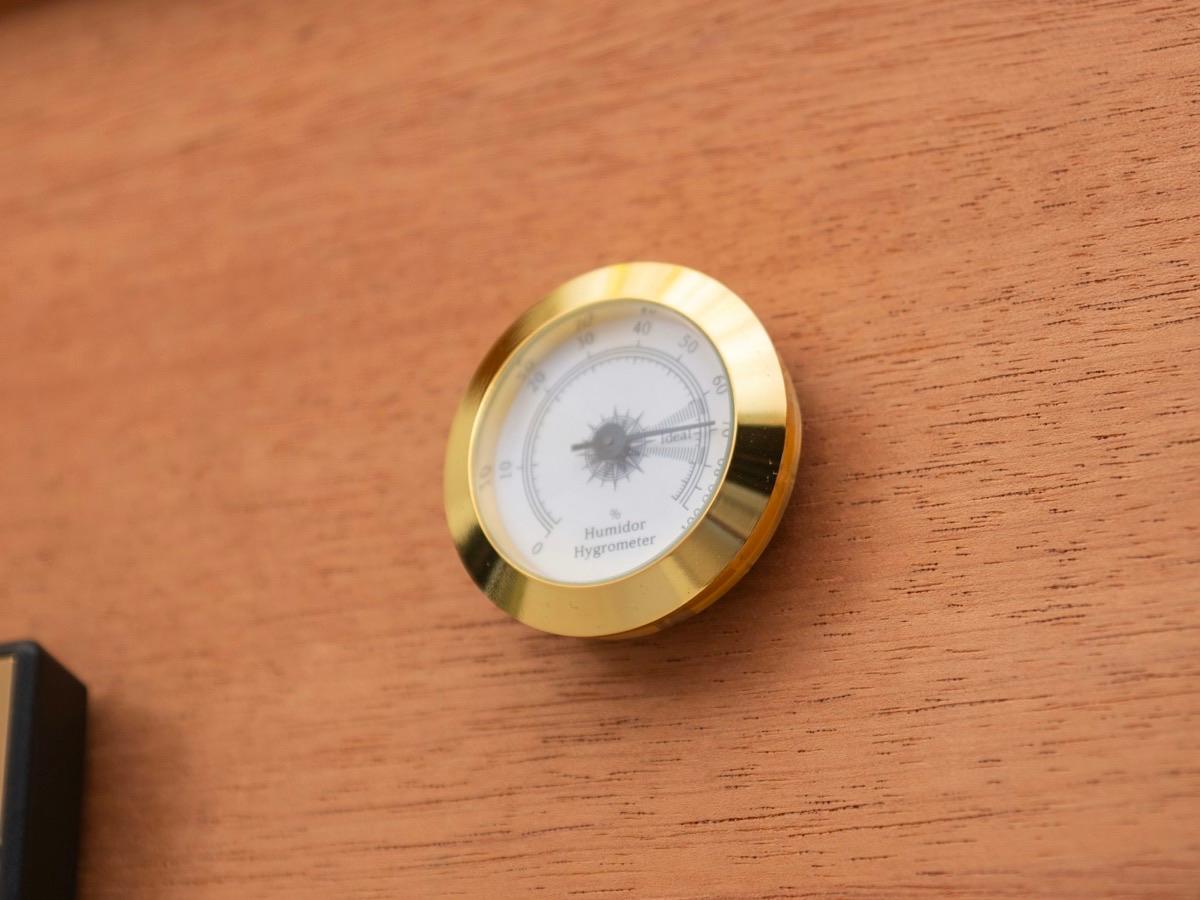
Every storage decision in this topic serves one fact: the water content of a cigar sits in balance with the air around it. This lesson explains that balance, sets out the two figures — relative humidity and temperature — that Habanos and Davidoff publish and the disagreement around them, and then follows a cigar to its two bad ends, too dry and too wet, before looking at the seasons, because the balance never holds itself. Cigar Construction describes the factory's own conditioning room, and Aging Cigars describes how the same balance is kept over years.
Water, burn and flavor
A cigar is dried and fermented leaf, and — as Seasoning a Humidor explains — it is hygroscopic, always giving water to or taking it from the air until the two agree. That water matters first to the burn. A leaf that holds too little moisture burns faster and hotter, and the heat drives off the delicate oils and aromatics before the palate meets them, so a dry cigar smokes quick, harsh and thin, as if its flavor had been turned down. A leaf that holds too much moisture burns slowly and unevenly; the tobacco smolders instead of glowing, the draw tightens as the swollen leaves close off, and the surface flavor goes sour and flat. In the middle, the water cools the burn enough that the oils vaporize at the right pace, and that is where flavor, draw and burn line up.
The wrapper cares too. A wrapper leaf is the thinnest, most elastic leaf on the cigar, and it must stretch around a burning, expanding filler without splitting. Kept at the right moisture it stays supple; dried out, it cracks at the cut or mid-smoke, and a cigar whose wrapper cracks falls apart and burns unevenly. The same water that guards the oils guards the skin.
The numbers, and where they disagree
The widely repeated figures for cigar storage are 65 to 72 percent relative humidity, and both numbers are worth stating plainly because the sources do not all agree. Habanos and Davidoff publish closer conditions: a temperature of 16 to 18 degrees Celsius (about 61 to 64 degrees Fahrenheit) and a relative humidity of 65 to 70 percent. That is the same 65 to 70 percent, at 16 to 18 degrees, at which Habanos keeps the factory conditioning room where finished cuban cigars rest after rolling, as Cigar Construction records. The broader 65 to 72 percent comes from elsewhere — from Habanos's own sales and franchise literature, from much American retailer advice, and from a widely used trade glossary, which describes a humidor as holding "around 70 percent." The older American rule of thumb was simply "70/70": 70 degrees Fahrenheit (about 21 degrees Celsius) and 70 percent humidity, and the quiz figure of 18 to 21 degrees Celsius descends from it.
So there are two disagreements to keep straight. On humidity, the makers' own figure is 65 to 70 percent, while looser guidance stretches it to 72, and a modern school now aims at the bottom of the band — 65 percent, or 69, or 62 for long aging — on the view that cooler and slightly drier cigars burn better and mold less readily. On temperature, Habanos and Davidoff specify 16 to 18 degrees Celsius, cooler than the American 70 degrees Fahrenheit, and the gap is not trivial: it is part of why the same advice reads cooler in Cuba and Europe than in the United States. The figures that follow use Habanos and Davidoff's, 65 to 70 percent at 16 to 18 degrees Celsius, with the usual margin that a few points either way does not matter nearly as much as staying steady. The rule crosses borders: a Padrón made in Nicaragua, an Arturo Fuente made in the Dominican Republic, and a cigar wrapped in Ecuadorian or Connecticut leaf all answer to water exactly as a Cuban Habanos does, and all are kept to the same figures.
Temperature matters in its own right, not only through humidity. Kept warm — above about 21 degrees Celsius — a humidor invites the tobacco beetle, *Lasioderma serricorne*, whose eggs can hatch into larvae that tunnel through the wrapper and out again as pinholes; one of the reasons for storing at 16 to 18 degrees Celsius is to stay below that threshold, and the beetle is why cigars bought from a suspect source are sometimes frozen before they enter a collection. Heat accelerates everything a cigar does, including the loss of its oils, so cigars meant to sit for years are kept cool as much as damp.
Too dry
A cigar kept too dry shows it at once. The wrapper feels stiff and waxy rather than supple, and it may rustle rather than lie quiet; it cracks at the foot when cut or along its length mid-smoke, and the cigar burns fast and hot, the smoke thin, sharp and bitter as the aromatics are driven off before they register. Over weeks or months the change goes deeper: the oils that carry much of the cigar's scent evaporate with the water that held them, and a cigar left bone-dry for long cannot be brought fully back. Re-humidifying a dried cigar slowly — days in a closed humidor with the humidity raised a little at a time — restores its burn and part of its flavor, but the bright top of the flavor is the part that does not return.
Too humid
At the other end, a cigar kept too wet swells. The filler and binder take up water, the leaves close the channels that carried the draw, and the cigar smokes tight, or goes out, or burns down one side while the other lags — the "canoeing" and "tunneling" of a wet cigar. The smoke comes off sour and green, and the extra water is exactly the invitation mold needs, as Mold and Plume describes. The box suffers too: wood swells in high humidity, and a lid that sealed well can stick or warp. Sustained humidity above about 72 to 75 percent is where the visible damage begins, and above it the risk of mold rises quickly, faster still in warmth.
Seasons and steadiness
The hardest thing about the numbers is that the room around the humidor will not leave them alone. A house in winter is drier, because the heating dries the air; a house in summer is wetter, and warmer. So a humidor that held 68 percent all winter may climb in July and fall again come the first frost, and the owner's job is to watch the hygrometer and adjust — a little more water in the source through the dry months, a gentler source or a slightly lower-rated pack through the damp ones. Steadiness matters more than the exact figure: a box parked at a steady 66 percent beats one that swings between 60 and 72 with every change in the weather, because it is the swings, not a point or two of difference, that crack wrappers and wake mold. Keep the box out of direct sun and away from radiators and vents, keep the hygrometer honest, and the balance, once set, is mostly a matter of the small adjustments each season asks for.