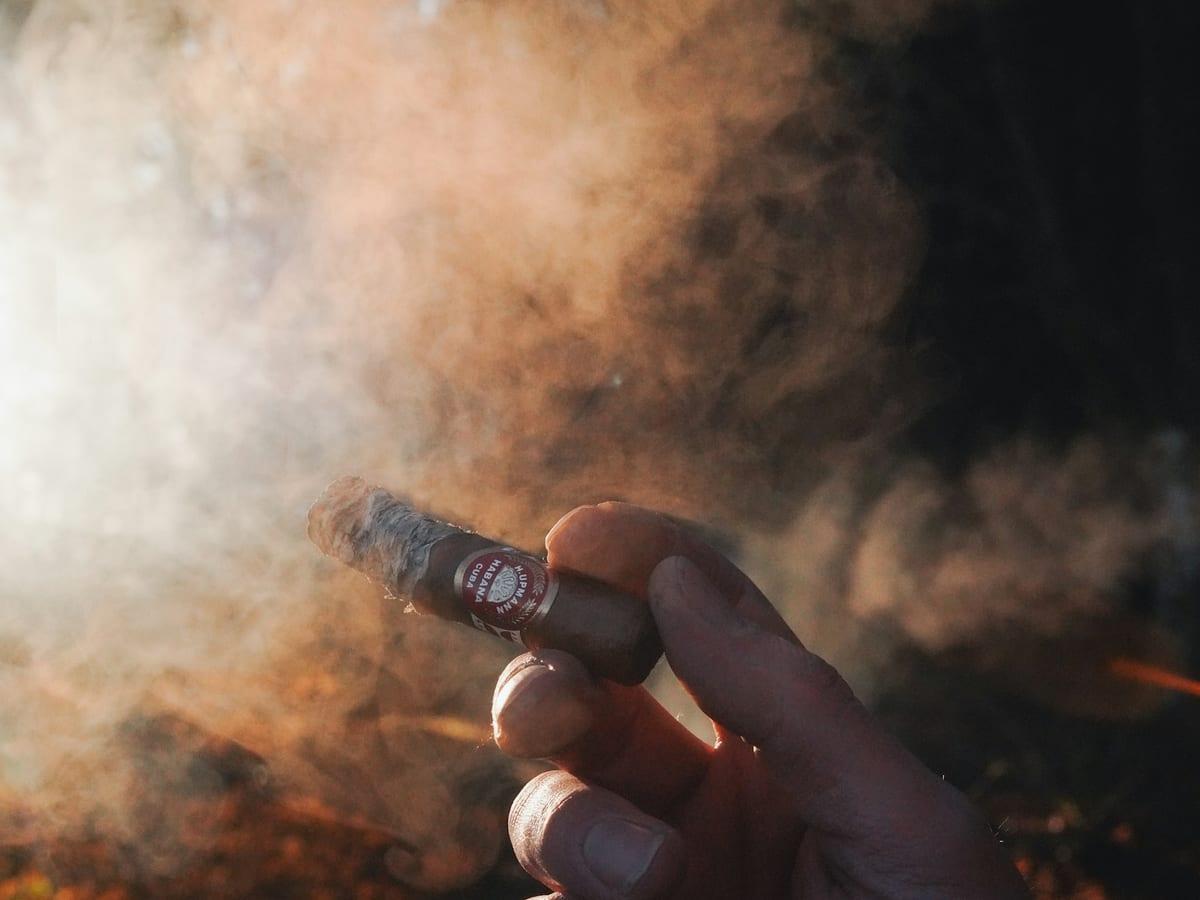
When smokers call a cigar strong, they are talking about what it does to them rather than how it tastes. Strength, fortaleza in Spanish, is the physical effect of the nicotine a cigar delivers: the pleasant alertness of a medium cigar, the warmth and slight heaviness of a strong one and, if you overdo it, lightheadedness. The richness and weight of the flavor is a different quality, called body, which the next lesson covers. The two are easy to confuse because they often rise together, but a cigar can taste full and still be gentle on the system, or taste fairly plain and hit hard.
How Nicotine Reaches You
Nicotine is a natural part of the tobacco leaf, and every premium cigar contains a good deal of it. Cigar smoke is not meant to be inhaled, which leads many newcomers to assume they take in very little. In fact the lining of the mouth absorbs it well. Cigar tobacco is air-cured and fermented, and its smoke is less acidic than cigarette smoke, which leaves more of the nicotine in a form the mouth can take up. Absorption through the mouth is slower than through the lungs, so a cigar's effect builds steadily over the smoke instead of arriving in the first few puffs.
The quantities are larger than most people expect. The US National Cancer Institute puts a large cigar at between 5 and 20 grams of tobacco and notes that a single cigar can deliver as much nicotine as a whole pack of cigarettes. Even a mild cigar, smoked over an hour, is a real dose, which is worth remembering before reaching for a second.
Where Strength Grows on the Plant
Strength begins in the field. A tobacco plant's leaves are harvested in stages, from the bottom of the stalk to the top, and each level is sorted and named separately because each behaves differently in a cigar. The higher a leaf grows, the more sun it receives and the longer it stays on the plant, and the thicker, oilier and stronger it becomes. Growers add to the effect by topping the plant, removing its flower bud so that its energy goes into the leaves, and the upper leaves gain the most nicotine.
The lowest leaves are the volado. They are thin, light in flavor and low in nicotine, and their value lies in how easily they burn: a blender includes them to keep the cigar alight. Above them come the seco leaves from the middle of the plant, milder than the leaves above them and the main source of a cigar's aroma and flavor. Growers in the Dominican Republic, Nicaragua and Honduras also keep a class between seco and ligero, called viso, which is stronger than seco but gentler than ligero and lets a blender add depth without adding much power. The ligero itself comes from the upper part of the plant, and on some plants two small leaves grow above it, the medio tiempo, rarer and fuller still. In Cuba the classes are numbered by strength, from fortaleza 1 for volado to fortaleza 4 for medio tiempo, and the Cohiba Behike is a well-known blend that uses medio tiempo alongside its ligero.
| Leaf | Where it grows | What it brings to a blend |
|---|---|---|
| Volado | The lowest leaves | Light flavor and little nicotine; an easy, steady burn |
| Seco | The middle of the plant | Most of the aroma and flavor, at mild to medium strength |
| Viso | Between seco and ligero | More depth than seco, less power than ligero |
| Ligero | The upper leaves | Most of the strength, and much of the body |
| Medio tiempo | The top two leaves, on some plants only | The fullest flavor; rare and used sparingly |
Read from top to bottom, the table runs from the mildest leaf to the strongest, and a blender makes a cigar stronger mainly by moving the mix down it.
The Ligero
Ligero is the engine of a cigar's strength. It is the thickest leaf in most blends, dark, oily and slow to burn, and it adds body as well as nicotine, which is why cigars rich in ligero are usually full in both. Its slow burn is also its difficulty. Ligero needs the heat of the leaves around it to keep burning, so rollers place it at the center of the bunch and wrap seco and volado around it. Put at the edge, or used in too large a share, it makes a cigar burn unevenly or struggle to stay lit, and blending a strong cigar that still draws and burns well is one of the harder tasks in the trade.
Because it is so thick, ligero is fermented and aged longer than the other leaves. In Cuba its final fermentation lasts about 90 days, and the leaf then rests for at least two years in bales before it is rolled. Fermentation takes away ammonia and harshness rather than nicotine, so a well-fermented ligero can be smooth and still strong.
How much ligero goes into a blend, from which farm, and what surrounds it are the main levers a blender has over strength. La Flor Dominicana named its Double Ligero line after the leaf. One of its cigars, the Double Ligero Lancero, took all its inner leaf from a single farm in La Canela, a dry, hot area of the Dominican Republic whose climate makes strong ligero stronger still.
Origin and Seed
Where tobacco grows, and from what seed, changes its strength as much as its position on the plant does. Nicaragua shows this most clearly. Leaf from Estelí, the country's best-known growing region, is prized for its strength; leaf from nearby Condega is more medium-bodied; and leaf from Jalapa, in the north, is subtle enough to be grown for wrapper. Most of it comes from Cuban-seed varieties such as Criollo '98 and Corojo '99, so much of the difference comes from soil and climate.
The Dominican Republic was long associated with mild cigars, and with reason: Olor Dominicano, a native variety, is known for its mildness and aroma. But Dominican growers also plant Piloto Cubano, a Cuban-seed variety grown for strength, and areas such as La Canela produce ligero as strong as any, so a Dominican cigar is no longer necessarily a mild one. Honduras grows Cuban-seed tobacco, Corojo among it, in valleys such as Jamastrán, near the Nicaraguan border. Cuban cigars are made only from Cuban leaf, most of it grown in the province of Pinar del Río.
The wrapper matters less to strength than its appearance suggests. A pale Connecticut Shade wrapper makes a cigar taste milder, but it neither adds much nicotine nor takes any away: the strength still comes from the filler beneath it.
Size, Shape and Pace
The same blend can feel quite different in different sizes, because the balance of wrapper, binder and filler changes with the length and the ring gauge. A thick cigar holds more filler, ligero included, and smokes cooler, so each puff can feel smoother. A slim cigar burns hotter and gives the wrapper a larger part in every puff, which can make it feel more intense. Size also sets the total. A longer or thicker cigar holds more tobacco and, over the whole smoke, delivers more nicotine, even when each puff feels gentler.
How you smoke changes strength as much as what you smoke. Quick puffs at short intervals keep the ember hotter and draw more smoke in less time, so a cigar smoked fast feels stronger and tastes harsher. Most guides suggest about one gentle puff a minute. Your own condition counts too: whether you have eaten, how tired you are and how used you are to nicotine all change how strong the same cigar feels from one day to the next.
Strength Ratings
Makers, retailers and reviewers rate strength on scales such as mild, medium and full, or from 1 to 5, but there is no shared standard and each uses its own. Habanos publishes a ranking of its brands from light to full, but it ranks them by flavor rather than nicotine, so it tells you more about body than about strength. A rating is a useful first guide. With a cigar you don't know, the foot can add a clue, since in many cigars you can see darker leaf at the center, the ligero, with lighter leaf around it. Over time, your own notes on what you smoked and how it affected you become a better guide than any scale.