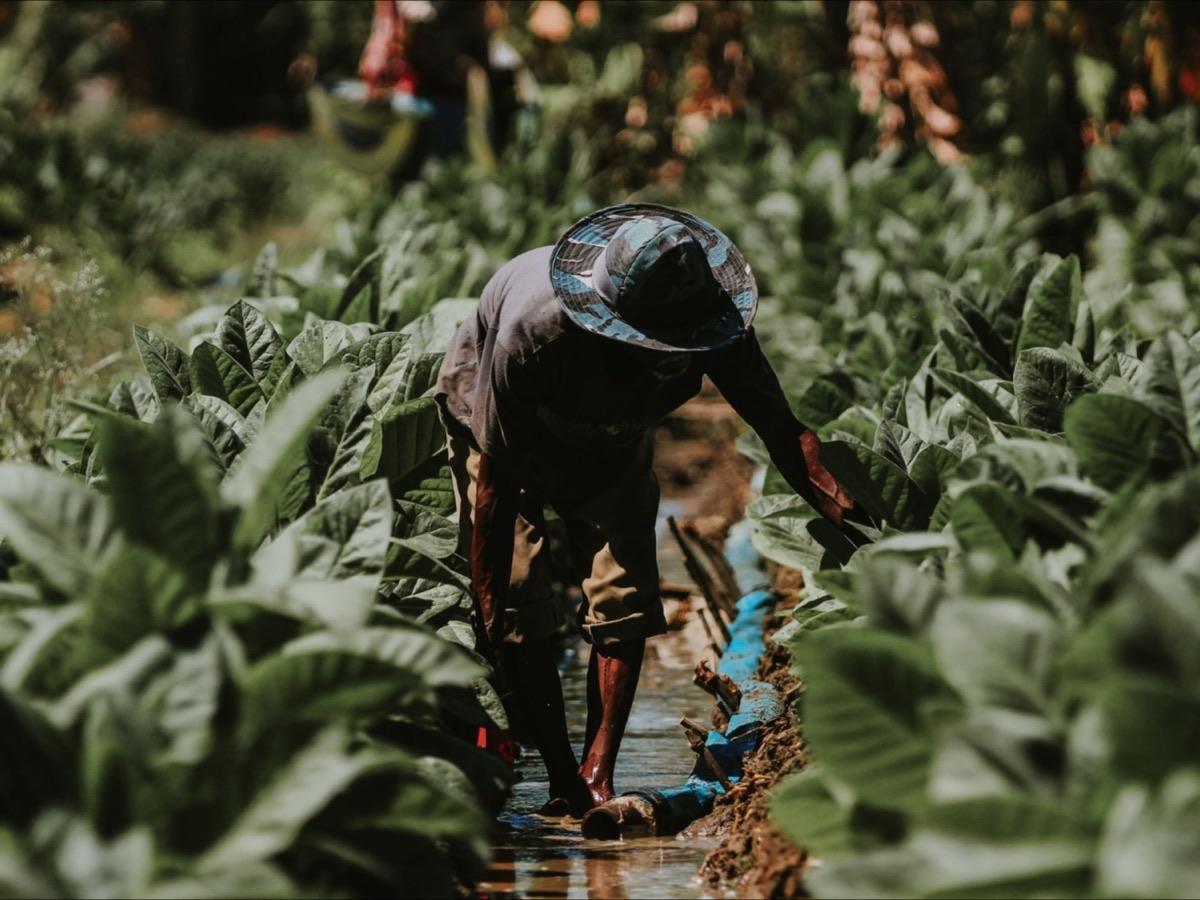
Tobacco grows fast. A seedling planted out in Cuba in November can be stripped of its last leaf by February or March, and Connecticut Broadleaf spends only nine or ten weeks in the field. This lesson follows the plant through that short life, from the day it is planted out to the day its top leaves are ripe, and the work each stage brings. The seed and the seedbed come before it and are covered in the Seed to Leaf topic. Topping and Suckering, Timing and Maturity and Priming and Harvesting take up the later stages in detail.
Taking root
A seedling arrives in the field with a few small leaves and a ball of roots. For its first days it does little but take hold: its roots spread into the soil, and new leaves begin to grow from the bud at the top of the stem. The lowest leaves on a cigar plant, which Cuban growers call mañanitas, are the ones that came with the seedling from the seedbed. They are the first leaves that can be picked, and the smallest.
The field work starts at once. In Cuba, soil is drawn up around the young plants about 10 to 12 days after planting, a job called tapar palito, and growers on shade-grown fields make a first pass along the furrows even sooner, six to eight days after planting. Between about the 18th and the 30th day comes the aporque, when soil is heaped against the stalk to form the ridge on which the row will stand, so that the roots can grow and the plant stays upright.
Rapid growth
In its second month the plant grows fastest. A review of tobacco research puts the period of most rapid leaf growth in the second month after transplanting, from about knee height to early bloom, when moisture matters most. Agricultural researchers in Connecticut came to a similar conclusion in the 1930s: the second half of July, some six to eight weeks after planting, decides the crop. A drought at this stage makes the leaves thicker, darker and gummier, and long cloudy spells make them thin and brittle, as Water and Irrigation explains.
Shade-grown plants shoot up fastest. Connecticut shade plants reach about nine feet (2.7 meters) by early July and can stand twelve feet (3.7 meters) by late August, so they are tied to wires overhead to keep them upright. In Cuba each plant under cloth is tied to a wire that runs beneath the cloth. The first suckering comes in this stage too: Cuban growers pull the first side shoots from the base of the stalk 28 to 30 days after planting, before the plant has even been topped.
Buds and flowers
Once the plant has formed its leaves, it sends up a flower head at the top of the stem. Left alone, it would put its energy into flowers and seed. Most cigar tobacco is topped as the bud appears or the first flowers open. In Cuba, cigar tobacco is ready to be topped at the bud stage 38 to 42 days after planting; small growers in Jalapa, Nicaragua, top 50 to 60 days after planting; and Connecticut Broadleaf grown in Kentucky and Tennessee is ready to top about seven weeks after transplanting. A plant that is never topped keeps going: Corojo 2012, a Cuban wrapper variety, flowers about 76 days after planting and carries some 24 leaves.
Topping changes the plant. It stops the flower from drawing the plant's energy upward, makes the stalk stiffer and less likely to blow over, and makes the roots grow. That matters for strength, because nicotine is made in the roots and carried up to the leaves: more root growth means more nicotine in the leaf. The plant answers by sending out suckers, new shoots from the joint of every leaf, which have to be removed. Topping and Suckering explains both jobs, and Topping Timing and Height explains when to top and how many leaves to leave.
Ripening
After topping, the leaves thicken and begin to ripen, the lowest first. A leaf low on the stalk ripens days or weeks before one near the top, and the upper leaves, which take the most sun and become ligero, ripen last; on one grower's farms in Estelí, Nicaragua, the ligero takes 15 to 20 days longer to mature than the leaves below it. That is why most cigar tobacco is picked a few leaves at a time over several weeks, and why stalk-cut tobacco is cut when the plant as a whole is at its best rather than when every leaf is.
The table follows a Cuban plant through a season, with the timings given in Cuban technical guidance and field studies. They vary from farm to farm and year to year.
| Days after planting | What the plant does | The work in the field |
|---|---|---|
| 0 | Takes root | Planting by hand into a wet furrow |
| 6 to 12 | Roots spread, new leaves form | Soil drawn up to the young plants |
| 18 to 30 | Grows fast | Aporque, the earthing-up of the stalk; first suckering |
| 38 to 42 | Forms its flower bud | Topping at the bud, in two or three passes, and suckering |
| About 40 to 60 | Lowest leaves ripen | The harvest begins at the foot of the plant |
| About 90 to 100 | Top leaves ripen | The last leaves are picked |
Read from top to bottom, the plant's whole life in the field lasts about three months. Cuban sources disagree on when the harvest begins: Habanos puts it at about 40 days after planting out, while a four-season study of shade-grown plants in Partido recorded the first leaves picked at 60 days and the last at 90. Elsewhere the season can be shorter or longer. Connecticut Broadleaf is topped about seven weeks after transplanting and cut two or three weeks later, while sun-grown tobacco in Nicaragua is often first picked 75 to 90 days after planting. Timing and Maturity compares the calendars.