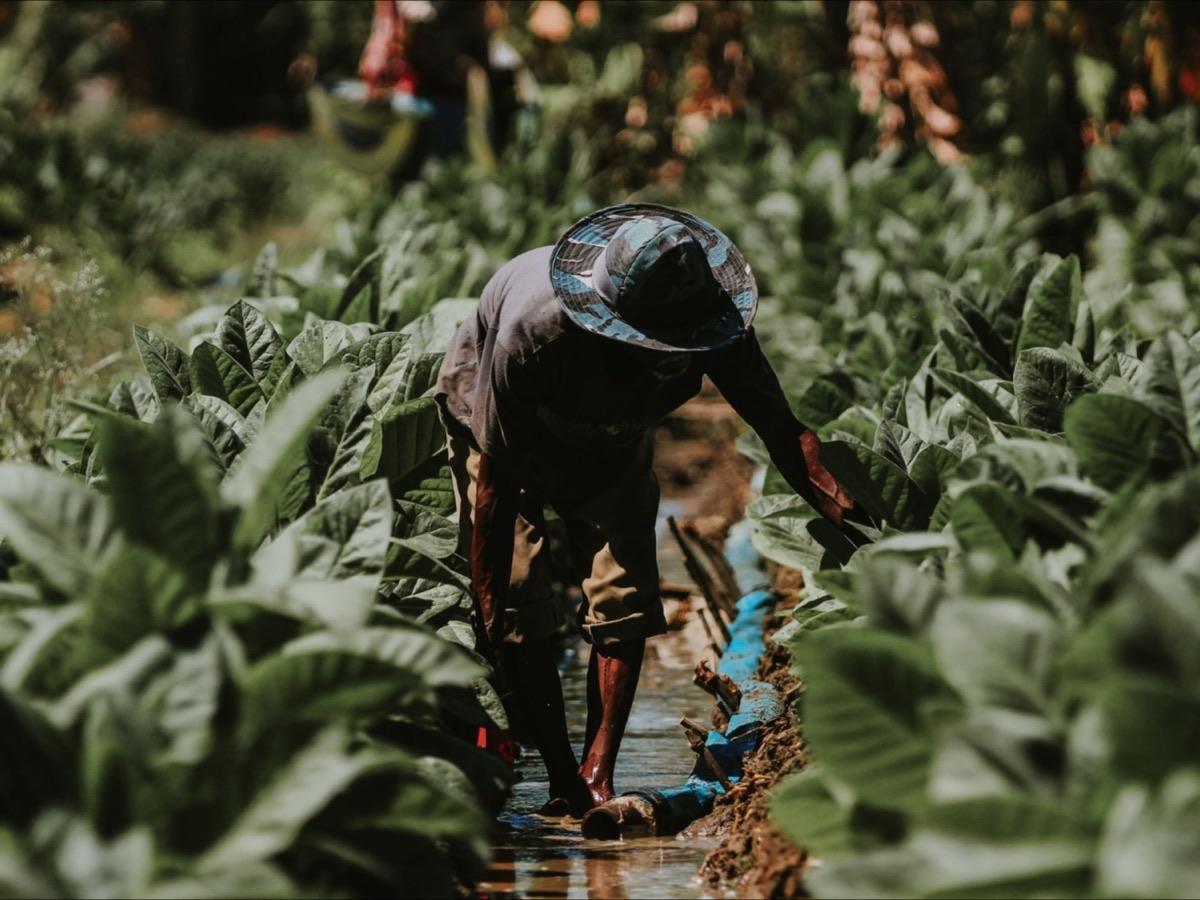
A tobacco plant grown for its leaves is a plant prevented from doing what it wants to do, which is to flower and set seed. Two jobs keep it from doing so. Topping removes the flower head, and suckering removes the shoots that grow in its place. Together they put more of the plant's strength into its leaves, and they are among the most skilled work in the field. This lesson explains what the two jobs do and how they are done. Topping Timing and Height explains when to top and how many leaves to leave.
Why growers top
A growing tobacco plant is led by the bud at its tip, which holds back the buds lower on the stem. Once the plant flowers, it sends much of its energy and food to the flowers and seed. Topping breaks that pattern. Extension guides in the United States describe its effects: plants topped late or not at all lose a good deal of their yield; topped plants grow more roots, and because nicotine is made in the roots, more nicotine goes up into the leaves; and a topped plant is less top-heavy and less likely to be blown over. The leaves left on the plant grow larger and thicker. In Cuba, topping is called desbotonar, from botón, the bud, and Habanos describes it as removing the top bud so that the plant puts its growth into its leaves.
Topping by hand
Cigar tobacco is topped by hand. In Cuba cigar tobacco is topped a la caja, as soon as the bud appears, and because the plants in a field don't all bud at once, the job is done in two or three passes. It takes skill to do well. A Cuban growing manual reckons that of every ten workers only one knows how to top properly, and only one in fifteen does it as well as it can be done. Nestor Andrés Plasencia, whose family grows tobacco in Nicaragua and Honduras, has said that the most important person in the tobacco field is the one who tops off the plant's flower.
The work itself is simple. In Connecticut the tops are broken off by hand with a sudden sideways twist. What takes judgment is choosing the moment and the height, which Topping Timing and Height explains.
Suckers
When the top goes, the buds in the joints between the leaves and the stalk wake up and grow into suckers. Left to grow, they take water and food from the leaves and shade them. Trials on burley tobacco in Kentucky and Tennessee show what is at stake: plants that were topped but never suckered gave roughly an eighth to a quarter less leaf than plants whose suckers were controlled.
Cuban growers remove suckers by hand, in a job called the deshije. The first pass, called quitar patica, pulls the shoots from the base of the stalk 28 to 30 days after planting, before the plant has been topped. After that, suckers are pulled while they are no more than five centimeters (two inches) long. Each plant is suckered two or three times, and because the plants in a field grow unevenly, a field is gone over three to five times. Shade-grown plants send out suckers fastest. Cuban guidance also advises against harvesting in the first days after a field has been suckered.
How thoroughly a field is suckered also changes the leaf. Trials on Connecticut Havana Seed in the 1920s found that suckering twice instead of once gave more weight, but a heavier, darker leaf, of the kind sold at lower grades, a trade-off Yield vs Quality Balance takes up.
Chemical sucker control
Outside Cuba, growers can also hold suckers back with chemicals. Extension guides divide them into three kinds, which the table compares.
| Kind | Examples | How it works | On cigar wrapper |
|---|---|---|---|
| Contact | Fatty alcohols | Burns small, tender suckers it touches, for five to ten days | Recommended, applied by hand down the stalk |
| Local systemic | Butralin, flumetralin | Absorbed where the leaf joins the stalk; stops the cells of the sucker from dividing | Recommended, applied by hand down the stalk |
| Systemic | Maleic hydrazide | Absorbed by the leaves and carried through the plant to the sucker buds | Not recommended: it harms the size and texture of the leaf |
The difference for cigar leaf lies in how the chemicals reach the plant. Guidance for Connecticut Broadleaf wrapper in Kentucky and Tennessee recommends the first two kinds, run down the stalk from a backpack sprayer or a dropline, about three-quarters of an ounce per plant, so that every leaf joint is wetted. It advises against spraying them over the leaves, and against maleic hydrazide altogether, because both harm the leaf a wrapper needs. In 1953 Connecticut's agricultural station would not yet recommend chemical sucker control at all, because its effect on the leaf had not been studied enough.
Many Central American growers still sucker by hand. In a 2021 survey of small growers in Jalapa, Nicaragua, four of five removed suckers by hand; the fifth used a chemical because it took less time and cost less in labor.
Shade plants
Under cloth, practice differs between Cuba and Connecticut. Cuba tops its shade-grown wrapper plants, leaving 14 to 20 leaves, more than on its sun-grown plants. Connecticut stopped topping its shade tobacco long ago. A U.S. guide of 1908 still told growers to top shade plants just before the flowers opened, but by the 1930s Connecticut growers only pinched out the young bud, and by 1953 the agricultural station noted that the tall shade varieties then coming in, such as Connecticut 15 and Connecticut 49, set their small seed heads so late in the season that no topping was needed. Modern Connecticut shade plants are generally not topped.