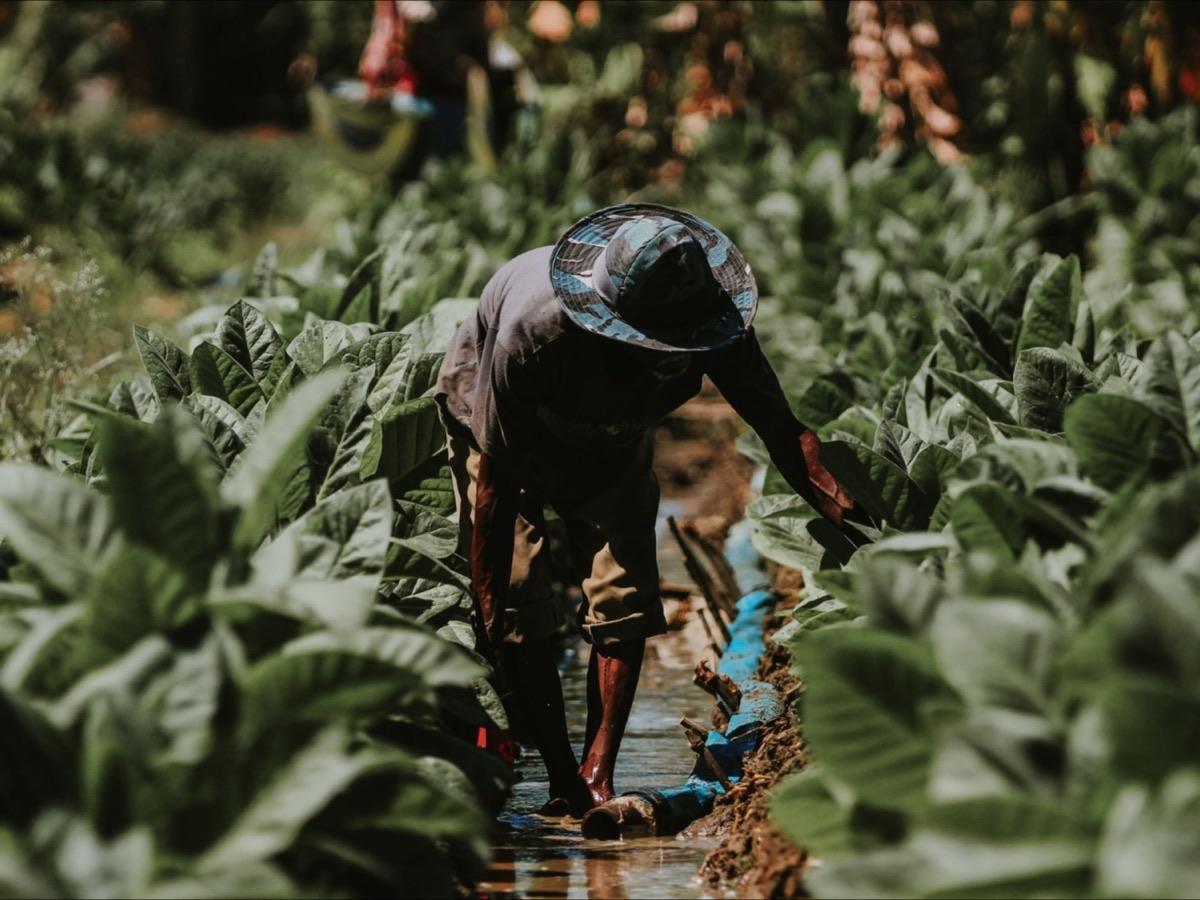
A tobacco field is planned before a single seedling goes into it. The grower decides how far apart the rows will run and how far apart the plants will stand in each row, how the rows will be furrowed and ridged for water, how a shade tent will sit over them, and how the field will be sheltered and reached. These choices shape the crop for the rest of the season. This lesson covers spacing, how many plants a hectare carries in different countries, furrows and ridges, the layout of a shade field, and wind and access. Soil Preparation Before Planting covers the work that comes first, and the Seed to Leaf topic covers the seedlings.
Why spacing matters
Each plant competes with its neighbors for light, water and nutrients. Set close together, plants stay smaller and their leaves grow thinner; given more room, each plant grows larger, heavier leaves. Neither is better in itself. It depends on what the leaf is for.
For shade-grown wrapper, a thin leaf is the aim, so close spacing serves quality. A U.S. government guide to growing wrapper under shade in the Connecticut Valley, published in 1908, set the plants 12 to 14 inches (30 to 36 centimeters) apart in rows three feet (91 centimeters) apart, and warned that setting them farther apart made the tobacco grow so large and heavy that its quality suffered, even if the crop weighed a little more. Connecticut Broadleaf, a sun-grown leaf wanted for its size, goes the other way: after trials in 2019, the University of Kentucky advised growers to plant about 6,000 plants an acre to get larger leaves and less disease.
Spacing doesn't always change the crop much. In a 2004 trial in Condega, Nicaragua, plants set 30, 36 and 41 centimeters apart in rows 91 centimeters apart gave yields with no significant difference, and the closest spacing gave the best return on its cost.
Rows and plants: the figures
In Cuba the distance between rows is called the camellón and the distance between plants in a row the narigón. The standard Cuban frame, used for both sun-grown and shade-grown tobacco, is 0.90 by 0.30 meters, which comes to about 37,000 plants a hectare. Growers' own numbers match it: a wrapper grower in San Luis had about 36,000 plants on little more than a hectare in 2024, and a sun grower in San Juan y Martínez some 220,000 plants on about 6.3 hectares. Cuban guidance asks for rows kept as straight as possible, laid out with a marker.
The table compares the spacing used for several cigar tobaccos. The plants per hectare are worked out from the spacing where the source gives only the distances.
| Crop | Between rows | Between plants | Plants per hectare |
|---|---|---|---|
| Cuba, sun-grown and shade-grown | 90 cm | 30 cm | About 37,000 |
| Nicaragua, sun-grown (Condega trial, 2004) | 91 cm | 30 to 41 cm | About 27,000 to 36,000 |
| Connecticut Shade (1953 guidance) | 91 to 102 cm (36 to 40 in) | 30 to 36 cm (12 to 14 in) | About 27,000 to 36,000 |
| Connecticut Broadleaf (Kentucky and Tennessee guidance, 2020) | 102 to 107 cm (40 to 42 in) | 61 to 66 cm (24 to 26 in) | About 15,000 to 16,000 |
| Brazil, Bahia (2016) | About 20,000 |
Read down the table and two groups appear. Cuban tobacco, Nicaraguan sun-grown leaf and Connecticut Shade all stand about 30 centimeters apart in the row, at 27,000 to 37,000 plants a hectare. Connecticut Broadleaf, grown for a big, heavy leaf, gets about twice as much room in the row and fewer than half as many plants. Some growers vary the pattern: Connecticut shade fields of the early 1990s set their plants 14 inches apart in rows that alternated between 36 and 44 inches wide.
Furrows and ridges
Most Cuban tobacco is planted in furrows. In Pinar del Río the usual method, and the only one used for shade-grown wrapper, is planting al dedo: a worker sets each seedling by hand in the bottom of a furrow that has just been filled with water. As the plants grow, soil is drawn up to them, first around the young seedlings and then, in the aporque, around the stalk, until each row stands on a ridge with a furrow between rows to carry irrigation water.
Ridges do two jobs. They keep the roots out of standing water, which is why Nicaraguan growers in Jalapa raise them in fields that puddle. And soil heaped against the stalk lets the plant grow brace roots that hold it upright in a storm; in Connecticut, ridging has long been used more under cloth than in the open.
Laying out a field under shade
A shade field is laid out around its frame. In Cuba, the wires that carry the cloth of a tapado, a shade-grown field, are stretched about 2.5 meters above the ground on posts some 10 meters apart, and a wrapper field can run 100 to 200 meters long. Most Cuban wrapper farms are small: in San Luis, the average grower farms about 1.2 hectares of tapado.
In Connecticut the posts have stood 33 feet (10 meters) apart each way since at least the 1930s, and the rows are fitted to them: a 1934 guide noted that shade was sometimes planted in rows 36 inches apart so that ten rows fit between two lines of poles. Sun Grown vs Shade Grown describes how the tents are built.
Wind, access and blocks
Wind tears and scorches leaves, so fields are sheltered. Cuban growers have a word, encallado, for surrounding a field with palm fronds or shade cloth so that the wind doesn't burn the edges of the leaves, and guidance for Connecticut Broadleaf in Kentucky and Tennessee advises choosing fields with windbreaks. Wrapper fields also need room for the work: the same guidance suggests leaving roadways or spray rows through the field, so that spraying doesn't damage leaves.
Large farms divide their land into blocks planted at different times, which spreads the work of the harvest and the space in the curing barns, as Timing and Maturity explains. Some also rest part of their land each year: Davidoff's wrapper farm at Yamasá, in the Dominican Republic, covered 100 hectares in 2016 but used only 21 of them for each harvest, in rotation.