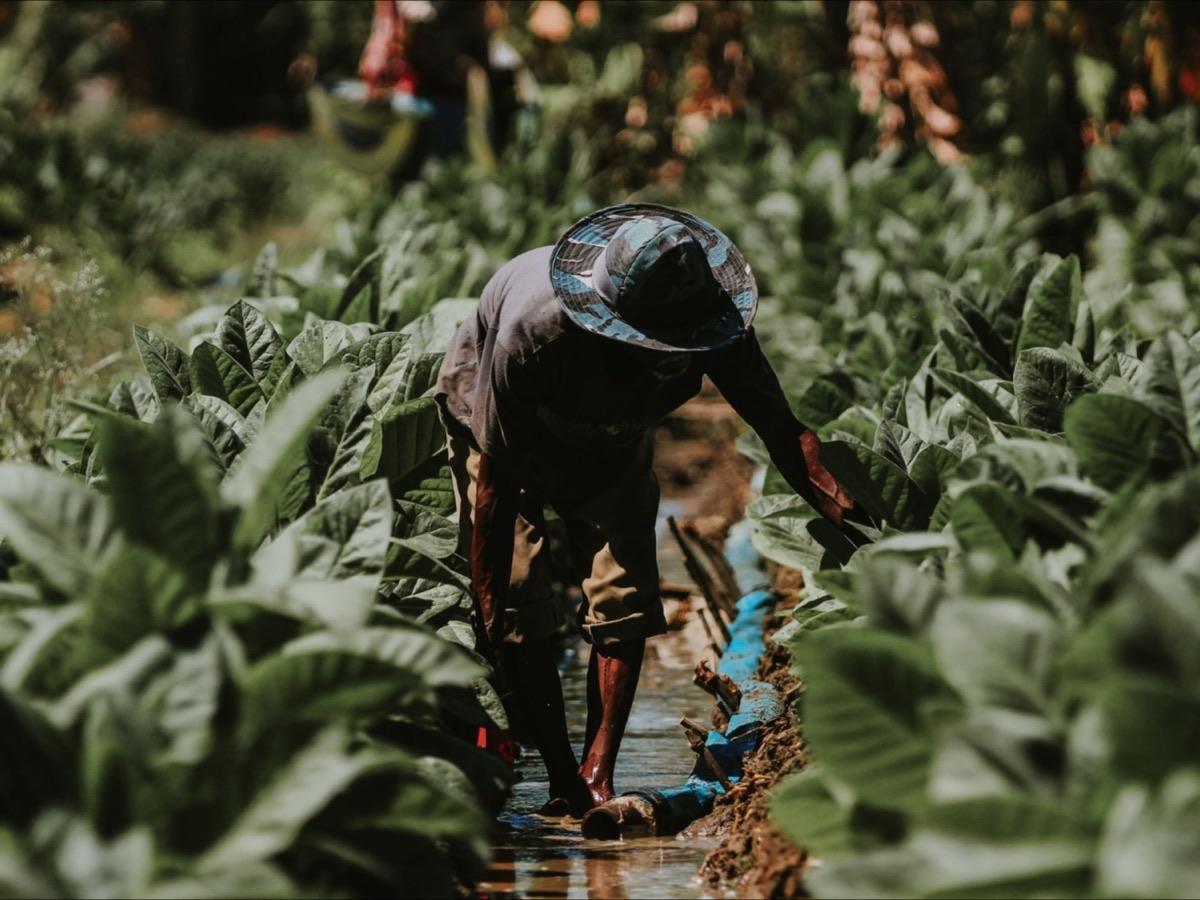
The soil sets limits on the leaf before anything is planted. A heavy, wet soil gives a dark, coarse leaf; a light, sandy one a thinner, lighter leaf; a soil full of disease can ruin a crop whatever the grower does later. This lesson covers the soils cigar tobacco grows in, how growers correct their acidity, how a field is plowed and shaped, and how organic matter, cover crops and rotation keep the soil in condition. Plant Spacing and Field Layout covers how the rows are then laid out, and the Seed to Leaf topic covers fertilizing the crop.
The soil tobacco wants
Cigar tobacco prefers light, well-drained soils. Connecticut's agricultural station described the typical tobacco soil of the Connecticut Valley in 1934 as a sandy loam, 60 to 80 percent of it coarse particles, and explained why it mattered: lighter soils give a lighter-colored, thinner leaf, which is more desirable, while heavy black soils give rank growth and a darker, heavier tobacco. Growers used the coarsest sandy loam for shade tobacco; it suited the open-field crops less well, because it dried out and lost its nutrients too easily.
The great cigar regions have soils of their own. The tobacco land of Pinar del Río, in Cuba, is mostly a yellowish, leached ferralitic soil, slightly acid and low in organic matter; a 2018 study found less than one percent in cultivated fields. Estelí, in Nicaragua, farms flat, volcanic soils, while Jalapa's soil is reddish-brown and ranges from loam to sandy loam. Ecuador's tobacco grows in volcanic soil that one grower describes as very powdery and loose, turning black when it is wet, and the San Andrés valley in Mexico has a nearly black volcanic soil so rich in potassium that the Turrent family adds no potassium fertilizer. The Tobacco Regions topic describes each region.
Acidity
Tobacco grows best in slightly acid soil, but the right level depends on the region and its diseases. In 1953 Connecticut's agricultural station put the best range at a pH of 5.0 to 5.6: soils above about 6.0 encouraged black root rot, a root disease, and soils below 4.5 could poison the crop with manganese. Connecticut growers today keep their soil around or below 6.0. Guidance for Connecticut Broadleaf grown in Kentucky and Tennessee, where conditions differ, recommends 6.2 to 6.6.
Where the soil is too acid, growers add lime. In the Dominican Republic, Davidoff prepared the red soil at Yamasá, rich in iron and aluminum, for years before it grew good wrapper, adding calcium carbonate and other forms of lime to raise its pH, and found that the nutrients it added washed out quickly. In Jalapa, Aganorsa raised the pH of its fields with magnesium and calcium; its owner has said it took twenty years to get the land up to the job. Cuba's Partido has the opposite problem. Its red soils, once among the best for wrapper, have become alkaline, with a pH of about 7.8, and Cuban researchers found that working acid peat into the soil, 45 cubic meters a hectare by hand ten days before planting, raised the share of export-quality wrapper by about 10 percent.
Breaking and working the ground
In Cuba, tilling begins in the summer: when Hurricane Ian struck Pinar del Río in late September 2022, the fields had already been plowed, ready for planting from October. The work is done with tractors or with oxen and the arado criollo, the traditional plow, which also opens the furrows. A study of a farm in Granma describes both at work, a tractor-drawn plow and disc harrow alongside an ox-drawn plow and harrow, with the planting furrows opened by oxen about 15 centimeters deep.
Nicaraguan studies describe the work on mechanized farms. In Jalapa, one grower's fields were broken with heavy machinery and then harrowed three times, the passes 25 and 10 days apart, before the planting furrows were marked; a trial in Condega used one pass of the plow, two of a heavy harrow and two more to level the ground; and small growers in Jalapa clear their land by hand with machetes before the machines come in. Together they describe the usual order of work:
- Clear the land of weeds and the last crop's remains.
- Plow, to break and turn the soil.
- Harrow two or three times, until the soil is fine.
- Level the field.
- Open the furrows, or raise the ridges, for planting. Not everyone wants a tractor on the land: Perdomo plows its rows with oxen to aerate the soil.
The finished field must drain. Tobacco seedlings die in waterlogged soil, so Nicaraguan growers raise ridges where the ground puddles, as Plant Spacing and Field Layout explains.
Organic matter and cover crops
Cigar soils are often poor in organic matter, and growers add it. Cuban guidance calls for calcium carbonate, organic manure or other fertilizer to be worked into the land before planting, and a prize-winning wrapper grower in Pinar del Río explained in 2024 that the soil had been covered with organic matter, because chemical fertilizer alone does not make good wrapper. In Jalapa, the Plasencia family feeds its soil with its own organic fertilizers.
In Connecticut, growers sow cover crops after the harvest to hold and feed the soil over winter. Trials at the station's farm in Windsor in the 1930s found oats the best of ten crops tried, with rye close behind and preferred by many growers because it could be grazed; a cover of oats kept 56 pounds of nitrogen an acre from washing out of the soil in a year. Rye later proved to control wireworms as well, and today winter rye is the usual cover, sown in October or November and ended in April.
Rotation and rest
Growing tobacco in the same field year after year lets its diseases build up in the soil. In Cuba, black shank has built up in this way in the oldest tobacco regions, as Pest and Disease Control explains. A 2018 survey of 40 growers in Pinar del Río found that 39 percent planted maize after the tobacco harvest, in April or May, 30 percent left the field fallow, and 31 percent grew other crops between the tobacco, such as velvet bean, beans, canavalia, maize and sorghum. Near León, in Nicaragua, one grower planted corn and sorghum in 1999 to clean the soil of the nematodes, tiny root worms, that tobacco leaves behind.
Some growers rest their land for longer. Davidoff used only 21 of its 100 hectares at Yamasá for each harvest in 2016, in rotation, and A.S.P., in Ecuador, never used all its land at once and grazed cattle on the fields lying fallow. In the 1890s, Dutch planters in Sumatra's Deli region left each field fallow for eight years after a tobacco crop.
Practice varies with the region. Guidance in Kentucky and Tennessee asks for Connecticut Broadleaf fields that have been out of tobacco for at least two years, yet in Connecticut tobacco has done well on the same land year after year. The wrong rotation can do harm too: Fusarium wilt, a soil fungus, first appeared in Connecticut in 1943 on land that had grown sweet potatoes. Where rotation is not enough, Connecticut growers from the late 1940s fumigated their soil against nematodes, waiting at least two weeks before planting, until resistant varieties made it unnecessary in some fields.