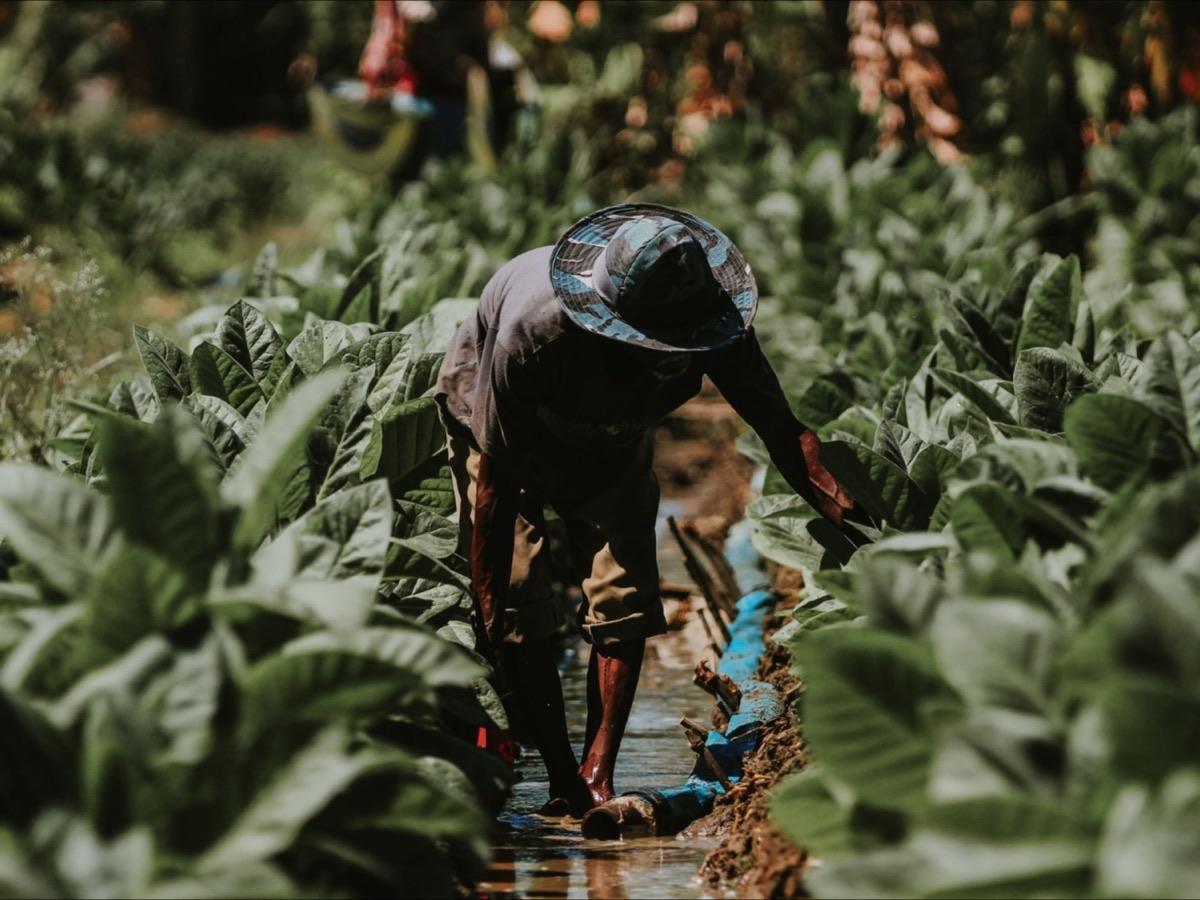
The choice between sun and shade is made before the field is planted, and it shapes everything that follows: how the field is built, how tall the plants grow, how often they are picked and what the leaf costs. This lesson looks at that choice from the field: what a shade tent does, how tents are built in Cuba, Connecticut and Central America, how sun-grown tobacco is farmed, and what each method costs. Growing Methods, in the Wrappers topic, explains what each method does to the wrapper leaf itself and to its flavor.
What the cloth does
A shade tent is a frame of posts and wires covered with cloth. Connecticut's agricultural station explained its purpose in the 1930s: growing tobacco under cloth gives thinner, smoother leaves with smaller veins, and it does so not only through the shade but equally through the higher humidity and the lower evaporation and wind inside the tent. Measurements in Cuban shade fields early in the 20th century found about a third less light under the cloth than outside it. Habanos describes the cloth as filtering the sunlight and trapping the heat, so that the leaves grow larger and finer.
The tent also protects the crop. When widespread hail struck the Connecticut Valley in 1929, it destroyed about 80 percent of the open-field broadleaf and Havana Seed crops but only 16 percent of the tobacco under shade. Under cloth the plants grow taller, with more leaves, and need support: in Cuba each plant is tied to a wire beneath the cloth, and Connecticut workers wrap and tie their plants to overhead wires.
The tapado in Cuba
Cuba calls shade-grown tobacco tapado, "covered". It has grown wrapper this way since 1902, when growers in San Luis, in the Vuelta Abajo, first covered their fields. Building a tapado is skilled, high work. Stilt walkers, the zanqueros, first stretch the wires across the whole field at a height of about 2.5 meters, on posts some 10 meters apart, and then lay the cloth over them. The side cloth, the rodapié, goes up around the field a day or two before planting, and the roof cloth some 10 to 20 days into the season, according to Habanos. Habanos calls the cloth muslin; it is often described as cheesecloth.
Cuban wrapper is grown on small farms. In San Luis, the average grower has about 1.2 hectares of tapado, and Cuba as a whole planned about 2,100 hectares of shade-grown tobacco for the 2022–23 season, against more than 15,000 hectares of tobacco altogether. Growers have experimented with the cloth itself: in 2006 the Robaina family tried a tapado so fine that insects could not get through it, and found they needed no insecticide.
Connecticut's tents
Connecticut raised its first crop under cloth in 1900. By the 1930s its tents stood on chestnut poles 12 feet (3.7 meters) long, set three to three and a half feet into the ground and 33 feet (10 meters) apart each way, so that the cloth hung about nine feet above the field. The cloth was a cotton fabric sewn in strips; a top cloth lasted one season and was often reused as side wall the next. Synthetic netting replaced cotton from the 1970s, and today's cloth is a polypropylene or nylon mesh. Irrigation was built to fit: Connecticut sprinklers of the 1950s were mounted on risers tall enough to spray from above the top cloth.
Shade in Central America and the Caribbean
Growers in Nicaragua, Honduras and the Dominican Republic build tents of their own, usually of mesh netting. In Nicaragua, Aganorsa grows all its wrapper under shade in Jalapa, Plasencia grows wrapper under mesh in Jalapa, and A.J. Fernandez grows shade wrapper on the La Lilia farm in Estelí. In 2013 the Plasencia family farmed about 850 acres (340 hectares) under shade and 800 acres (320 hectares) in sun across Nicaragua and Honduras. In the Dominican Republic, all the wrapper at Arturo Fuente's Chateau de la Fuente grows under cheesecloth, and La Aurora and Davidoff grow their Dominican wrapper under shade as well.
Two wrapper regions need no tents. In Ecuador a thick, almost constant layer of cloud does the work of the cloth, as Growing Methods describes, and in Cameroon the cloud cover of the growing season makes cloth unnecessary too.
Growing in full sun
Most cigar tobacco grows in the open. In Cuba all filler and binder is tabaco de sol, sun-grown, and filler is grown in the sun in the other cigar countries too. Some of the best-known wrappers are sun-grown as well, among them Connecticut Broadleaf, Mexico's San Andrés Negro and the sun-grown Nicaraguan wrappers of makers such as Padrón and Perdomo. A sun-grown plant stays shorter, with thicker, heavier leaves.
Sun-grown fields are cheaper to run but more exposed. Cuban growers shelter them from wind with palm fronds or strips of cloth around the field, and they top sun-grown plants lower than shade-grown ones, as Topping Timing and Height shows.
What each method costs
The table compares the two methods in the field.
| Under shade | In full sun | |
|---|---|---|
| The plant | Taller, with more leaves | Shorter, with fewer, thicker leaves |
| Topping in Cuba | 14 to 20 leaves left | 8 to 18 leaves left |
| The harvest | More pickings, because the plant has more leaves | Fewer pickings, or the stalk is cut |
| Cost in Connecticut, 1953 | About $2,000 an acre | About $500 to $800 an acre |
| Used for | Wrapper | Filler, binder and some wrapper |
The cost gap has grown since. Connecticut shade growers put the cost of running a shade farm at about $20,000 an acre in the early 1990s and $30,000 to $40,000 by 2019. Shade also has its own risks. The humid air under cloth suits disease: Connecticut growers found that blue mold could damage tobacco in the tents in cool, wet seasons, and in 2021 a Nicaraguan grower reported more blue mold than usual on Connecticut-seed wrapper plantings because of the humidity. A wrapper that fails its grades also loses most of its value, as Yield vs Quality Balance explains.