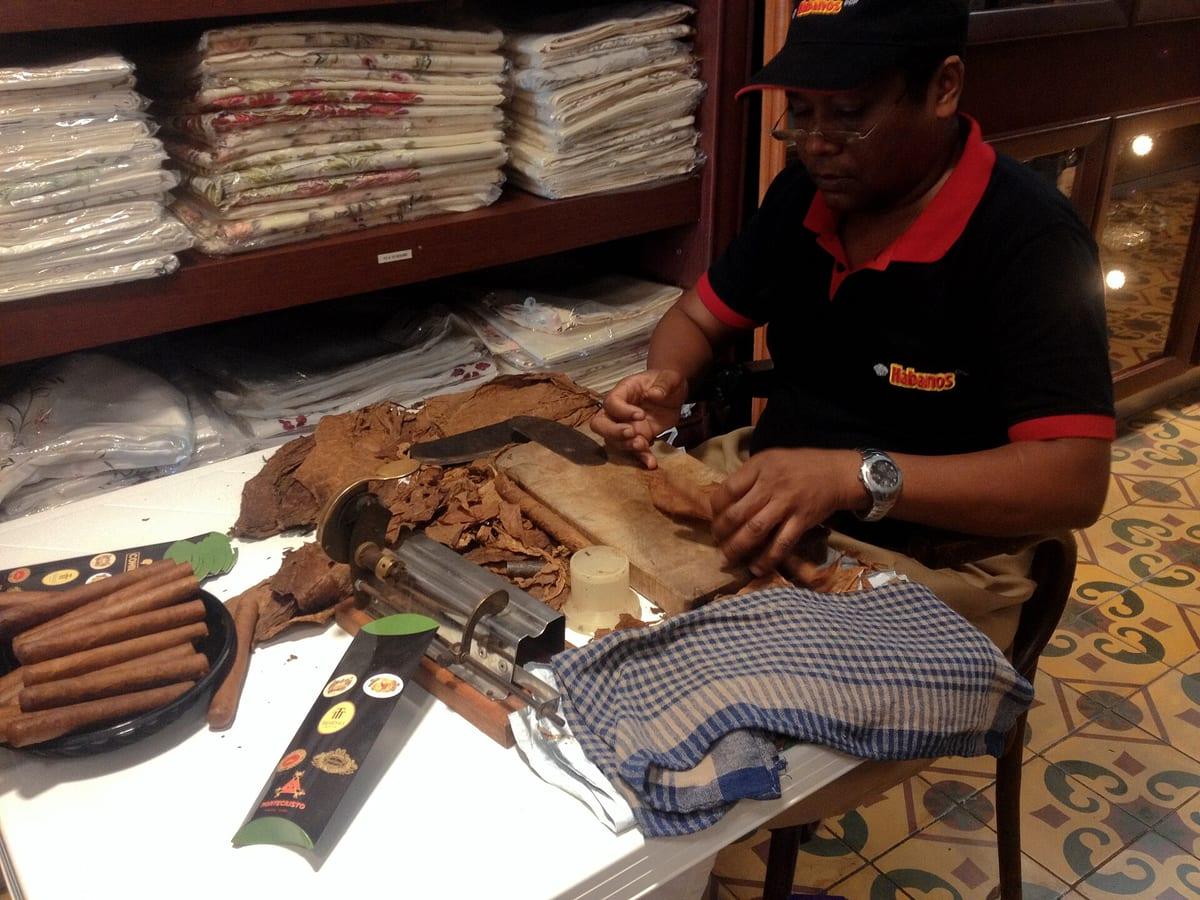
A cigar that has passed the checks described in Control de Calidad — Quality Control Specialists is finished as an object but not yet as a product. It is still damp from the rolling table, it has no band, and it belongs to no box. The workers in this lesson give it all three. Their work decides what a buyer sees first when the lid is lifted, and in Cuba it also produces the stamps and seals that show where and when a box was made. The grading of the leaf before rolling, including the rezagado, the classing of the wrapper leaves by size, colour and texture, belongs to the sorting houses and is described in Sorters — Tobacco Classification Specialists; this lesson begins after the cigar is made.
The escaparate
A freshly rolled cigar holds more water than it should, because the wrapper is moistened to make it supple enough to stretch and the roller works the leaf with damp hands. In a Cuban factory the cigars are therefore taken, between making and packing, to the escaparate, the conditioning room, where they rest in cedar-lined drawers while the excess moisture leaves them. Habanos gives the conditions as 16 to 18 °C and 65 to 70 percent relative humidity, which is noticeably cooler and drier than the Cuban air outside. The cigars become smokable after about a week, and the longer they stay, the better. Because the room holds the factory's finished stock, it is often called the treasury of the factory. Cigars were formerly kept there in bundles of 50, the media rueda or half wheel, a count described in History and Tradition in the Cigar Boxes topic.
The same pause exists outside Cuba under the name of the aging room, and makers set its length themselves. At Tabacalera A. Fuente in Santiago, in the Dominican Republic, rolled cigars rest in the aging room so that their flavours blend and the different tobaccos reach the same humidity; at TABSA in Estelí, Nicaragua, the aging room's shelves are stacked high with resting cigars before they go to a back room for banding and boxing; and Villiger stores the premium long-filler cigars made at its Nicaraguan factory for at least six weeks before they are banded, wrapped in cellophane and packed. The published accounts give no single temperature or humidity for these rooms, and makers rarely state them.
The cool temperature does a second job. The cigarette beetle, Lasioderma serricorne, the small beetle that bores through stored tobacco, develops fastest at about 30 to 33 °C in laboratory studies of beetles raised on dried tobacco leaf, so a room held at 16 to 18 °C keeps it far below the conditions in which its numbers grow. Humidor Essentials explains why the same rule applies to a smoker's own box.
Matching the colours
Wrapper colour is natural. No process forces it; the leaves from the upper levels of the plant are darker to begin with and darken further in fermentation, so even cigars of one brand and one size come out of the escaparate in many slightly different shades. A box in which every cigar shows the same shade looks like the work of one hand, and makers sell that impression, so the cigars are matched before they are boxed.
In Cuba this is the work of the escogedores, from escoger, "to choose", whom Habanos counts among the most senior workers in a factory. They work in pairs. The first sorts the cigars of a batch into colours and shades of each colour, laid out on a table in columns and rows that may represent 60 or more finely distinguished shades. The second works within each shade one box at a time, setting out the cigars so that the slight differences that remain run from dark to light, left to right across the box, and choosing which face of each cigar will look upward and carry the band. Either may reject a cigar that does not look good enough. The figure of 65 shades that appears in some glossaries is not Habanos's own; Habanos gives "60 or more". Sorters — Tobacco Classification Specialists describes the escogedores alongside the leaf sorters.
Makers in the Dominican Republic, Nicaragua and Honduras publish no comparable account of how many shades they sort into.
Banding
The band, the anilla in Cuba, is put on after the colours have been matched, because the escogedor has already decided which face of each cigar will show. The work belongs to the anilladora, the bander, who places a band on each cigar by hand and lays the cigars into their part-dressed box with the same face upward, the band aligned and the same order kept from left to right. At the Partagás factory in Havana a spacer is used so that each band sits at exactly the same height on the cigar every time, and a skilled bander fills a box with banded pirámides in a few minutes before taking the next. The feminine form of the word is the usual one: a study of the tobacco manufactories of central Cuba between 1939 and 1952 found that women made up about a fifth of their workforce and worked in stripping the leaf, classing the wrappers and in the anillado and fileteado, the banding of the cigars and the trimming of the boxes.
Bands have carried more than a name for a long time. Habanos dates the first bands to the 1860s and credits them both with distinguishing one brand from another and with making copies harder; the Cohiba Behike band of 2010 was the first to carry two holograms, and the Cohiba lesson in Major Cigar Brands follows that brand's bands in detail. Second bands are added at the same stage: at La Corona in Havana a secondary band marks cigars made for Habanos' own franchised shops or for one region.
Outside Cuba, too, the work is done in a packing room near the end of the line. At A.J. Fernández in Estelí, bands and ribbons are applied by hand and the cigars then go into cellophane sleeves and their boxes. Machines that band cigars have been patented since the early 1900s, but no reliable account shows how many premium factories use them today, so this lesson does not estimate it.
Into the box
Before a Cuban box is closed, inspectors, the revisadores, look at the colour matching, the banding and the appearance of every cigar in it. A cigar that fails is turned upside down in its place and the whole box goes back to the escogedor to be put right.
How the cigars lie depends on the box. Habanos makes its labelled boxes deliberately a little too small for the cigars, so that round cigars packed into them are pressed square; some brands press most of their sizes this way and some none, and Habanos says the present trend favours round cigars. A box of 25 pressed cigars is usually packed in two layers, which collectors' guides give as 13 over 12. The 8-9-8, with its curved sides, does the opposite: it holds round cigars in three rows of 8, 9 and 8, or 3, 4 and 3 for a box of ten, so that they are not pressed. The cabinet, the slide-lid box, holds round cigars tied with a silk ribbon, and La Corona's packers tie bundles of Por Larrañaga Petit Coronas with ribbon before they go into such cabinets. Box Types and Styles, in the Cigar Boxes topic, describes each box.
Cedar goes in with the cigars. A thin sheet of Spanish cedar is laid in the box to separate or cover the cigars, and some sizes, the cedros, are wrapped one by one in cedar. In Cuba those sheets come from a private workshop in Cabaiguán, in Sancti Spíritus province, Laminados Concepción, which in 2024 described itself as the state's only supplier; its owner built his own veneer lathe about twenty years earlier to replace imported sheets, and it cuts them 0.3 to 0.7 mm thick. Other cigars are packed singly. Habanos's aluminium tubes, the tubos, are lined with cedar and were first made in the 1930s for railway companies, and one Cuban brand, Fonseca, wraps its cigars in tissue paper, papel de seda. Habanos uses cellophane today only on machine-made cigars, though it once wrapped some brands in it for certain countries; makers in the Dominican Republic, Nicaragua and Honduras commonly sleeve their handmade cigars in it.
Dressing the box
A Havana box is dressed in a set of printed papers called the habilitaciones, and every one of them is applied by hand, some before the box is filled and some after. Cuba's first trademark law, of 1884, gave these labels legal standing, and they served both to sell the cigar and to make forgery harder, as the Romeo y Julieta lesson in Major Cigar Brands explains.
Habanos names each piece. The cubierta is the image on top of the lid; it recalls the days when names were branded into the wood with a hot iron. The vista is the large picture inside the lid, often embossed and gilded, showing medals won at exhibitions, the arms of former royal customers and notes on the brand's history. The bofetón is the decorated paper leaf inside the box that covers and protects the cigars, printed to go with the vista. The filete is the decorative strip that seals the hinge of the lid, and the fileteado is the work of putting such strips on; at La Corona the strips are still applied by hand to the corners of the box. The papeleta is a rectangular or oval seal on the short side of the box. The largero and the costero are the coloured strips on the long and short sides, the first usually carrying the brand and the second the name of the size, and on some boxes a small seal, the tapaclavo, covers the nail that holds the lid. In a finishing room at Partagás a worker brushes glue onto the papers, and the freshly dressed boxes are left to dry before they are filled.
Seals and stamps
The Cuban warranty seal, the sello de garantía, is the oldest mark on the box. It goes back to 1889, when Cuba was still a Spanish colony: the manufacturers' union of Havana, the Unión de Fabricantes de Tabacos, decided with the colonial government's approval to place a seal on every exported box, and Habanos describes the seal as introduced by a royal decree of the King of Spain. The two accounts describe the same step from different sides. In 1912 the government of independent Cuba passed a law authorising a new design close to the one used today; it was slightly modified in 1931, and in 1999 it was changed radically, adding a red serial number and an emblem visible only under ultraviolet light.
The present seal dates from March 2009, when Habanos announced it would be introduced gradually on all packaging. It adds a hologram and an individual barcode, and each barcode is recorded in a database with the destination and the invoice number, so that a box can be followed from the factory to the distributor and checked on Habanos's online authenticity check. The seal is printed on a synthetic paper that destroys itself if anyone tries to peel it off, it resists scanning and photocopying, and it carries a microdot that only a laser scanner can read. Old and new seals circulated side by side for a time. Habanos's own descriptions of the seal speak of a barcode, not a QR code, and this lesson found no Habanos source for a QR code on the seal. Since 1994 every box has also carried a second seal, in the upper right corner, marking the cigars' Protected Denomination of Origin.
Stamps hot-pressed into the wood add more. Hecho en Cuba, "made in Cuba", has been burned into the bottom of every box since 1960; before that the English "Made in Cuba" was often used. Totalmente a mano, "totally by hand", has been stamped on boxes of long-filler cigars since 1989, while short-filler boxes have carried the ink stamp TC, for tripa corta, since 2002, and the company name Habanos s.a. has been hot-stamped since 1994. Two ink stamps give a code for the factory and the month and year of boxing, the month in Spanish abbreviations such as ENE for enero, January. Such stamps were introduced in 1985 in code; the year has been printed in figures since 2000. Distributors add stamps of their own for their markets, and in 2025 Habanos introduced a separate seal for cigars sold inside Cuba, brown for that year. Some recent releases carry an NFC chip that a phone can read. Certification and Security, in the Cigar Boxes topic, explains how a buyer reads these marks, and Packaging and Presentation, in Cuban vs. Non-Cuban, compares them with the safeguards of the other countries, which have no state seal.
The box makers
The boxes themselves are made in specialised workshops. In Cuba the state's packaging enterprise for tobacco, the Empresa Nacional de Envases para el Tabaco, known as ARCA, supplies the trade; envase is the Cuban industry's word for any container, and a Cuban national standard of 2015, NC 1082, sets the specifications for the wooden boxes, envases de madera, of hand-rolled cigars. At the end of December 2017 the state tobacco group Tabacuba opened a factory for wooden cigar boxes in Guanabacoa, in Havana, at a reported cost of US$27 million and with a capacity of 8 million boxes a year, built to replace imports. Smaller workshops add to it: one in Pinar del Río, De Cuba Arte en Maderas, makes export boxes from cedar supplied through ARCA and Habanos.
In the other countries many cigar makers build their own boxes. Tabacalera A. Fuente runs a large box factory, La Gran Fábrica de Cajas, across the street from its main plant in Santiago, where high-gloss boxes receive their final coats of paint, and General Cigar Dominicana in Santiago also has its own. In March 2023 DBL Cigars opened a box factory beside its cigar factory in Tamboril, near Santiago, with about 80 employees and 90 woodworking machines, planned to make more than 200,000 boxes a year for itself and for other Dominican makers. Estelí had more than ten box factories by late 2014, as Economic Impact in Nicaragua records. One of them, Cigar Box Factory Estelí, opened in 2014 and moved to a larger building in the city's free-trade zone in 2019, with more than 100 staff making boxes and humidors for Drew Estate, A.J. Fernández and Altadis U.S.A.; Oliva's Nicaraguan company, Tabolisa, built a box factory north of the city in 2017 at a cost of US$850,000, planned for 100,000 to 120,000 boxes a month. In Honduras, Central American Cigars in Danlí had what was described in 1996 as one of the most sophisticated box shops in the town.
The humidor makers who build cabinets for cigars are cabinetmakers first, and their trade, from the lacquered humidors of Paris to the controls on the export of Spanish cedar under CITES since 2020, is described in Accessories Industry, in the Industry topic.
The people and the pay
No source divides the cigar workforce by job, so the share of women in the packing rooms is not known. The national figures give the frame. In the Dominican Republic's free-trade zones, where most cigars are made, women held 23,818 of the 38,622 tobacco jobs in 2025, 61.7 percent; in Nicaragua the industry's own estimates put the share of women at 55 to 60 percent. Economic Impact in the Dominican Republic and Economic Impact in Nicaragua give those figures in full.
Pay for packing jobs is not published separately. In the Dominican Republic every free-zone worker is covered by the free-zone minimum wage, raised to RD$20,875 a month from 1 June 2026. Rollers are paid by the piece, as Torcedor — Cigar Roller / Cigar Artisan explains, but no reliable source states how Cuban or Central American factories pay their banders and packers, and the figures published for Cuban tobacco workers as a whole disagree too widely to give here.
The jobs side by side
The table sets the jobs of this lesson against one another: the trade's name for each, what the worker does, and where the work is done. The first four happen in that order in a Cuban factory between the escaparate and the shipping room; the last two are done in separate workshops that supply the factories.
| Job | Spanish name | What they do | Where it happens |
|---|---|---|---|
| Conditioning-room staff | escaparate (the room) | Keep rolled cigars at 16 to 18 °C and 65 to 70 percent humidity until they lose the moisture of rolling | Every Cuban factory; aging rooms in factories elsewhere |
| Colour grader | escogedor | Sorts finished cigars into 60 or more shades, orders each box dark to light and picks the face that shows | Cuban factories; colour matching by hand in factories elsewhere |
| Bander | anilladora | Bands each cigar by hand at a fixed height and lays it in the box | Packing rooms in every producing country |
| Inspector | revisador | Checks colour, banding and appearance before the box is closed and sends faulty boxes back | Cuban factories |
| Box dresser | fileteado (the work) | Glues on the habilitaciones, from the vista to the filete, and lets the box dry before filling | Cuban factories and box workshops |
| Box maker | envases (Cuba); fábrica de cajas | Cuts and assembles the cedar or plywood boxes | ARCA and the Guanabacoa plant in Cuba; makers' own and independent box factories in Santiago, Estelí and Danlí |
Read down the table and the line from rolling table to shipping room becomes visible: the cigar is first left alone, then judged by eye, then dressed, and then judged again. Only the box makers stand outside the factory, and outside Cuba they are as likely to belong to the cigar maker as to sell to many of them.