Seed and soil set what a wrapper can become, but the way it is grown decides much of what it does become: how thick and elastic the leaf is, how fine its veins are, how dark it cures and how much flavor it carries. This lesson compares the three ways wrapper is grown, under cloth, under clouds and in full sun, then follows the leaf through harvest, curing, fermentation and sorting, and explains why every step costs more for wrapper than for any other leaf. Sun Grown vs Shade Grown, in the Tobacco Farming topic, covers the field work in general, and the Curing & Fermentation topic covers what happens in the barn and the fermentation room.
Under cloth
Shade-grown wrapper grows beneath cloth stretched over a frame, which filters the sun and keeps the air around the plants more humid. Early in the 20th century, a study of Cuban shade fields measured about a third less light under the cloth than outside it, with higher humidity and almost the same temperature, and found that the leaves grew much larger and thinner. A shade-grown plant also grows taller than a sun-grown one and carries more leaves, each with finer veins and a smoother, more elastic surface.
Growing under cloth began in Florida, where farmers found in 1896 that shade-grown leaf was ideal for wrapping cigars, and Gadsden County had more than 5,000 acres under shade by 1906. Connecticut followed in 1900, when the first crop was raised under thin cheesecloth on a frame nine feet (2.7 meters) high. Connecticut plants reach about nine feet by early July and as much as twelve feet (3.7 meters) by late August. Today the cloth is usually a white polypropylene netting.
In Cuba, shade-grown tobacco is called tapado, "covered". Some 10 to 20 days into the growing season, the fields are enclosed under canopies of muslin, and each plant is tied by a string to the frame. Cuba grows its wrapper this way, mainly in the Vuelta Abajo, above all around the town of San Luis, and in Partido, a region south-west of Havana that specializes in wrapper, while all Cuban filler and binder is grown in full sun.
Under clouds
Ecuador grows wrapper without cloth. During its growing season, which runs from the seedbeds in May to the harvest toward the end of the year, a nearly constant layer of thick gray cloud covers the tobacco regions of Los Ríos and the foothills of Guayas, filtering the sun much as cloth does. Growers there need no netting or artificial shade, and Connecticut-seed plants can grow as tall as eleven feet. The clouds, the volcanic soil and lower labor costs together made Ecuador one of the world's main sources of wrapper, for Connecticut, Sumatra and Habano seed alike.
In full sun
Sun-grown tobacco grows in direct sunlight, which makes a thicker, darker leaf with heavier veins and more pronounced flavor, and many makers now choose sun-grown wrapper on purpose for that fuller flavor and darker leaf. Padrón grows its Cuban-seed wrapper in full sun in Nicaragua, Oliva's Serie V wears a sun-grown leaf from Ecuador, and J.C. Newman's The American, released in 2019, was the first cigar wrapped in Florida Sun Grown leaf, grown in central Florida. The great maduro leaves are sun-grown too: Connecticut Broadleaf, Mexico's San Andrés Negro and Brazil's Mata Fina. Their thick leaf stands up to the long, hot fermentation that a maduro needs.
A thicker leaf also means more tobacco on each cigar. An early Connecticut study found that wrapping 1,000 cigars took about 2.9 pounds (1.3 kilograms) of shade-grown leaf but nine pounds (4 kilograms) or more of sun-grown broadleaf. The same study found that broadleaf grown under shade lost the elasticity it had in the open, a reminder that variety and method have to suit each other.
The table compares the three methods.
| Under cloth | Under clouds | In full sun | |
|---|---|---|---|
| Where | Cuba (tapado), Connecticut, Nicaragua, the Dominican Republic | Ecuador | Nicaragua, Mexico, Brazil, Connecticut (broadleaf), Ecuador, Florida |
| The plant | Tall, with more leaves | Tall | Shorter |
| The leaf | Large, thin and elastic, with fine veins | Thin and elastic | Thicker and darker, with heavier veins |
| Typical wrappers | Cuban wrapper, Connecticut Shade, Jalapa Corojo | Ecuador Connecticut, Habano and Sumatra | Habano, Corojo, Broadleaf, San Andrés, Mata Fina |
Picking the leaf
Most wrapper is primed: picked a few leaves at a time, from the bottom of the plant up, as each level ripens. A ripe leaf turns a lighter green, with a yellowish cast at its tip. In Cuba, the harvest of shade-grown plants begins about 40 days after they are planted out. Two or three leaves are taken at each pass, a single plant is harvested over close to 30 days, and the shade-grown plants, taller and with more leaves, need more pickings than sun-grown ones. The first, smallest leaves at the very bottom, the mañanita, are too small for Habanos. Connecticut shade is picked in six or more primings, two or three leaves from each plant at a time.
The leaves of the Cuban shade plant have names of their own, from the bottom up: libre de pie, uno y medio, centro ligero, centro fino, centro gordo and corona. Traditionally the middle leaves gave most of the wrapper. The leaves at the top of the plant are darker, and Habanos uses upper leaves for its darker wrappers, such as those of the Ediciones Limitadas and Cohiba Maduro 5.
Some wrapper is harvested whole instead. Stalk cutting cuts the whole plant at once and hangs it in the barn to cure. It is the usual method for Connecticut Broadleaf, which is cut fairly young, and for Brazil's Mata Fina, and it was the tradition with San Andrés Negro, although some Mexican growers now prime it because the stalk-cut leaves broke too easily.
Curing, fermentation and sorting
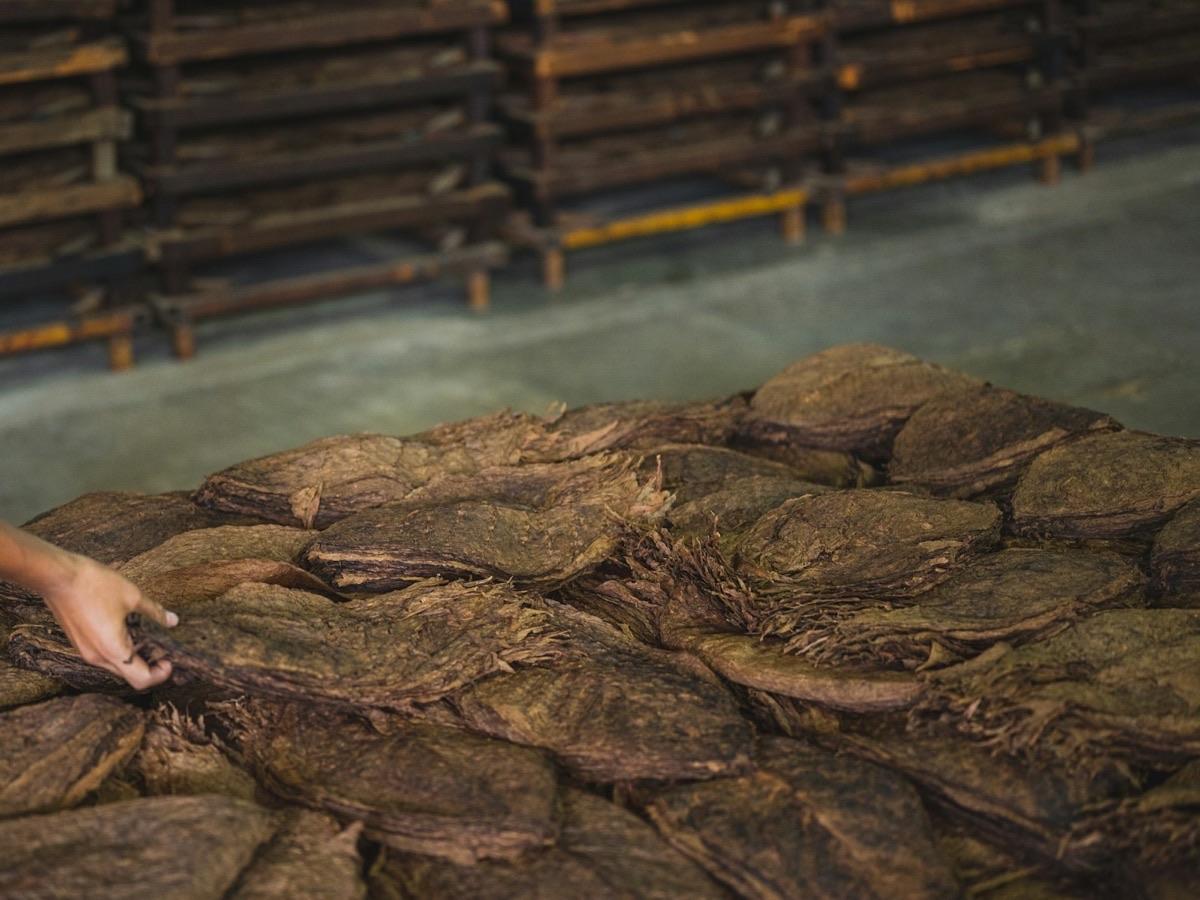
After the harvest, wrapper is air-cured in barns, where it slowly dries and turns from green to brown. In Cuba a traditional barn cures wrapper in about 50 days, and the controlled barns used since the 1990s, whose temperature and humidity are managed, take about 25. Connecticut barns use gas burners to keep the leaf in warm, tropical conditions, around 38 °C (100 °F), for up to six weeks. Candela, the green wrapper, is the exception: it is dried with heat in 60 to 72 hours, which fixes its chlorophyll, as Color Scale explains.
Wrapper is usually fermented more lightly than filler. In Cuba it goes through a single fermentation of at least 20 days and then ages for at least six months in a tercio, a bale wrapped in palm bark. A maduro wrapper is the exception again, fermented for months at a higher heat. The Curing & Fermentation topic compares the stages for each kind of leaf.
Then every leaf is sorted. Graders judge each wrapper by size, color and texture, and set aside those with holes, stains or uneven color for binder or filler. In Cuba, wrapper leaves are sorted into some 50 categories, and Connecticut growers have sorted each priming into at least 18 grades. The sorted leaf then often travels to another country: Connecticut Shade, for example, is shipped to the Dominican Republic to be finished and rolled into Macanudo cigars.
Why wrapper costs so much
Every step of growing wrapper costs more than for other tobacco. Cloth is costly in itself, and in Cuba some 5,000 yards of it cover a single acre. Connecticut growers put the cost of running a shade farm at about $20,000 an acre in the early 1990s and $30,000 to $40,000 by 2019, while a new curing barn cost $100,000 to $230,000. Labor costs most of all, because every leaf is picked, sewn, hung, sorted and handled by hand, and in 2019 farm workers in the Connecticut valley earned about $14 an hour against just over $3 in Ecuador.
The weather adds risk. A wet year gives a thinner crop, which is poor for maduro wrapper, and in Ecuador heavy rains can bring out frog-eye, a fungus whose small spots blossom in the curing barn and keep a leaf from being sold as wrapper. Disease can be worse still: blue mold destroyed more than 95 percent of Cuba's crop in 1979–80. Every leaf that fails as wrapper is sold for much less as binder or filler, and in Connecticut even that was said in the late 1990s to be uneconomical.