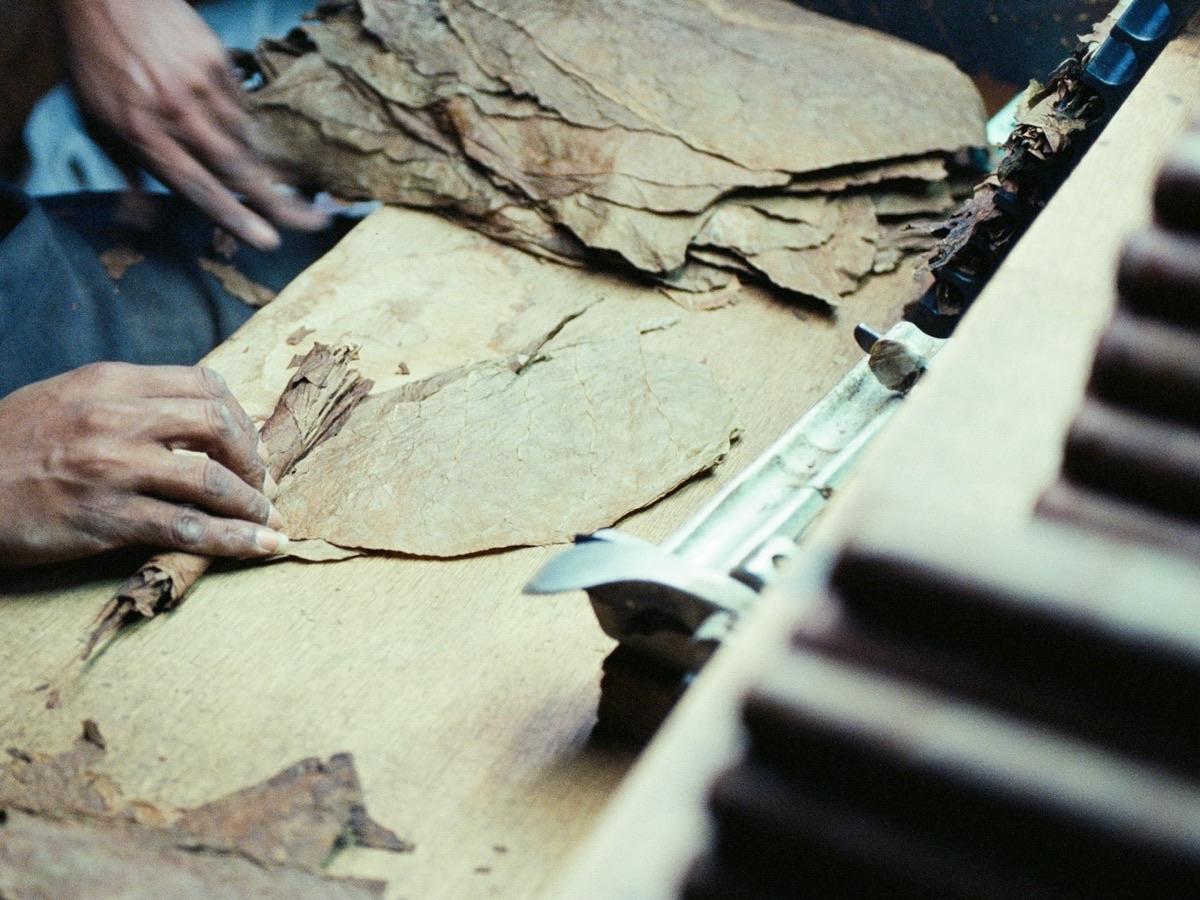
A filled bunch is still only half a cigar. Two leaves go over it: the binder holds it together, and the wrapper finishes it and gives it its look. This lesson follows both leaves onto the cigar, and then the closing of the head and the cutting of the foot. It picks up where Bunching the Filler ends, and it ends where Pressing and Finishing begins.
The binder goes on first
The binder, capote in Spanish (and sometimes banda), is the leaf directly under the wrapper. Its first job is to hold the filler in its final shape, so it must be elastic and supple enough to stretch around the bunch without tearing. Its looks hardly matter, which is why the binder is a leaf almost never seen as such: sound wrapper leaf that failed on color, veining or texture, and the large, fine volado or seco leaves from the lower and middle of the sun-grown plant, all serve as binder once the wrapper hides them. In Cuba the binder comes from those volado and seco leaves, and a torcedor lays two, sometimes three, half leaves for each cigar, with their veined undersides facing inward.
The binder is rolled, never twisted. The torcedor lays the half leaves on the board, gathers and folds the filler onto them, and rolls them around the filler from the foot to the exact diameter, so that the binder holds the bunch under even tension without a twist. Outside Cuba the buncher usually uses a single half leaf of binder, and a few blends use two different binders at once, a double binder. The Binder topic covers the leaf, its origins and its elasticity in detail, and Binder Elasticity and Torcedor Skill, in that topic, describes this same rolling step from the leaf's side.
Grading the wrapper
The wrapper, capa, is the leaf rolled around the outside, and it is chosen far more strictly than the binder. Before a wrapper reaches the rolling board it has been graded at the escogida, the sorting house where every leaf is classed as wrapper, binder or filler and where the wrapper leaves are also fermented. Habanos names the grading of the wrapper its own term, rezagado, the final classification of the wrapper leaf, done by size, color and texture. The leaf must be thin enough to burn evenly with the leaves inside it, elastic enough to stretch without tearing, even in color, fine-veined and free of holes and stains. In Cuba the wrapper leaves are graded into some 50 categories, and color matters so much that after rolling, pairs of color graders, the escogedores, sort the finished cigars into 60 or more shades. The Wrappers topic follows the wrapper from the field to this grading.
Stretching the wrapper on
A wrapper leaf is cut along its central vein into two halves, and each half wraps one cigar, so a single leaf usually wraps only two. The roller trims the half leaf with the chaveta, the roller's crescent-shaped blade, and lays it with the veined side up so that the smooth face will end up outside. The leaf is stretched around the bunch under even tension, not tugged, and it is rolled on from the foot toward the head, so that the first turn sits at the end you light. The two halves of a leaf are rolled in opposite directions, the right half from right to left and the left half from left to right, because each is the mirror of the other and only rolled that way does the leaf lie naturally on the bunch. Where one turn of the leaf overlaps the next is the seam, and on a well-rolled cigar the seams are tight and even, with no lifting edges. A wrapper that is stretched past its elasticity, or pulled thin, will split, and a seam that lifts lets the burn race ahead along the wrapper, the streak called a runner.
Closing the head
When the wrapper reaches the head, the roller has to close the cigar. The head is the end you cut and draw through; its Spanish name is cabeza, and in Cuba it is the perilla. The roller trims the end of the wrapper into a narrow strip, the flag, called the pañuelo, "handkerchief", in Cuba, and winds it over the open end. On top of that small flag goes the cap: a disc cut from the leftover wrapper with the casquillo, a little cylindrical punch, and fixed with goma, a tasteless, odorless vegetable gum, usually tragacanth. This flag-and-cap finish is the usual one on premium cigars. Cuban rollers add one more piece, a teardrop of wrapper woven into the flag beneath the round cap, leaving three seams around the head; that is the triple cap, or gorro, the traditional Cuban finish. Some cigars end with the flag alone, and the Trinidad brand twists the flag into a pigtail. Cap (Perilla), in the Cigar Anatomy topic, covers the styles of head and how to cut each.
The foot, the size and the shape
At the other end, the foot is the open end you light. Its Spanish name is pie, and in Cuba it is the boquilla. The foot is where the roller started the wrapper, and it is cut flat with a guillotine so that filler, binder and wrapper end together, the only place where the filler shows. The guillotine has a stop set to the cigar's exact length, and the diameter is fixed by the ring gauge, measured in sixty-fourths of an inch, so a 50-ring cigar is 50/64 of an inch across, about 19.8 millimeters. Straight-sided cigars, the parejos, come off the guillotine as simple cylinders; the tapered shapes, the figurados, have to be shaped by hand and are left to the most skilled rollers. Both the ring gauge and how the shapes are made come up again in Shapes & Sizes. What the binder and wrapper have now produced is a rolled cigar that is still too damp and too soft to smoke; it goes next into a mould, which Pressing and Finishing describes.