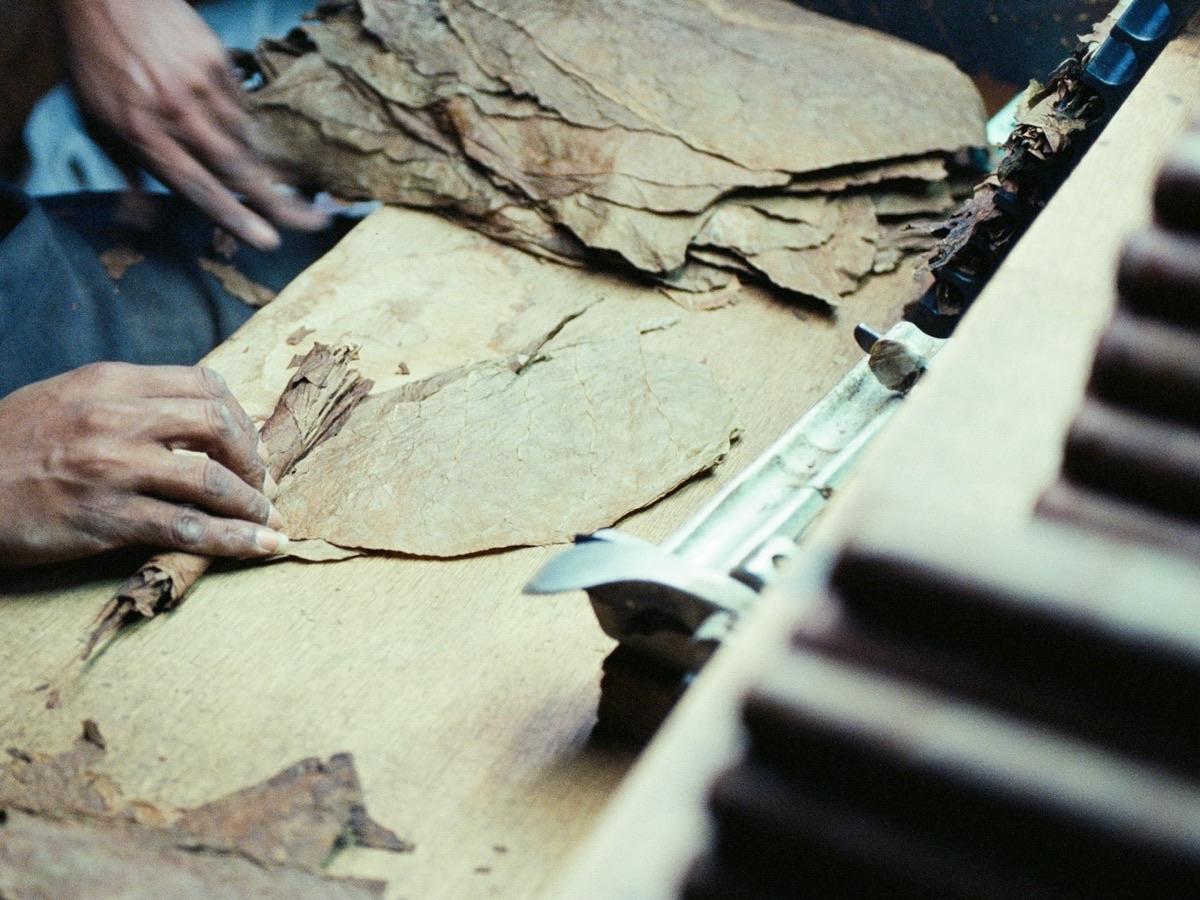
A blend of tobacco exists only on paper until a set of hands turns it into a cigar. The leaf was chosen, cured, fermented and aged years earlier, and the Fillers topic covers each of those steps. What this lesson covers is the moment the leaf becomes a cigar: how the filler leaves are gathered and folded into the bunch, and how that work decides the draw and the burn. It runs from the blender's recipe to the folded leaves, and ends where Binder and Wrapper Application takes over.
Reading the recipe
The recipe is set by the blender, the ligador, who issues each roller the day's leaf in the right proportions. A Habano's filler is a blend of two, three or four kinds of leaf, and blenders elsewhere work the same way, mixing several leaf classes rather than one. The classes come from the height of the leaf on the plant: volado at the bottom burns easily and keeps the cigar alight, seco carries the aroma, and ligero, the slow-burning leaf from the top, gives most of the strength. In Nicaragua, the Dominican Republic and Honduras a fourth class, viso, sits between seco and ligero.
The roller turns that recipe into a cylinder. The Spanish word for the roller is torcedor, from torcer, "to twist", and the finished, rolled cigar is a torcido, "the twisted". The name is a warning in disguise, because twisting is the one thing a roller must not do when bunching: the leaves are folded, never wrung, and the Habanos glossary says of the torcedor that twisting "is the last thing a cigar roller should do when making a cigar".
Stripping the midrib
Not every leaf that reaches the rolling board has had its thick central vein, the midrib, removed. The wrapper has its midrib stripped out and is split into two pliable halves, and the binder is stripped the same way, a step called the despalillo, which also names the stripping house where it is done. The midrib is woody and does not burn like the rest of the leaf, which is why the wrapper and the binder have it taken out. Cuban filler, by contrast, is only partly stripped: the lower part of its midrib is taken out and the rest of the leaf goes into the bunch. In Cuba the strippers, the despalilladoras, are women. Outside Cuba, whether a filler's rib is stripped at all is a factory's or a maker's own choice rather than a national rule.
Folding the leaves
The filler leaves are folded, and the fold decides where the air will travel. Three methods are in common use, and Three Ways of Preparing La Tripa, in the Fillers topic, compares them in detail. In entubado, from entubar, "to put into a tube", each leaf is rolled into itself like a small scroll and the scrolled leaves are gathered; every tube keeps its own channel for air, giving a firm cigar with a free, even draw, but the method is the slowest and hardest. In the accordion method each leaf is folded back and forth into pleats and the pleats stacked, the folds leaving room for air. In the book method, the simplest and quickest, the leaves are laid flat on one another and folded together like closing a book, which leaves fewer air channels and so depends more on the buncher keeping the leaves straight and the pack even.
Entubado is the old Cuban way. In 2007 a retired Cuban roller, Rodolfo Taboada, said he still preferred it because cigars bunched that way always draw, though by then most Cuban rollers had moved to the quicker accordion method. Outside Cuba a few makers keep entubado for particular lines: Drew Estate has rolled every Herrera Estelí, made in Estelí, Nicaragua, since 2013, this way, and its rollers also use a looser hybrid they call estrujado, "lazy entubado". Tapered shapes, the figurados, do not fit any one fold neatly, and a buncher shaping a torpedo or a perfecto often combines methods, because a single misplaced leaf can plug a pointed head.
A fourth device is not a fold at all. Some factories use a Lieberman, also called a Temsco, a hand-cranked frame with a leather or canvas apron: the buncher lays the binder and filler on the apron and works the handle, which rolls them together. It is faster and more uniform than rolling by hand, and where it is used is a maker's decision, line by line — a company may roll one cigar on a Lieberman and bunch another entirely by hand — so the device cannot be tied to any one country. Cuban factories do not use it. A Lieberman rolls the bunch but never folds a leaf, so the buncher still chooses and lays every one.
Even compression, the right amount
Whatever the fold, the buncher works to one rule. Habanos asks that the compression of the filler be the same at every point along the bunch, and that the bunch be rolled to the exact diameter its size requires. The strongest leaf, ligero and the rare medio tiempo above it, goes at the center, where the heat of the leaves around it keeps it burning, and every leaf is laid with its lighter-flavored tip toward the foot, so the first puffs are gentle. Too little filler leaves the cigar soft, drawing too easily, and it burns hot and fast; too much closes the air channels and the cigar is hard to draw and keeps going out. A folded or twisted leaf, or a knot of filler, can block the draw almost completely, the fault called a plug. These are the errors Construction Defects, in the Cigar Anatomy topic, teaches a smoker to recognize.
Who bunches the cigar
The people doing this work differ by country. In Cuba one torcedor makes each cigar from start to finish, the bunch included, and most torcedores today are women. New Cuban rollers train for about nine months before they roll for production, and are then ranked in four grades, with only the top grade allowed to make the largest and most complicated sizes. A skilled torcedor makes between 60 and 150 cigars a day, depending on the size and shape.
In Nicaragua, the Dominican Republic and Honduras the work is usually split: a buncher, the bonchero, makes the bunch, and once the bunches are pressed a roller, the rolero, puts on the wrapper. Many factories cap how many cigars a team may make in a day to keep the work careful, and Rocky Patel limited each of its rollers in Honduras to 250 a day in 2005. Rolling by hand survives everywhere, because a machine cannot feel a leaf the way a buncher does; even where a Lieberman rolls the bunch, the wrapper and cap are still put on by hand, as Binder and Wrapper Application describes.