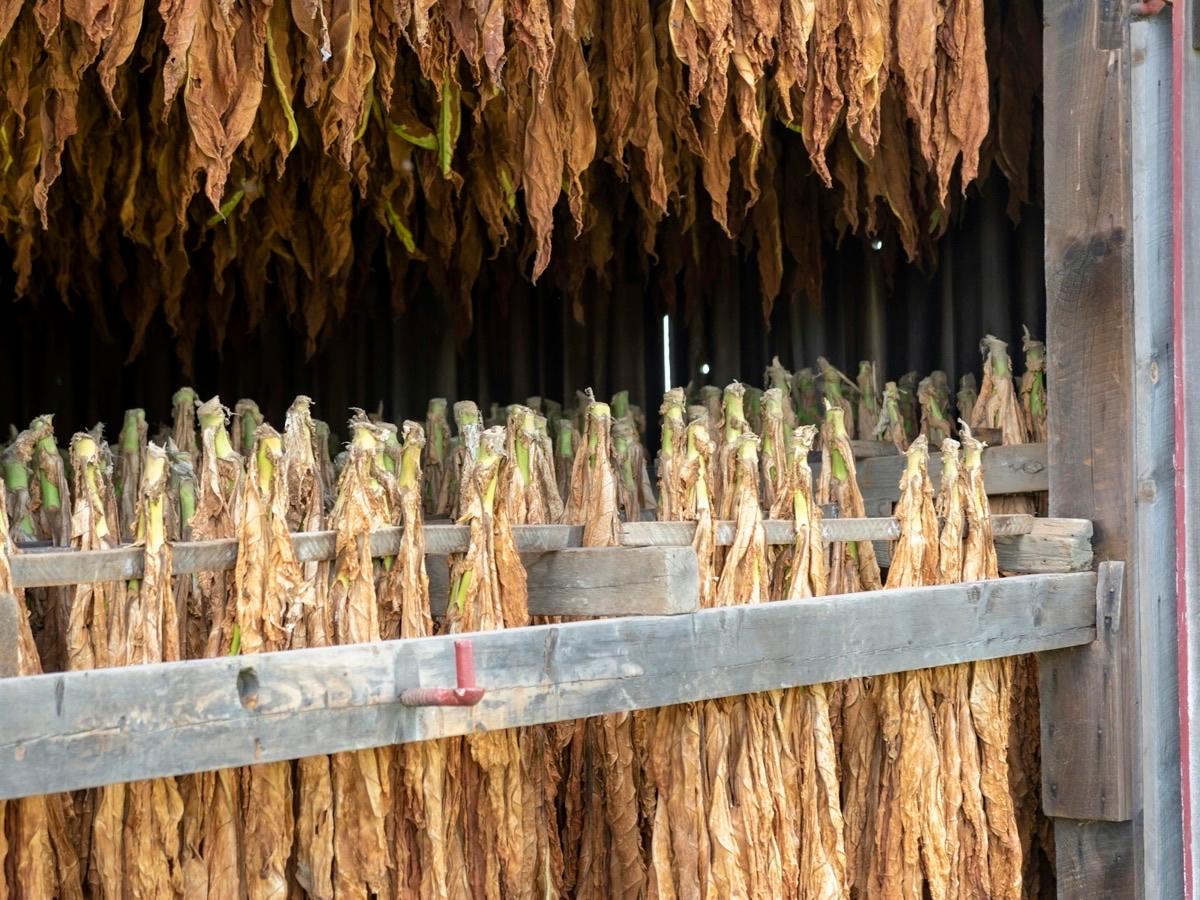
Anyone who has walked into a tobacco fermentation room remembers the smell. The ammonia that fills the air is a by-product of the chemistry that turns cured leaf into smokable tobacco. This lesson explains where the ammonia comes from, what else changes in the leaf as it is released, what fermentation does and doesn't do to nicotine, and what it means when a finished cigar smells of ammonia.
Where the ammonia comes from
Fresh tobacco is rich in protein. During curing the leaf's enzymes break half or more of it down into amino acids, and in the later stage of the cure some of those amino acids lose their nitrogen as ammonia. Fermentation takes the process much further. In the heat and moisture of the pile, proteins, amino acids and other nitrogen compounds break down, and part of the nicotine with them, and all of them release ammonia. Heat speeds the reactions: the chemistry of the leaf runs about twice as fast for every 10 °C (18 °F) rise in temperature.
The smell in the room
In a busy fermentation warehouse the smell of ammonia can be overpowering, and opening and turning a pile, which the trade calls working the bulk, releases a fresh wave. The smell overstates the amount, though. An 1899 U.S. study found only traces of free ammonia in the air drawn from a fermenting pile, because most of what forms stays bound to the leaf's organic acids. Turning the pile airs it, and makers describe fermentation as the process that drives ammonia and other impurities out of the leaf.
What else changes in the leaf
Ammonia is one sign of a larger change. The same 1899 study listed what happens to cigar leaf in the pile: its nicotine falls, its ammonia rises, it becomes more alkaline, its sugar disappears, its nitrate falls, and its flavor and aroma improve. Later work adds that half or more of the leaf's remaining carbohydrates and up to a third of its organic acids are used up, a large share of its polyphenols is broken down, and the leaf loses about 10 to 15 percent of its weight. The result is leaf that smokes less harshly, with the flavor and aroma that fermentation is meant to bring out. Not every study agrees on every detail: most find the fermented leaf slightly alkaline, but a 2023 study of Chinese cigar leaf found its acidity rose instead.
Nicotine and strength
Fermentation lowers nicotine much less predictably than it lowers ammonia. Measurements range from no significant change, in that 2023 study of leaf from three regions, to losses of a sixth to a half in older work, depending on the heat, the length of the fermentation and the leaf. What fermentation reliably removes is ammonia and harshness, which is why a well-fermented ligero can be smooth and still strong, as Strength: Nicotine and Ligero explains.
The ammonia in a cigar's smoke is a separate matter. It forms mainly as the nitrate in the leaf burns, and it adds to the pungency of cigar smoke.
Ammonia in a finished cigar
A cigar that smells or tastes of ammonia was usually made from leaf that wasn't fermented or rested long enough, and it is most often a very young cigar, as Flavor & Aroma Descriptors, in the Cigar Terminology topic, explains. Factories rest new cigars before boxing them, in the escaparate in Cuba and in aging rooms elsewhere; Perdomo ages every cigar for at least six to eight months before it is shipped. Smokers are usually advised to rest such a cigar for some weeks or months, and many find the smell fades, though no study has measured it.