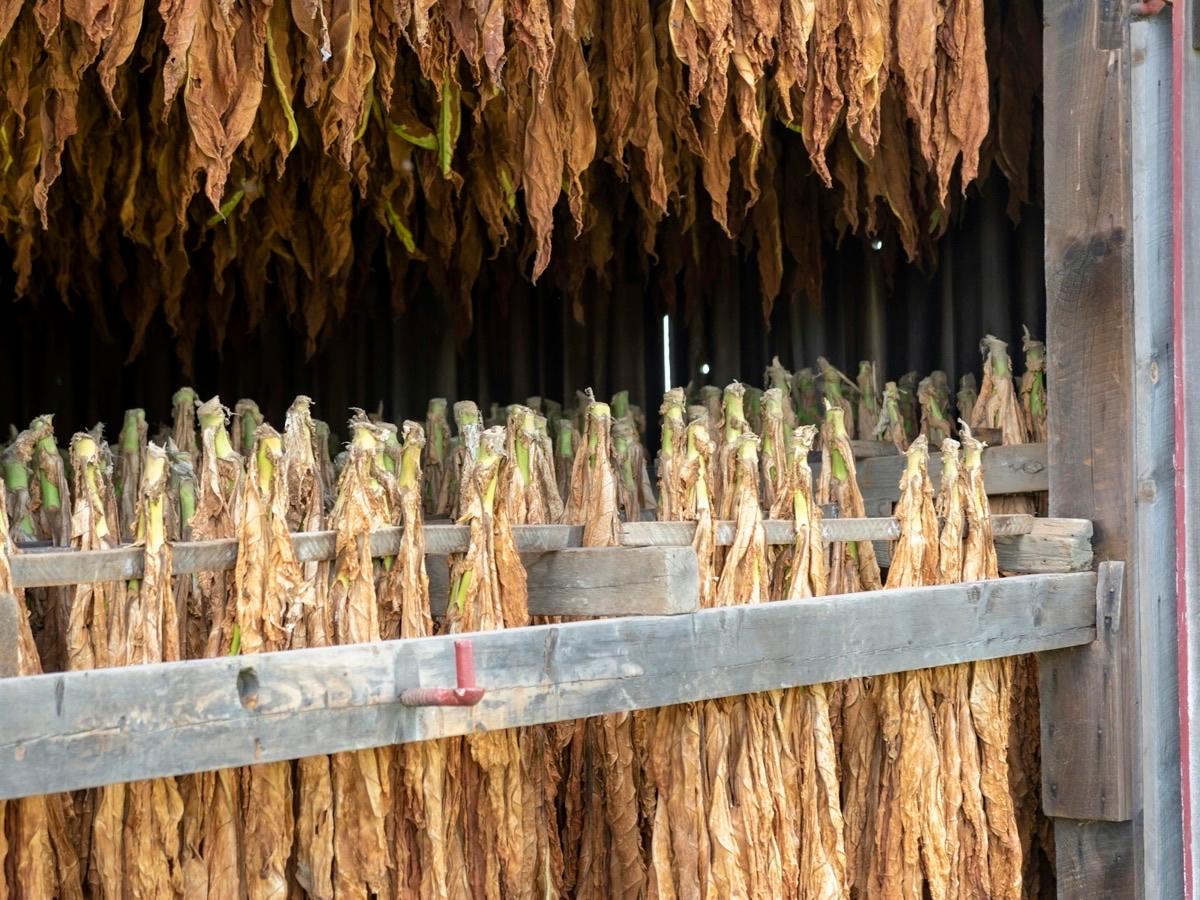
Color is the first thing anyone judges in a wrapper, and most of it is set in the curing barn, not in the field. Over two or three weeks a hanging leaf goes from green to yellow to brown, and the way that change runs decides whether it ends pale or dark, even or blotched, sound or rotten. This lesson follows the leaf from green to brown, explains what decides its final shade and what goes wrong, and shows how fermentation, and the candela and maduro processes, take color further. The names of the wrapper colors, from candela to oscuro, are covered in the Wrappers topic and in Tobacco & Growing, in the Cigar Terminology topic.
A leaf that is still alive
For its first days in the barn, a picked leaf is still alive. Cut off from the plant, it starves: it turns its starch into sugar and burns the sugar for energy, and its enzymes break half or more of its proteins down into amino acids. Its chlorophyll, the green pigment, is gone within four or five days. The leaf's yellow pigments, the carotenoids, break down far more slowly, so as the green fades the yellow shows through. It is the same aging, or senescence, that turns a leaf yellow on a tree in autumn, and it needs the leaf to stay alive, which is why the barn is kept warm and humid at this stage.
From yellow to brown
Once the leaf's cells die, the browning begins. It is the same reaction that browns a cut apple: the leaf's polyphenols, chief among them chlorogenic acid, rutin and scopoletin, meet two enzymes, polyphenol oxidase and peroxidase, which oxidize them into brown pigments. In studies of cigar leaf, the browning is fastest around the twelfth day, and by about the sixteenth the leaf blade is brown all over, with only the veins still lighter. At the same time the leaf burns off the last of its sugars and starts to break down its amino acids, which releases its first ammonia, as Ammonia Release explains.
The stages of curing
Curing is usually divided into three stages. Cuban technical guidance sets these targets for each:
- Yellowing (amarillamiento): about 8 to 10 days at 27 to 29 °C (81 to 84 °F) and 85 to 90 percent relative humidity. Below 80 percent the cells die too soon; above 90 percent mold sets in.
- Curing of the leaf blade, when it turns brown: until about the 18th to 20th day, at 30 to 32 °C (86 to 90 °F) and 70 to 75 percent humidity, with a steady flow of air.
- Drying of the midrib: the thick central vein dries last, below 70 percent humidity and at no more than about 32 °C (90 °F) in a traditional barn, until the leaf holds 17 to 19 percent moisture and the vein snaps when it is bent.
U.S. sources give a similar timetable: cigar leaf is yellow 10 to 12 days after the harvest and brown 6 or 7 days later, and the whole cure takes 30 to 40 days. The blade, in other words, colors within about three weeks; the rest of the time in the barn is spent drying the vein.
What decides the color
A leaf's final color comes from several things at once. One is its position on the plant. The upper leaves get the most sun and grow thicker and oilier, and they cure darker than the thin leaves near the ground; in Cuba the darker wrapper of the Edición Limitada comes from the upper leaves of the shade plant. Another is how the plant was grown. Shade keeps wrapper thin and smooth, and Connecticut Shade, grown under cloth, cures to its typical pale golden color, while thick sun-grown leaf such as Connecticut Broadleaf cures dark.
The cure itself shapes the shade. Leaf held too long in cool, damp air cures slowly and turns dark, as Connecticut growers were warned in 1940. Cuban growers keep the cujes low and humid for the first weeks so that the brown comes out full instead of pale or yellowish. Where heat is used, it follows the color: General Cigar's shade sheds raise their temperature a degree at a time as the leaves change color.
When the color goes wrong
Most color faults come from drying at the wrong pace. Leaf that dries too fast, before it has time to yellow and brown, dies with its chlorophyll still in it and stays green; Connecticut growers called it hayed down. Cold has the same effect, because it stops the leaf's chemistry. A warm barn with very dry air can leave leaves blotched with yellow, a fault burley growers call piebald.
Leaf that stays wet too long rots. The rot strikes most at the turn from yellow to brown and darkens and spots the leaf, and Moisture Control explains it. Not every mark is a fault, though. Small green or white spots on a finished wrapper are natural and don't affect the smoke, as The Anatomy of a Cigar notes.
Candela: green on purpose
Candela, called American Market Selection in the U.S. trade, is the one wrapper kept green deliberately. Instead of a slow air cure, it is heat-cured. The barn is warmed within hours of hanging, the leaves wilt within two days, and the heat is finally raised to about 74 °C (165 °F) to dry the veins. After 60 to 72 hours the chlorophyll is fixed in the leaf, which keeps its green color and the taste of green leaf.
Fermentation and the final shade
Most of the browning is done in the barn; fermentation then darkens the leaf further, the more so the longer and hotter it runs. A natural wrapper is fermented gently enough to keep its color, while a maduro is fermented longer, hotter or both until it turns dark brown and sweet. Perdomo, for example, ferments its natural sun-grown wrapper at 27 to 32 °C (80 to 90 °F) and its maduro at 43 to 46 °C (110 to 115 °F). Differences by Tobacco Type describes how maduro is made, and why a dark color alone proves nothing.
Because color varies from leaf to leaf even within one harvest, wrapper is sorted again after fermentation. In Cuba the escogida, the sorting house, grades wrapper leaves into some 50 categories by size, color and texture, and once the cigars are rolled the escogedores match them into 60 or more shades, as The Anatomy of a Cigar describes.