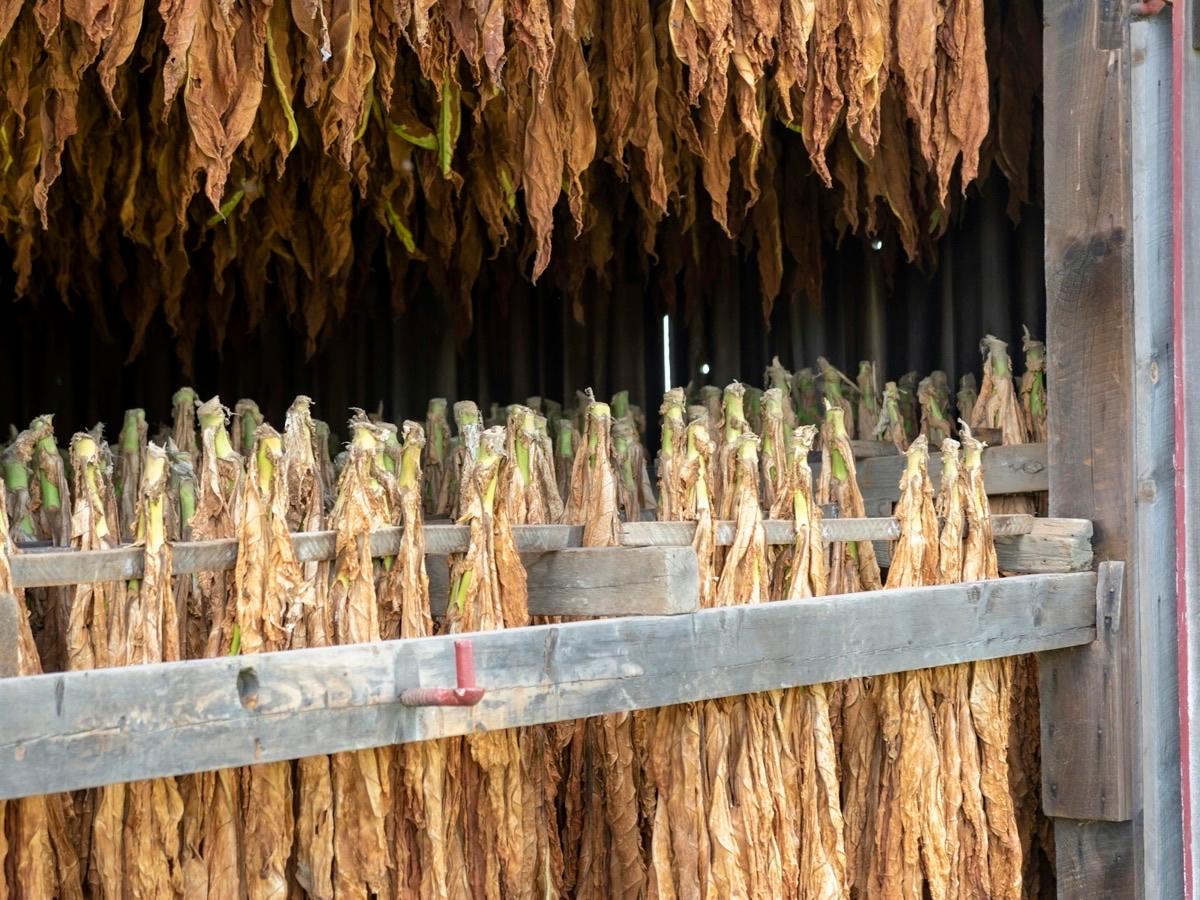
Every stage between the field and the rolling table is a matter of water: how fast it leaves the leaf, how much is put back, and when. Get it wrong in the barn and a season's crop can rot on the poles or dry green; get it wrong in the pile and the leaf ferments badly or spots. This lesson follows the leaf's moisture from the harvest to the factory. Curing Barns describes the barns themselves, and the Storage & Humidity topic covers the humidity of finished cigars.
The leaf's water, stage by stage
The table follows one leaf through the process. The figures are percentages of the leaf's weight that is water, from Cuban guidance, from Perdomo and from recent studies of cigar leaf.
| Stage | Water in the leaf |
|---|---|
| Freshly picked | 80 to 85 percent |
| End of the cure, when the vein snaps | 17 to 20 percent |
| Moistened for fermentation | About 20 to 30 percent |
| Dried and baled after fermentation (Perdomo) | About 14 percent |
Read from top to bottom, the leaf loses most of its water in the barn, takes some back to ferment, and is dried again to a level at which it keeps without fermenting, before the factory moistens it one last time to roll it.
Drying in the barn
Curing removes about four-fifths of the leaf's fresh weight, nearly all of it water. The quantities are large: a Connecticut study of shade tobacco reckoned that about five tons of water per acre, some 11 tonnes per hectare, leave a shed during a cure, most of it in the first ten days. The difficulty is that the water must go at the right pace. In the first days the leaf has to stay alive and moist enough to yellow; after that the air must carry water away steadily, so that the leaf browns and dries before molds can take hold. The thick midrib holds its water long after the blade is dry, and it is where rot most often starts.
Too wet: pole rot
The worst enemy in the barn is damp. When the air around the hanging leaves stays at 95 to 100 percent humidity for days, especially as the leaves turn from yellow to brown, molds and bacteria attack them. The disease has many names, pole rot, pole sweat, shed burn and house burn among them. It darkens the leaf, spots or rots it through and costs it weight. The remedy is moving air and, if need be, heat to dry it. Cuban guidance treats humidity above 90 percent as harmful at any stage, and a U.S. guide for Connecticut Broadleaf adds heat, for four to eight hours a day and never above about 38 to 41 °C (100 to 105 °F), when the daily humidity stays above 80 percent for more than two days.
Too dry: green leaf
The opposite fault is drying too fast. Leaf that loses its water before it has had time to yellow and brown dies green and stays green, and Color Transformation explains why. In dry weather Cuban growers sprinkle water to raise the humidity, and the Broadleaf guide advises wetting the barn floor when the humidity stays below 65 percent for more than two days. Water never goes on the leaf itself during the cure.
In case: handling the leaf
Cured leaf is brittle when it is dry and pliable once it has taken up a little moisture. The trade says leaf that is soft enough to handle without breaking is "in case", or "in order". Leaf is moved only in case. In Cuba it is taken down from the poles in the morning, after the night air has softened it, and in a very dry year it can stay hanging for weeks longer, waiting for damp air.
Wetting the leaf to ferment
Cured leaf is too dry to ferment, so it is moistened before it goes into the pile. Fermentation needs water: the leaf's own enzymes and the microbes on it work only in moist leaf. Makers wet it in different ways. Perdomo sprays each hand of leaves with a fine mist and then airs it for 12 to 14 hours before building the pilón, and Rocky Patel rehydrates every leaf. In Cuba the leaves are moistened at the escogida when they arrive, and wetted again with pure water, the moja, at the stripping house before their final fermentation. Too much water is as bad as too little: in one early U.S. study, leaf put into a pile at 36 percent moisture lost its texture and developed spots and then holes. Wrapper goes into the pile with as little water as possible.
Drying for the bale
After fermentation the leaf is dried again before it is packed. Perdomo dries its filler to about 14 percent moisture, the level that matches air at about 70 percent humidity; the thin seco takes three to four hours and the thick ligero seven to ten. The leaf is then pressed into bales of 120 to 125 pounds (55 to 57 kilograms), gently enough that no leaf cracks, and stored at about 68 percent humidity. In Cuba the fermented leaf is aired for a few days on racks before it is baled. Dried to that level, leaf no longer ferments actively, but it goes on changing slowly in the bale, the long aging that Fermentation Cycles describes.
Before rolling
Leaf comes out of the bale too dry to roll. In the factory it is loosened, which Cubans also call the zafado, and moistened again, the moja, so that it can be handled. Wrapper needs the most care, because it has to stretch around the bunch without tearing: Cuban torcedores lay it on the board as a moist half leaf. Once rolled, the cigars rest before they are boxed, in Cuba in the escaparate, a conditioning room kept at 16 to 18 °C (61 to 64 °F) and 65 to 70 percent humidity, and elsewhere in an aging room.