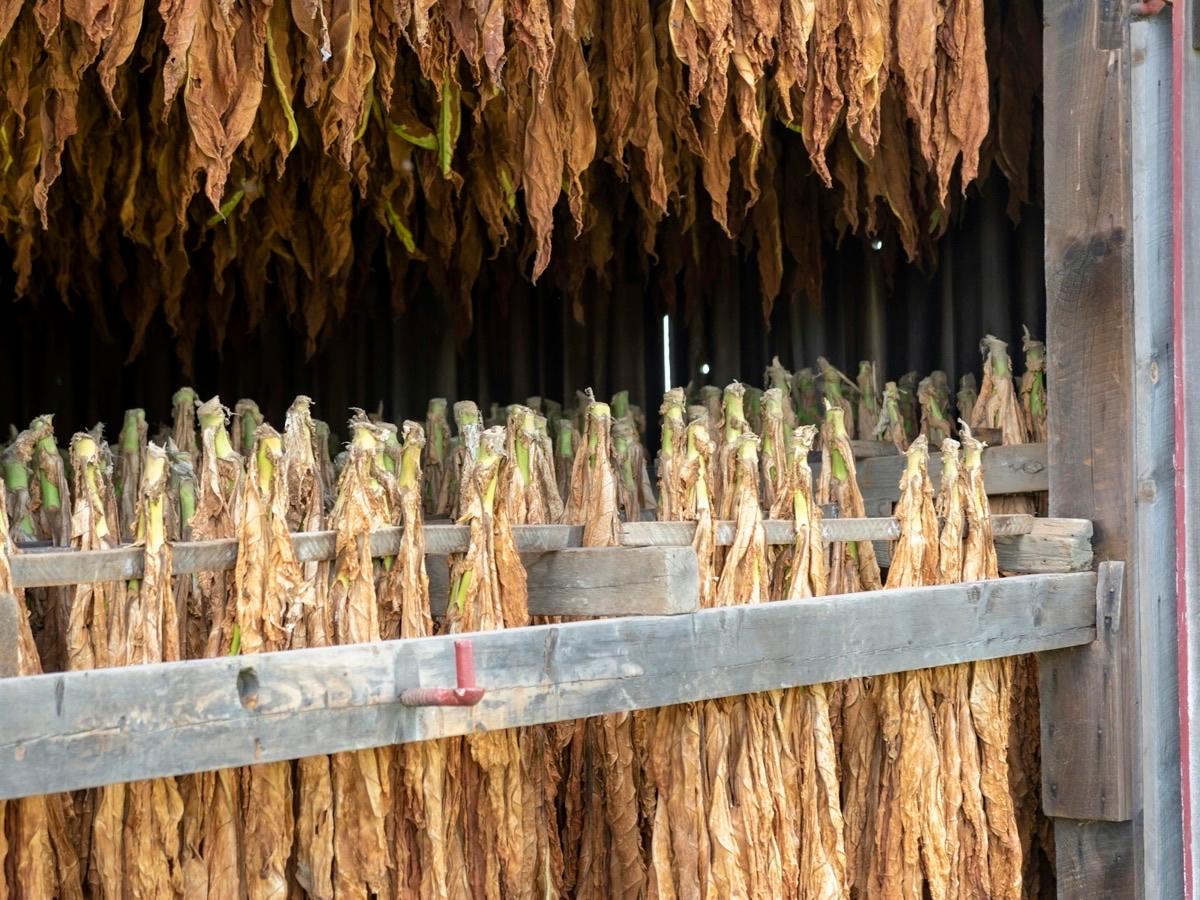
Curing is the first thing that happens to tobacco after the harvest. A freshly picked leaf is green, heavy with water and harsh. Weeks later, hanging in a barn, it is brown, light and leathery, ready to be fermented. Nearly every leaf in a premium cigar, wrapper, binder and filler alike, is cured this way, in moving air. This lesson explains how cigar tobacco is cured and how that differs from other tobaccos, how curing barns are built and run in Cuba, Central America, the Dominican Republic, Ecuador and Connecticut, and how long the leaf stays in them. Color Transformation and Moisture Control, the next two lessons, follow what happens inside the leaf.
Four ways to cure tobacco
Tobacco is cured in four main ways, and the method does much to decide what the leaf becomes. The table compares them.
| Method | How the leaf dries | What it is used for |
|---|---|---|
| Air-curing | Hung in a ventilated barn for weeks, with heat only to correct cold or damp weather | Nearly all premium cigar leaf; burley and Maryland tobacco for cigarettes |
| Flue-curing | In closed barns heated through pipes, or flues, so that no smoke touches the leaf | Virginia, or bright, tobacco for cigarettes |
| Fire-curing | Over smoldering wood fires on the barn floor, whose smoke flavors the leaf | Snuff and chewing tobacco, the Italian Toscano cigar and a few premium blends |
| Sun-curing | Strung up outdoors in the sun | Oriental, or Turkish, tobacco for cigarettes |
The real difference between the methods is how long the leaf is allowed to stay alive. A picked leaf goes on living for several days, using up its stored starch and sugar. Flue-curing raises the barn above about 41 °C (105 °F) once the leaf has yellowed, which stops the leaf's enzymes and locks its sugar in, so bright tobacco keeps between 7 and 25 percent of its dry weight as sugar. Air-curing lets the leaf live and starve slowly, so it burns up nearly all of it: cured cigar leaf keeps only about 1 to 3 percent. That low sugar is one reason cigar smoke is less acidic than cigarette smoke, a difference Strength: Nicotine and Ligero, in the Strength vs. Body topic, explains.
Fire-curing gives the smoky, dark tobacco of Kentucky and Tennessee. It is rare in cigars, but the Italian Toscano is made from dark fire-cured leaf, and Drew Estate's Kentucky Fire Cured cigars, first sold in 2013, blend in fire-cured leaf from Kentucky. Everything else in this topic is about air-cured leaf.
The casa de tabaco
A curing barn is a tall, airy building whose job is to give the leaf shade, shelter and moving air. In Spanish it is the casa de tabaco. The traditional Cuban barn has a wooden frame, walls of yagua, the bark of the royal palm, or of palm boards, and a roof of guano, palm thatch, although aluminium roofs have become common. Cuban barns are built on an east–west line, so that the low sun of morning and evening falls only on their ends. Inside, the leaf hangs in tiers on poles four to five meters long, the cujes, which rest on horizontal beams. In Cuba the casa de tabaco is also where filler and binder go through their first fermentation, which Fermentation Cycles describes.
Barns elsewhere follow the same idea in local materials. In Nicaragua, the Dominican Republic and Honduras they are usually wooden, traditionally with thatched palm roofs, and have doors and openings on every side to let the air through. Dominican growers also cured in simpler structures called quisqueyas. Some barns are very large: each of the four on Perdomo's Finca Natalie, in Nicaragua, holds about 9.7 million leaves in a season, and one JRE farm in Honduras has 52 barns for its Corojo. In Cameroon, wrapper cures in barns built of bamboo poles and leaves.
In the Connecticut River Valley the barns are called sheds. They are long, low and windowless, 9 to 12 meters (30 to 40 feet) wide and sometimes more than 30 meters (100 feet) long. Every other board of their vertical siding is hinged, so it can be swung open like a tall, narrow door, and more vents run along the ridge of the roof. Opening and closing those boards is how a Connecticut grower controls the air.
Hanging the leaf
Most cigar leaf is primed: picked a few leaves at a time, from the bottom of the plant up, as each level ripens, a practice the Tobacco Farming topic covers. Primed leaves are sewn onto string before they are hung. In Cuba the sewing is called the ensarte. A needle passes through the midrib about 3 centimeters from the base of each leaf, and the leaves are hung in pairs, back to back, 50 pairs to a cuje. Elsewhere the leaves are strung on cords, sartas, and hung over poles or wooden laths; Perdomo hangs its leaf on eucalyptus sticks.
A few tobaccos are stalk-cut instead. Connecticut Broadleaf is the best-known: workers chop down the whole plant with hatchets and hang it, stalk and all, so that the leaves go on drawing on the stalk as they cure. Stalk-cut leaf takes longer to cure than primed leaf and tends to taste earthier. Mexico's San Andrés leaf is often described as stalk-cut too, but the Turrent family, its best-known growers, harvest theirs by priming.
The leaf doesn't stay in one place. Cuban growers start the cujes low, in the more humid air near the floor, and raise them step by step toward the roof as the leaf dries, which helps it brown fully instead of turning pale.
Running the barn
A barn is run by its doors. Cuban growers watch the humidity, the temperature and the rain, and open or close the doors as these change; ventilation and light are adjusted constantly. Cuban guidance names what harms the cure: relative humidity above 90 percent or below 60 percent, a south wind, and air moving faster than about 4 meters a second. On Plasencia's wrapper farms in Jalapa, Nicaragua, the moisture is drawn out of the leaf gradually, over weeks, so that it develops its natural sweetness.
When the weather won't cooperate, growers add heat. Small charcoal or propane fires are lit to fight cold or to lower the humidity; the aim is usually to dry the air rather than to heat the leaf. In Connecticut nearly all shade growers have long used heat: General Cigar's shade sheds have gas burners across the whole floor, keeping the air in the low 90s °F (about 33 °C) and raising it a degree at a time as the leaves change color. At the end of the cure the burners go off and atomizers put moisture back into the air. Ecuador's barns need heat as well, and the Oliva family uses gas burners in some and old-fashioned charcoal pits in others. U.S. rules still count tobacco cured this way as air-cured only if the heat is used to prevent rot in damp weather and the leaf doesn't smell of smoke.
The targets vary a little from source to source. Cuban guidance puts a good cure at about 27 to 32 °C (81 to 90 °F) and 70 to 75 percent relative humidity. A U.S. guide for Connecticut Broadleaf asks for daily averages of 16 to 32 °C (60 to 90 °F) and 70 to 75 percent for at least the first four weeks. Perdomo keeps its Nicaraguan barns at about 75 percent humidity for the first 20 days. Moisture Control explains what happens when the air is too wet or too dry.
Since the 1990s Cuba has also cured some of its wrapper in controlled barns and chambers, fitted with equipment that sets the temperature and humidity. Cubans call the system kalfrisa, after the Spanish company that made the equipment. It cures wrapper in about 25 days instead of about 50, and is used for wrapper only.
How long curing takes
Curing ends when the thick central vein of the leaf, the last part to dry, snaps when it is bent. How long that takes depends on the leaf, the barn and the weather, and the published figures differ from country to country and from maker to maker.
| Where | Leaf | Days in the barn |
|---|---|---|
| Cuba, traditional barn | Sun-grown filler and binder | At least 50, longer for the upper leaves |
| Cuba, traditional barn | Shade-grown wrapper | About 50 |
| Cuba, controlled barn | Shade-grown wrapper | About 25 |
| Nicaragua (Perdomo, Joya de Nicaragua) | Filler and wrapper | 45 to 65 |
| Dominican Republic (Davidoff) | Dominican leaf | About 45 |
| Honduras (JRE) | Corojo and other leaf | About 60 |
| Ecuador (Oliva) | Wrapper, cured with added heat | 35 to 45 |
| Connecticut | Shade wrapper, cured with added heat | About a month to 60 or more, by source and brand |
| Connecticut | Broadleaf, stalk-cut | About 45 |
| Any wrapper country | Candela, heat-cured | 60 to 72 hours |
Read down the table and most cigar leaf spends six to nine weeks in the barn. The upper leaves, thicker and oilier, take longest. Heated barns, as in Ecuador and Connecticut, and Cuba's controlled barns cure faster. Dry years stretch the cure the other way: in Cuba a traditional cure of 40 to 50 days can run to 60 or even 90, because the leaf can't be taken down until the air is damp enough to soften it. Candela, the green wrapper, is the exception, cured in less than three days, as Color Transformation explains.
Taking the leaf down
When the leaf is cured, it comes off the poles. Cubans call this the zafado. It is done in the morning, once the night air has softened the leaf enough to bend without cracking; for Cuban wrapper the end of the cure falls in the rainy season, whose damp air makes it possible. The leaves are then tied into bundles, gavillas in Cuba and hands of about 35 leaves at Perdomo, and piled for their first fermentation, which Pilon Building describes.