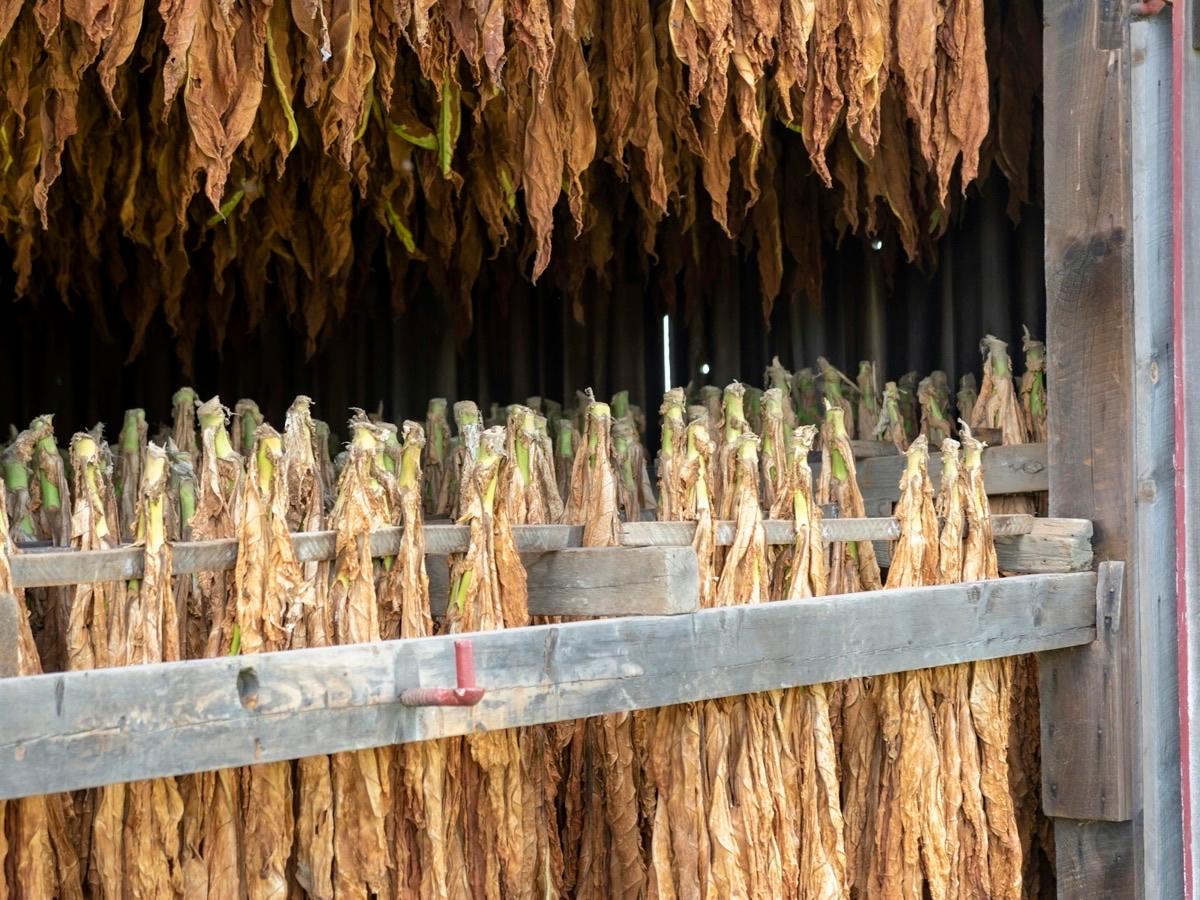
Fermentation needs space: room for tonnes of leaf in piles, for teams of workers to take them apart and rebuild them, and for the sorting, stripping and drying that come between one fermentation and the next. In Cuba the grower does the first fermentation on the farm and the state takes the leaf from there; elsewhere most leaf goes from the barn straight to a maker's own warehouse, sometimes in another country. This lesson describes those places, what the rooms are like inside and what happens in them. Pilon Building and Fermentation Monitoring and Timing describe the piles themselves.
From the barn to the warehouse
In Cuba, filler and binder go through their first fermentation in the casa de tabaco on the farm, for up to 30 days. The state's tobacco purchasing company then buys the leaf and takes it to the escogida, the sorting house, where it is moistened, aired and sorted into its classes; only about half of it makes the grade for Habanos. The despalillo, the stripping house, does the rest: it ferments the leaf a second time, strips out the lower part of the midrib and ferments it a final time in burros. Wrapper is fermented only once, in rooms built for the purpose at the escogida.
In Nicaragua, the Dominican Republic and Honduras, many large makers own their farms and processing warehouses, and the cured leaf travels from barn to warehouse in bales or boxes. Leaf also crosses borders to ferment. The Olivas pack the wrapper they cure in Ecuador into boxes of 100 pounds (45 kilograms) and ferment it in their plant in Estelí, Nicaragua. General Cigar bales its Connecticut shade leaf after curing and sends it to the Dominican Republic to ferment. In the late 1990s, Cameroon wrapper was fermented in bulks across the border, in the Central African Republic, then baled and shipped to the Netherlands.
Inside the room
A fermentation room is large, warm and damp, with the piles standing in rows, and the air smells sharply of ammonia, most of all when a pile is opened. The room is kept humid, but the heat that matters comes from the leaf itself, not from the room. Published conditions vary. More than a century ago, Connecticut fermentation rooms were held at 24 to 29 °C (75 to 85 °F) and kept "quite moist"; recent studies of cigar-leaf fermentation work at 75 to 85 percent relative humidity; General Cigar keeps its baled leaf in dim light at 72 to 76 percent. Each maker sets its own.
Rooms that add heat
Some rooms do more than shelter the piles. In the U.S. cigar industry of the mid-20th century, leaf was fermented in heated rooms at about 45 °C (113 °F) and 60 percent humidity, for three to five weeks at a time. Some factories keep a mulling room, a hot, wet room at 35 to 38 °C (95 to 100 °F) and about 90 percent humidity, where leaf from the cooler top and sides of a pilón is finished, darkened and sweetened. Cuba ferments its wrapper in purpose-built chambers at the escogida. Other makers avoid added heat: Davidoff fermented the Ecuadorian wrapper of its 2024 Maduro with the piles' own heat alone. In Los Tuxtlas, the Mexican region around San Andrés, leaf ferments in nearly airtight warehouses, in piles of one to ten tonnes called trojas.
Sorting, stripping and drying
Between fermentations the leaf is handled again and again. It is moistened, the moja, so that it can be handled without breaking; sorted by class, size, color and texture, the escogida; and stripped of its central vein, the despalillo, a word that names both the work and, in Cuba, the house where it is done. Filler in Cuba loses only the lower part of its midrib before its final fermentation. After the last fermentation the leaf is aired on racks, parrilleros in Cuba, for a few days, dried to the moisture it will keep in storage and pressed into bales. Cigar Terminology defines these words in Tobacco & Growing.
The bale and the aging room
The bale is the leaf's last home before the factory. In Cuba, wrapper is packed in tercios, bales wrapped in yagua, the bark of the royal palm, and aged for at least six months. Filler and binder go into pacas, hessian bales whose labels record the leaf's size, harvest year, packing date and class, and the escogida and despalillo that processed it. Elsewhere bales are usually burlap: Perdomo's weigh 120 to 125 pounds (55 to 57 kilograms), and Cameroon's were about 78 kilograms (170 pounds). The bales rest in humid warehouses, often for years, and Fermentation Cycles explains why.