This lesson describes what cigars mean to Nicaragua's economy: what the country earns from them and where they go, how the industry grew, who works in it and on what terms, where the leaf is grown, and the taxes, politics and tariffs that shape it. The number of Nicaraguan cigars sold in the United States, and Nicaragua's place as the largest supplier there since 2016, are covered in Global Market Trends; the country and its growing valleys are described in the Tobacco by Nation lesson Nicaragua and the Tobacco Regions lessons Estelí (Nicaragua), Jalapa (Nicaragua), Condega (Nicaragua) and Ometepe (Nicaragua). Economic Impact in the Dominican Republic covers the other great producer.
What the figures measure
Nicaragua counts its cigar trade in two ways, and they do not cover the same goods. Most cigar factories work under the free-trade-zone regime (zona franca), in which a company exports almost everything it makes in exchange for tax relief, and the Central Bank of Nicaragua (Banco Central de Nicaragua, BCN) reports their exports as a separate line, "tobacco", without dividing it into cigars, leaf and other goods. A smaller trade passes through the ordinary customs regime (régimen general), where the export-processing office (Centro de Trámites de las Exportaciones, CETREX) records leaf tobacco (tabaco en rama) and finished cigars (puros elaborados) separately. Industry bodies publish their own totals, built on different definitions again. The figures in this lesson therefore name their source and year, and they are best read as a trend rather than added together.
What cigars earn
Free-zone tobacco exports, nearly all of them cigars, were worth $413.5 million in 2023, $421.8 million in 2024 and $431.7 million in 2025, according to the central bank. That is close to a flat line: growth of 2 percent a year at most, after much faster growth earlier in the decade, when the bank reported a rise of $79.9 million in 2021 and of 13.7 percent in 2022. The record for each recent year has therefore been only slightly above the last, and a Nicaraguan newspaper described the trade in June 2026 as stagnant. A government official quoted in the Cuban state press in 2026 gave a different picture, saying premium cigars had grown by 7 percent and earned more than $300 million a year; that figure uses a narrower definition than the bank's and cannot be set beside it.
The ordinary customs regime adds a smaller sum. CETREX recorded $42.7 million of finished cigars exported in 2022, against $38.9 million in 2021, and $55.7 million of leaf tobacco, against $45.0 million. The central bank's own figures for the same channel are lower for leaf: $9.0 million in 2024 and $8.8 million in 2025, besides $47.7 million of manufactured tobacco products in 2025. The two offices classify leaf differently, and neither explains the gap.
Earlier figures come from the industry. The growers' and makers' association of the time, the Asociación Nicaragüense de Tabacaleros, put the country's cigar exports at $91.8 million in 2009, $100.5 million in 2010, $126.4 million in 2011, $152.3 million in 2012 and $227.7 million in 2013. Ten years before that, the central bank counted only ten tobacco companies in the free zones, with exports of $13.5 million in 2003, a sign of how small the formal trade was before the large factories moved into the regime.
Cigars are a large part of a small export economy. Nicaragua's total exports, ordinary and free-zone together, were $7,543.3 million in 2023 and $8,908.9 million in 2025, so free-zone tobacco alone made up about 5.5 percent in 2023 and 2024 and 4.8 percent in 2025. Its share fell in the last year only because gold and coffee prices rose. Among single products, tobacco ranked behind textiles, gold, beef, coffee and wiring harnesses in 2025, and within the free zones it was third, after textiles and harnesses.
Where the cigars go
The United States buys most of what Nicaragua makes. In 2023 it took 78.9 percent of free-zone tobacco exports, the Dominican Republic 4.0 percent and Honduras 3.2 percent, according to the central bank; in the last quarter of 2025 the shares were 83.0, 2.7 and 2.4 percent. The bank does not say what goes to the two neighbouring producers, which have their own cigar factories. The free-zone commission (Comisión Nacional de Zonas Francas) named the main markets for Nicaraguan cigars in 2023 as the United States, Germany, France, Hungary, Israel, Poland, Russia and Switzerland, and the industry says its cigars are sold in more than 90 countries.
The dependence on one market is the industry's most important economic fact. Industry estimates of the share sold in the United States range from 80 to 90 percent; the Joya de Nicaragua lesson notes that Joya, which sells less than half of its cigars there, is an exception. The reason lies in history: Nicaragua's industry grew up to supply American smokers who could not buy Cuban cigars, and it has served them ever since, while Cuba sells mostly to Europe and Asia through Habanos S.A.
The main figures side by side
The table brings together the export and employment figures used in this lesson. The sources measure different things, cigars counted in the United States, dollars earned by the free zones, jobs estimated by the industry or the government, so each row is best compared only with rows from the same source.
| Year | Measure | Figure | Source |
|---|---|---|---|
| 1995 | Nicaraguan premium cigars exported to the United States | about 3.5 million, up from about 600,000 | Trade press |
| 1997 | Nicaraguan premium cigars exported to the United States | about 44 million (the peak of the 1990s boom) | Trade press |
| 1998 | Nicaraguan premium cigars exported to the United States | about 27 million | Trade press |
| 2003 | Free-zone tobacco exports (ten companies) | $13.5 million | Central Bank of Nicaragua |
| 2009 | Cigar exports | $91.8 million | Industry association |
| 2013 | Cigar exports | $227.7 million | Industry association |
| 2013 | Direct and indirect jobs in Estelí | 31,000 direct, 52,500 indirect | Industry association |
| 2014 | Direct and indirect jobs in the tobacco industry | 30,000 direct, more than 50,000 indirect | Industry association, in the Nicaraguan press |
| 2023 | Free-zone tobacco exports | $413.5 million (78.9 percent to the United States) | Central Bank of Nicaragua |
| 2023 | Direct and indirect jobs in the tobacco industry | 44,000 direct, 60,000 indirect | Government records, as reported in 2023 |
| 2024 | Free-zone tobacco exports | $421.8 million | Central Bank of Nicaragua |
| 2024 | Jobs in the tobacco industry | about 35,000 direct in Estelí; more than 65,000 nationwide | Industry, as reported in 2024 |
| 2025 | Free-zone tobacco exports | $431.7 million (about 4.8 percent of all exports) | Central Bank of Nicaragua |
Read down the export rows and the industry has grown from a few million dollars to more than $400 million in two decades, with the fastest growth between 2009 and 2022 and little since. The job estimates move less, and the spread between them, 30,000 to 44,000 direct jobs, reflects different definitions rather than a clear trend.
The first factories
Nicaragua grew tobacco long before it made fine cigars. The modern industry began after the Cuban revolution of 1959, when Cuban growers and cigar makers looked for land to replace the farms they had lost. Cubans began growing cigar tobacco in northern Nicaragua in the early 1960s, and in 1968 Juan Francisco Bermejo and Simón Camacho founded the Nicaragua Cigar Company in Estelí, the country's first cigar factory, whose story is told in Joya de Nicaragua. José Orlando Padrón moved his production to Estelí in 1970. The American embargo on Cuba, in force since 1962, gave these makers their market: a cigar made from Cuban-seed tobacco by Cuban hands, sold in the United States. By the mid-1970s the Estelí factory alone employed more than 600 people and made about 9 million cigars a year.
War and the embargo
Revolution and war undid most of this. The uprising against the Somoza government reached Estelí in 1978: Padrón's factory burned in May of that year, and Joya's was destroyed in the fighting of 1978 and 1979, and after the Sandinistas took power in July 1979 the new government nationalised factories and land; Oliva, the Cuban-American leaf company, lost more than 200 acres (about 80 hectares) in 1980. Then the United States, the industry's only large market, closed. On 1 May 1985 President Ronald Reagan banned all trade with Nicaragua, and the embargo lasted until March 1990; Nicaraguan cigars were absent from the American market from 1986 to 1989. Throughout the decade the Contra war was fought largely in the north of the country, where the tobacco grows.
The industry survived by moving across the border. Many growers and makers left for Honduras and the Dominican Republic, and their skills helped build both countries' cigar trades. Padrón shifted all its production to Honduras when the embargo came and kept a plant in Danlí long after, as insurance against further trouble in Nicaragua. The American rights to the Joya de Nicaragua name stayed with Somoza's side, and cigars sold under it in the United States were made in Honduras. Danlí, just across the border near the Jamastrán valley described in the Tobacco Regions lesson Jamastran (Honduras), became the place where Nicaraguan tobacco knowledge waited out the war.
The boom of the 1990s
Peace, the end of the embargo and the American cigar boom of the 1990s rebuilt the industry within a few years. Exports of Nicaraguan premium cigars to the United States rose from about 600,000 to about 3.5 million in 1995 and reached about 44 million in 1997. Producers came from three directions. Some came back from Honduras: Padrón rolled again in Estelí, and the Plasencia family, growers of Cuban origin who farm and roll on both sides of the border, built a factory there and employed about 2,000 people in Nicaragua by 1999. Some came from Miami: the Perdomo family opened its Estelí factory in about 1995. And some came from Honduras for the first time: Drew Estate, whose first cigars had been made in Honduras, moved its production to Estelí in the autumn of 1998, after Hurricane Mitch had wrecked its Honduran supply. Joya de Nicaragua was bought in 1994 by Alejandro Martínez Cuenca, who rebuilt it with the boom's orders.
The boom ended as quickly as it had come. When American demand fell in 1998, Nicaraguan exports dropped to about 27 million cigars, and to about 18 million in 1999, and many of the brands born in the boom disappeared, as Cigar Boom (90s) in the Cigar History topic explains. Among the makers that survived, several, Perdomo and Oliva among them, did so by growing their own tobacco, and they led the second growth after 2000. A new wave of Cuban makers came directly from the island or through Miami: A.J. Fernandez began with six rollers in Estelí in about 2003, and the García family of My Father Cigars, who had rolled in Miami since 2003, opened their Estelí factory in 2009. In 2000 Nicaragua was the third supplier of premium cigars to the United States; by 2016 it was the first.
Estelí, the industry's centre
Estelí is the capital of the trade. The city lies in the northern highlands about 150 kilometres north of Managua and had about 110,000 inhabitants by one 2019 count. In late 2014 the industry association counted more than 50 cigar factories and more than ten box factories in the city; a 2019 report counted about 70 factories; and in 2024 the head of Joya de Nicaragua put the number of tobacco-related businesses in Estelí at more than 150, while the chamber of the larger makers, the Cámara Nicaragüense del Tabaco (CANATAB), had 26 member companies. In 2023 the 28 factories operating there under the free-zone regime employed more than 30,000 people. The counts differ because a large factory, a family workshop and a leaf warehouse are all "tobacco companies" in one list and not in another.
The industry is the city's economy. According to figures from the mayor's office reported in 2014, tobacco produced more than 60 percent of the output of the department of Estelí's six municipalities, and the department had the second-largest number of people enrolled in social security after the capital, a sign of how much of the work is formal. Around the factories have grown the businesses that serve them: box makers, printers of bands and labels, transport, and leaf warehouses. The city also holds an annual tobacco fair in January, Puro Sabor, at which makers show their cigars and fields to foreign buyers; the tenth was held in 2023 and the eleventh in 2024.
Jobs and the people who do them
Estimates of employment vary widely, and none comes from a regular count. The industry association put direct jobs in Estelí at 31,000 in 2013, with 52,500 indirect jobs around them, and at 30,000 direct and more than 50,000 indirect jobs in 2014. Government records cited in January 2023 gave 44,000 direct and 60,000 indirect jobs for the whole tobacco industry, and industry figures reported in 2024 gave about 35,000 direct jobs in Estelí and more than 65,000 people working across the country on farms, in curing barns and in factories. A 2019 report said that half the people of Estelí worked in tobacco; that is a reporter's estimate rather than a count, and it implies more workers than the chamber's own figures. The largest employers are large indeed: Perdomo reported more than 4,000 employees in 2018, Oliva about 1,500 in Nicaragua the same year, and the García family about 5,500, farm workers included, in 2025.
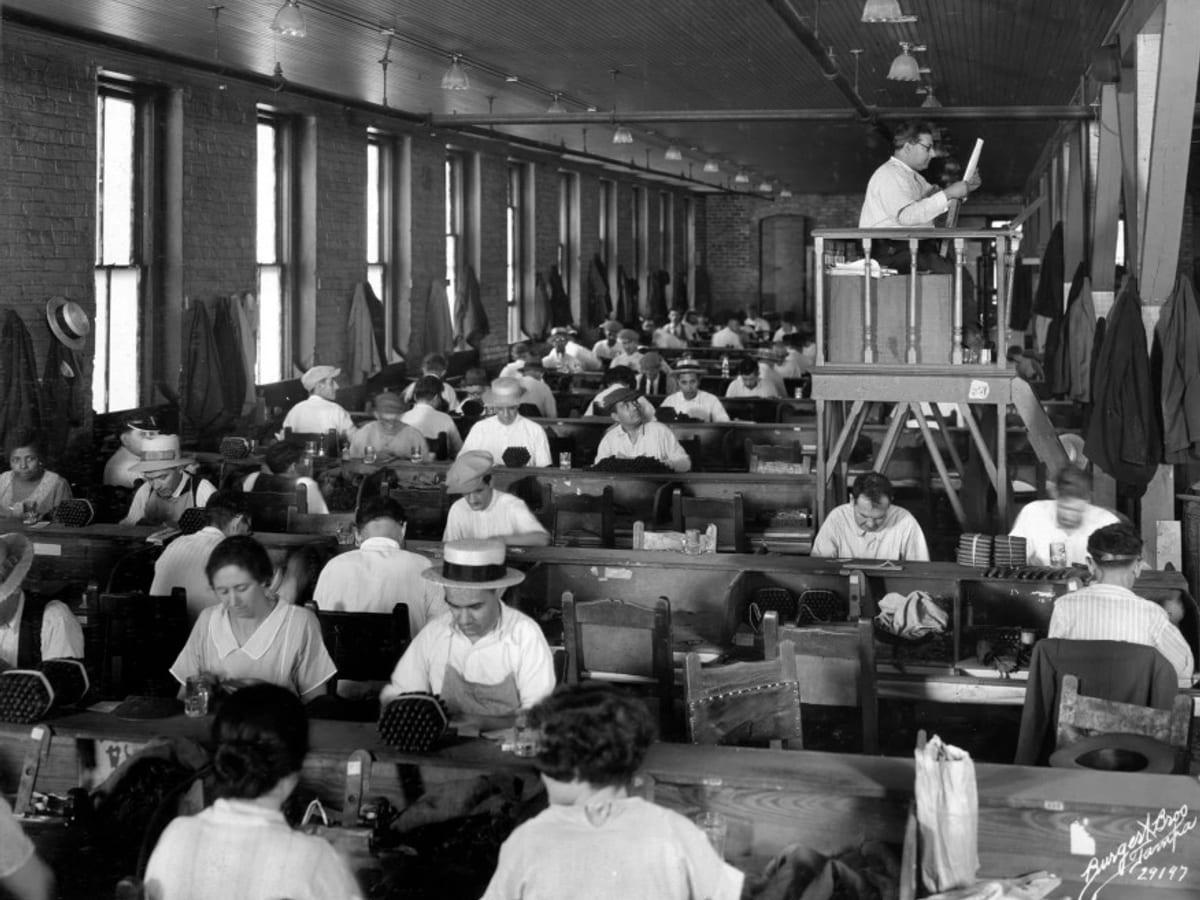
Most of the workers are women. The head of the industry association said in 2015 that women made up 60 percent of the cigar workforce, and a Nicaraguan newspaper reported in 2017 that about 55 percent of the labour in Estelí's tobacco industry was female, most of it in production rather than management. Women hold most of the jobs in stripping and sorting the leaf, which the Workers topic describes as traditionally women's work, and many work at the rolling tables. Factories employ some staff by the day and some by the fortnight, and their rollers work in pairs, a buncher (bonchero) who makes the bunch and a roller (rolero) who puts on the wrapper, each pair set a number of cigars to make; the Workers topic describes each job.
The jobs differ in rhythm. Field work follows the growing season of the dry months, from planting in the autumn to harvest in the spring, and much of it is seasonal and informal. Leaf processing and rolling go on all year, because the leaf is fermented and aged for months or years before it is rolled, and that is why factory jobs are steadier than farm jobs.
Pay and working conditions
Wages in the factories follow the free-zone minimum, which is set separately from the rest of the economy. It was 9,359.46 córdobas a month, about $255, from 1 January 2025, and rose by 6.7 percent to 9,986.54 córdobas, about $273, from 1 January 2026, under a five-year agreement between employers, unions and the government that runs to 2027. The minimum for farm work, set separately, was 6,188.02 córdobas a month, about $169, from March 2026. What individual workers earn above the minimum, through output bonuses or skill, is rarely published.
Child labour is reported on the farms, not in the factories. The United States Department of Labor lists tobacco from Nicaragua among the goods it has reason to believe are produced with child labour, and its report for 2024 names tobacco, with coffee and bananas, among the crops in which children work. The same report rated Nicaragua's efforts against child labour as "minimal advancement", in part because the government does not publish the data that would show how widespread it is. No report found describes child labour in an Estelí cigar factory; the reports concern work on tobacco farms.
Health and safety studies of Estelí factories, carried out under Nicaragua's occupational safety law (Ley 618), have pointed to everyday exposure to tobacco dust and the smell of fermenting leaf, and to long hours seated at the rolling table; one study of 2023 recommended replacing the rollers' seats with ergonomic chairs. Nicaragua gave notice on 28 February 2025 that it would leave the International Labour Organization, after complaints about labour rights were placed on the organization's agenda; under its constitution a withdrawal takes effect two years after notice.
Where the leaf grows
Nicaragua grows most of the tobacco it rolls, but not all of it. More than 80 percent of the leaf comes from the departments of Estelí and Nueva Segovia, according to a central bank study of the mid-2000s: the valleys of Estelí and Condega in the first, Jalapa in the second. Smaller amounts grow in Jinotega and Matagalpa and on the island of Ometepe in Lake Nicaragua, where the Plasencia family planted its first trial acre in 1994. The area has grown with the industry. The central bank estimated about 2,200 manzanas harvested in 2005, the manzana being the Central American land unit of about 0.7 hectares; CETREX put the area at 6,130 manzanas, about 4,300 hectares, for the 2022–23 season; and the industry gave about 4,900 hectares in 2024. Those figures are small beside a staple crop, but each hectare of cigar leaf carries a great deal of labour.
Two kinds of farmer grow it. The large makers farm their own land: Perdomo reported about 1,200 acres (about 485 hectares) in 2018, and Padrón, Oliva, Plasencia, A.J. Fernandez and the Garcías all grow much of their own leaf. Smaller farmers grow under contract, and the central bank described in the 2000s how the leaf companies lend them the money for the season and then buy the whole crop. Most of the leaf is Cuban-seed tobacco, which Nicaraguans call Habano, with some Connecticut-seed varieties for wrapper.
What Nicaragua does not grow, it imports. Free-zone factories bought $102.7 million of unprocessed leaf abroad in 2023, $117.9 million in 2024 and $107.3 million in 2025, the bank does not say from where, but the blends of many Nicaraguan-made cigars name Ecuadorian, Mexican and American wrappers and Dominican or Honduran leaf. Those imports equal about a quarter of the value of free-zone tobacco exports, and they show that a Nicaraguan cigar is often a blend made in Nicaragua rather than a Nicaraguan puro, a cigar made entirely from one country's tobacco.
Free trade zones and taxes
The free-trade-zone regime is the legal frame of the export industry. Created in 1991 and rewritten as Law 917, in force since 16 October 2015, it lets approved companies import their raw materials and equipment free of duty and pay no income tax for an initial period, as long as they export what they make. Until 2026 the income-tax exemption ran for ten years, with partial relief after that. A reform passed by the National Assembly in April 2026 granted a full exemption for 15 years to companies that run free-zone parks and 10 years to companies that operate in them, renewable without limit with the commission's approval, and extended it to dividends. The same package required exporters to declare to customs that their goods were not made with forced labour, a response to the American trade measures described below.
The regime explains a good deal about the industry's shape. It drew foreign capital, American, European and Nicaraguan, into large factories built for export, and it means that the government collects little direct tax from cigar makers; Nicaragua's gain comes instead from wages, local purchases and foreign currency. It also means that the free-zone figures, which the central bank publishes, cover most of the trade, and the ordinary-regime figures only a remainder.
Politics since 2018
The political crisis that began in April 2018, when protests against the government of Daniel Ortega were put down by force, reached the industry through the roads. Roadblocks (tranques) halted cargo between Estelí and the ports for weeks, and the exporters' association said the effect on tobacco was concentrated between April and June, when shipments were delayed but not stopped. Demand in the United States held up, and cigar exports kept growing while the wider economy shrank in 2018 and 2019. Free-zone employment in other industries, mostly textiles, has fallen sharply since then, by about 40,000 jobs in three and a half years according to business groups citing central bank data in 2026, while tobacco has stayed steady.
Politics has touched the industry directly in one case. In May 2025 exile media reported that the customs authority had sued Joya de Nicaragua, whose owner, a former Sandinista minister, had fallen out with the government, for more than $15 million and frozen some of its property; the company said it was operating normally, and no later report settles the case. The Joya de Nicaragua lesson tells the story. American sanctions since 2018 have been aimed at officials and state bodies rather than at cigar companies, and none found names a cigar maker.
Tariffs and the American market
The industry's greatest risk is a change in the terms on which it sells to the United States, and that risk became real in 2025. Nicaraguan cigars had entered the United States free of duty under the Central American free-trade agreement (CAFTA-DR). In 2025 the American government imposed tariffs under emergency powers, 18 percent on goods from Nicaragua, as Global Market Trends describes. At the same time the United States Trade Representative pursued an investigation, opened on 10 December 2024 under Section 301 of the Trade Act of 1974, into Nicaragua's labour rights, human rights and rule of law. A proposal of September 2025 would have allowed tariffs of up to 100 percent on Nicaraguan goods. The decision announced in December 2025 was milder: a tariff on Nicaraguan goods that do not qualify as originating under CAFTA-DR, set at zero in 2026, 10 percent from 1 January 2027 and 15 percent from 1 January 2028, and subject to change if Nicaragua does not address the concerns. Whether a given cigar qualifies depends on where its tobacco comes from, so cigars with imported wrapper may be treated differently from Nicaraguan puros; trade sources disagreed about how far cigars were covered.
The rules changed again in 2026. On 20 February the United States Supreme Court ruled that the emergency powers did not allow tariffs, and the government replaced them with a temporary tariff under another law, which expired on 24 July 2026. From that day new Section 301 tariffs, applied to 60 economies over their failure to ban goods made with forced labour, set 12.5 percent on goods from Nicaragua and the Dominican Republic and 10 percent on goods from Honduras, with no exemption for cigars. As of November 2026 the 10 percent step on non-originating Nicaraguan goods was still due on 1 January 2027, and how the two measures would combine had not been settled. American cigar associations were asking for premium cigars to be exempted.
Tariffs matter more to Nicaragua than to its neighbours because of its dependence on one market and its lead within it. Since July 2026 a Nicaraguan cigar has paid more at the American border than a Honduran one, and a Nicaraguan maker has few other markets to turn to. Some makers have spread their production across borders for this reason: Oliva built a factory in Danlí in 2007, after Daniel Ortega's return to power, so that it depended less on one country, though it closed that factory around 2013; Padrón kept a plant in Danlí through the 1990s, and the Plasencia family still rolls in both countries. The industry's other risks are familiar ones: hurricanes, such as Mitch in 1998, which can destroy a crop and its curing barns; falling consumption in the United States and Europe, which one of the largest cigar groups expected to continue in 2026; and tobacco taxes and rules in the markets that buy its cigars, described in Regulation and Legal — USA, EU, Russia.