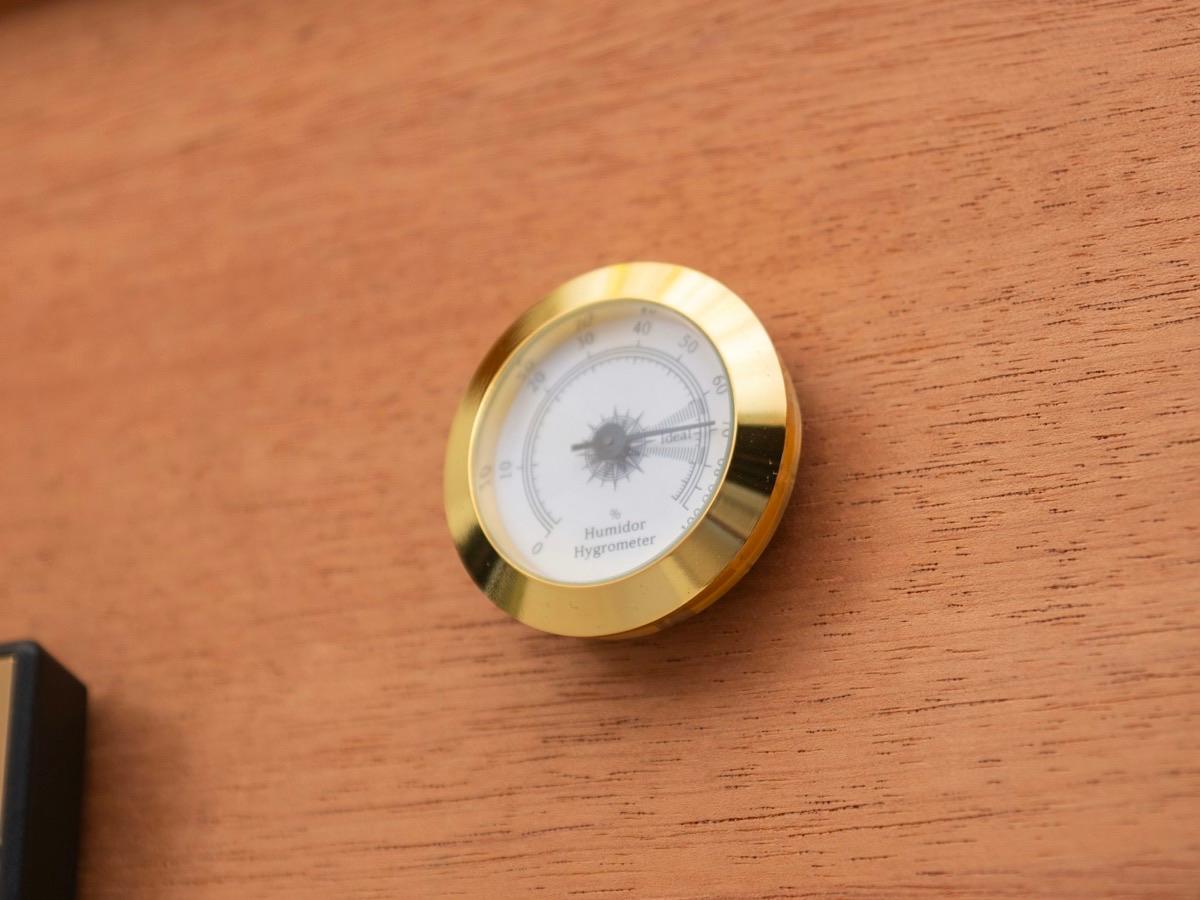
A humidor is a small, still room, and still air separates. Warm air rises and cool air sinks, moisture near the humidifier stays near the humidifier, and two cigars pressed together trap whatever is between them. This lesson explains how air moves in a closed box, why that matters to every cigar in it, and how to keep the conditions even in a passive humidor and in a large, fan-driven one.
Why evenness matters
A cigar is judged, in part, by how it burns, and the burn follows the water in the leaf. A wrapper that sits wet draws and burns one way, a dry one another; Why Humidity Matters covers those directions in detail. When one part of a humidor runs a few points wetter than another, the cigars from the two places taste and burn differently, and a cigar held against a damp wall or a warm source of moisture can pick up enough water to swell, draw tight, or begin to grow mold. Evenness is not a refinement; it is what lets the humidity reading on the gauge mean something for every cigar in the box.
How air moves in a closed box
In a box that is shut and has no fan, the air barely moves at all. What little happens is convection: warmer air, which is lighter, rises, and cooler air falls, so a humidor kept on a warm shelf develops a mild temperature difference between its top and its bottom. Each opening of the lid changes the air completely for a moment, which is why a humidor that is opened often stays more even than one that is shut for a month. In practice, a desktop humidor depends on its lid, and a large one on a fan, because there is nothing else to stir the air.
Keeping a passive humidor even
Three habits do most of the work in a box with no fan. The first is not overfilling it. When the cigars are packed edge to edge so that the top almost touches the lid, air cannot pass between them or over them, and the box is effectively a wall of tobacco with a damp patch on one side. Leaving a finger's width of air at the top and small gaps between the rows — a box filled to roughly four-fifths or a little more — lets the air reach every cigar.
The second is keeping the humidifier open and central. A humidifier mounted on the lid, or one standing in the middle of a desktop box, releases its moisture into the moving air rather than into a corner. Setting it behind a solid divider, or burying it under the cigars, gives the moisture nowhere to go.
The third is rotating the cigars. Moving the bottom row to the top, and the far cigars to the near side, every month or two evens out the slow differences that no amount of static care removes. It is the same idea as turning a mattress.
Fans and active humidifiers
A large cabinet or a walk-in humidor cannot rely on its door. The electronic units described in Humidification Methods move air with a fan, and in a big cabinet several small fans on low speed do the job better than one strong one. Slow is the point: air that moves gently carries moisture to the far shelves, while a strong jet aimed at the wrappers dries their surfaces and can damage the leaf. The ideal is a slow loop — air drawn in, moistened, and pushed back out at low speed — with no fan pointed directly at a cigar. A cabinet with a fan still needs the same spacing and rotation as a desktop box, because the fan stirs the air but cannot reach between two cigars that are jammed together.
Reading the signs
Unevenness announces itself. If the cigars on one side of a box smoke wet while those on the other side burn dry and fast, the air is not reaching the dry side; move the humidifier toward the middle and open the space around it. If mold keeps appearing in one corner, that corner is the dead spot, and the fix is the same, together with lowering the humidity, as Mold and Plume explains. A humidor whose lid is rarely opened may simply need opening more often — half a minute's worth of air exchange, a few times a month, does for a still box what a fan does for a cabinet.