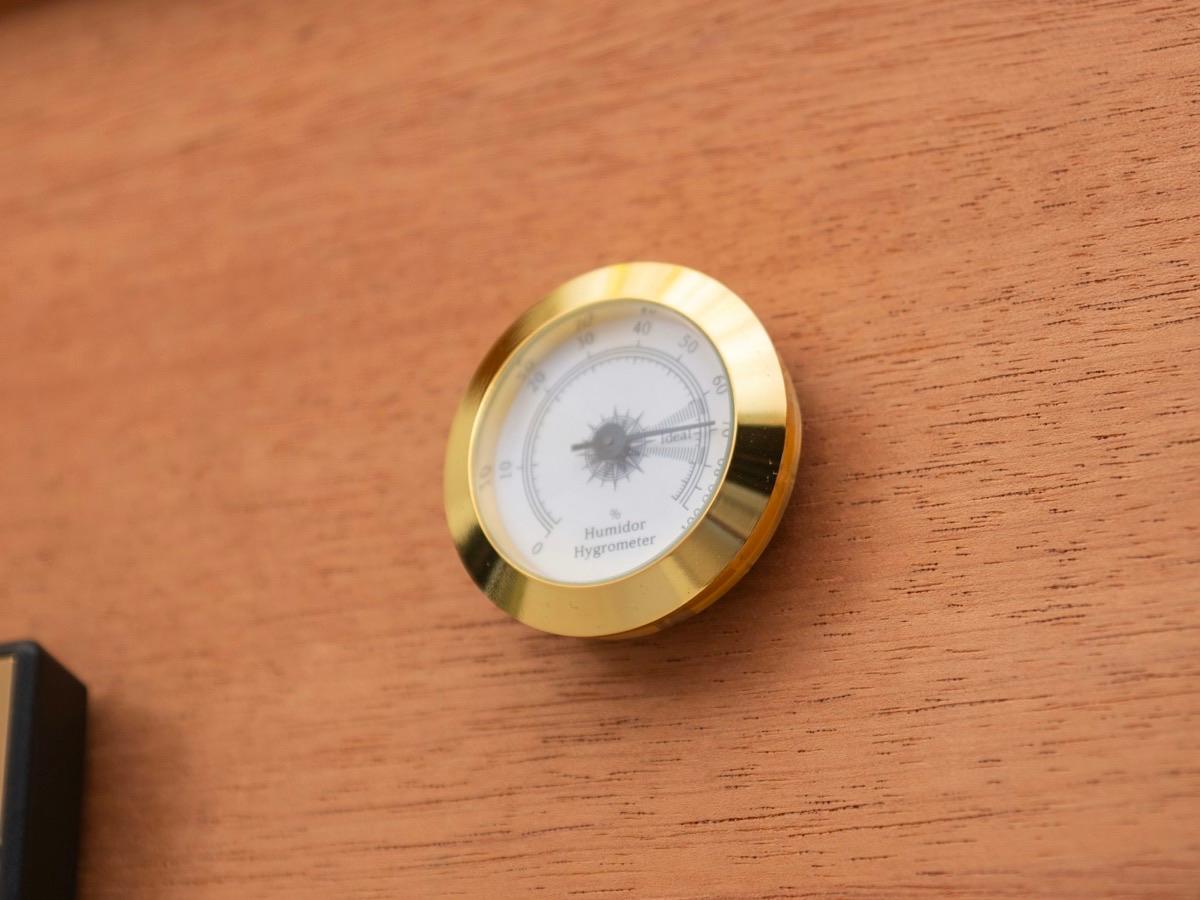
Every humidifier is trying to do the same thing — hold the air inside a humidor near a chosen relative humidity — but they do it with different materials, different precision and different amounts of work. This lesson explains what relative humidity is, then takes the six main methods in turn: distilled water and propylene glycol on a foam, crystal gel, humidity beads, two-way packs, and electronic units. Maintenance and Hygrometers, in the Humidor Essentials topic, covers keeping whichever one you choose running.
Relative humidity
Relative humidity is how much water the air holds as a share of the most it could hold at that temperature; warmer air can carry more. That last point is why humidity and temperature are always discussed together, and Why Humidity Matters takes up the consequences. A humidifier is not adding raw volume of water to the air; it is holding the air at a share of saturation, and it has to keep doing so as the box is opened, as cigars are added or removed, and as the room around it changes with the seasons.
Distilled water and propylene glycol
The oldest humidifier is a block of open-cell foam, the familiar green or black sponge, charged with a solution of distilled water and propylene glycol. Propylene glycol is a colorless, near-odourless liquid; in a humidor its job is to act as a buffer. A half-and-half mixture of propylene glycol and distilled water settles the air in a closed box at roughly 70 percent relative humidity, and it holds there because the glycol is far less eager to evaporate than the water, so the solution releases or takes up water as the box swings. The glycol is what keeps a plain water-filled sponge from over-humidifying.
The sponge is cheap and simple, and for that reason it is still sold in most starter boxes. Its weakness is care. The foam needs topping up often, it can spike the humidity hard after a refill before settling, and its wet, open surface is the one a mold spore finds first. Only distilled water belongs on it, never tap water, because the minerals in tap water collect in the foam and feed the same growth.
Crystal gel
Crystal gel humidifiers use a superabsorbent polymer, the same material as the grains in a plant pot or a disposable diaper, which holds many times its weight in water and lets it go gradually. The grains are charged with distilled water or a propylene-glycol solution, and as they dry they shrink to a powder that shows, at a glance, that a top-up is due. Gel is low-maintenance compared with foam and gives off a strong, steady moisture when first charged, but it is more a one-way source than a true regulator, and a jar overfilled with plain water can push a humidor too high.
Humidity beads
Humidity beads are small porous beads of silica or an acrylic polymer, sold to charge with distilled water. The useful kind is treated so that the beads absorb moisture from air that is too wet and release it into air that is too dry, holding the box near one chosen figure — commonly 65 or 70 percent. Heartfelt Industries and other makers tune the beads to a set level and sell them by the pound for a given box capacity. Beads are about as hands-off as humidification gets: add distilled water when they start to look dry, and they do the rest. Their trick is that they work in both directions, absorbing as well as releasing, which a foam sponge does not.
Two-way packs
Two-way humidity packs are sealed pouches of a salt-and-water solution behind a membrane that sets a precise relative humidity. Boveda and Integra Boost are the best-known makers, and their packs are sold at fixed levels — for cigars, usually 62, 65, 69 or 72 percent, plus higher-rated packs made for seasoning. The pack gives off water when the air is below its rating and takes water back when the air is above it, so one pack holds a humidor at a single, known figure better than almost anything passive. The cost is that packs are used up: they stiffen as the salt solution inside is spent, and most are meant to be replaced rather than recharged. Their precision, and the fact that there is nothing to spill, is why they are now the default recommendation for a first humidor and the standard insert in a travel case.
The table compares the passive methods.
| Method | How it works | Holds what level | Upkeep | Watch for |
|---|---|---|---|---|
| Foam with distilled water and propylene glycol | Water leaves a charged sponge; glycol buffers | About 70% with a 50/50 glycol mix | Frequent refills | Spiking after refills; mold on wet foam |
| Crystal gel | Superabsorbent grains release water | Varies; a one-way source | Occasional top-ups | Overfilling with plain water |
| Humidity beads | Treated silica or acrylic beads absorb and release | Tuned, often 65% or 70% | Add water when dry | Keeping the beads only just damp |
| Two-way packs | Sealed salt solution behind a membrane | Fixed, e.g. 62, 65, 69 or 72% | Replace when stiff | Replacing before they run out |
Electronic units
Active humidifiers add machinery to the job. An electronic unit — Cigar Oasis and Xikar make the best-known — holds a reservoir of distilled water and a small fan, and a sensor switches the fan on when the air drops below the set point and off when it returns. Some are set by a dial, others by a digital display, and a few take a cartridge of their own glycol-based solution instead of open water. The fan spreads the moisture through the box, which matters most where air would otherwise sit still, and Why Humidity Matters and Air Circulation explain that side of it.
Electronic units are expensive, need mains power or batteries, and their reservoirs have to be cleaned, but for a large cabinet or a walk-in humidor holding hundreds or thousands of cigars they are usually the only device that keeps the whole volume even. A desktop box of twenty-five cigars does not need one.
Choosing
The choice is between precision, cost and care. A small, well-sealed desktop humidor is served by a pair of two-way packs or a dish of beads, which ask for almost nothing. A cabinet is served by an electronic unit, whose fan does the spreading that a desktop box gets only when its lid opens. Climate matters too: a dry room makes a small reservoir evaporate fast, so a passive unit there runs out quickly, while a damp one makes the same device contribute too much. Match the device to the box's rated capacity rather than to the number of cigars it happens to hold today, and everything else follows.